


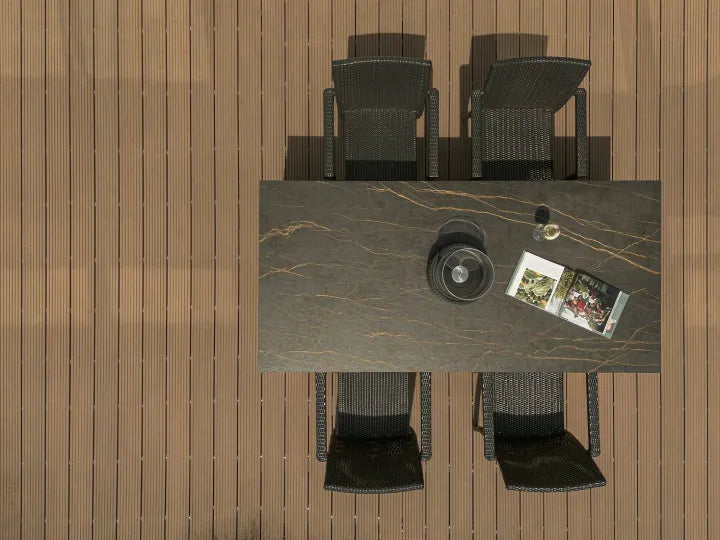


White sintered stone is a colour family, not one fixed surface. It can be a nearly solid white slab, a soft cloud white, a fine grey-vein marble look, or a dramatic white-and-gold statement pattern. The right choice depends on undertone, finish, vein scale, slab format, thickness and fabrication—not simply whether the sample is labelled “white.”
Is White Sintered Stone a Good Choice?
Yes—white sintered stone is a strong choice when a project needs a bright, low-absorption surface with good resistance to heat, everyday stains, scratching and UV exposure. It is widely used for countertops, worktops, benchtops, kitchen islands, bathroom walls, vanity tops, furniture and large interior panels. The exact product still needs to be matched to the application, support system and fabrication method.
Sizes, thicknesses, finish, exterior approval and current availability vary by product. Confirm the exact slab specification before fabrication or quotation.
What Counts as White Sintered Stone?
In search results, “white sintered stone” covers both solid-colour slabs and white-background stone or marble visuals. That is why two surfaces with the same colour filter can produce completely different rooms. A uniform white recedes into the architecture; a Calacatta-style slab becomes a focal point.
| White Surface Direction | What It Looks Like | Where It Usually Works Best |
|---|---|---|
| Pure or solid white | Uniform or nearly uniform white with minimal movement | Minimal interiors, cabinetry, bathroom walls, retail fixtures and clean furniture surfaces |
| Cloud white | Soft tonal movement without obvious marble veins | Quiet feature walls, wardrobes, vanities and calm residential interiors |
| Fine grey vein | White field with light, low-contrast grey drawing | Kitchen worktops, islands, splashbacks and bathrooms that need texture without visual noise |
| White and gold marble look | Warm white ground with gold, beige or charcoal veining | Statement islands, hospitality walls, fireplaces and premium reception surfaces |
| Bookmatched white | Paired slabs arranged for mirrored or continuous movement | Large feature walls and projects where the vein layout is part of the design |
Choose from a full-slab image and a physical sample under the project lighting; a small white swatch cannot show vein scale, undertone, gloss or layout repetition.
Compare Three White Sintered Stone Directions
These three Funtek surfaces demonstrate the practical difference between a quiet solid colour, a subtle marble vein and a bold bookmatched pattern. Click a surface swatch to compare the complete upright slab and its specification.
Watch on YouTube
Selected White Sintered Stone Slabs

Quiet Solid Colour
Comfort Cloud White
A soft white field with faint cloud-like tonal movement. Choose it when the surface should brighten the space without behaving like decorative marble.
- Main look
- Solid colour
- Finish
- Soft matte
- Sizes
- 900 × 1800 to 1600 × 3200 mm
- Thicknesses
- 6 / 9 / 12 / 15 mm
Select a surface

Subtle Marble Look
Ink White
A clean white background with light, sketch-like grey veining and a low-glare matte finish. It adds movement without making a small kitchen or bathroom feel busy.
- Main look
- Marble vein
- Finish
- Matte
- Sizes
- 900 × 1800 to 1600 × 3200 mm
- Thicknesses
- 6 / 9 / 12 / 15 mm
Select a surface

Statement Bookmatch
Fish Belly Flower White
A bright white marble ground with soft fish-belly-style veining in a polished bookmatched composition. Use it when a large island, feature wall or reception surface needs coherent movement without a dark background.
- Main look
- White marble vein
- Finish
- Polished
- Layout
- Bookmatched
- Thicknesses
- 6 / 9 / 12 / 15 mm
Select a surface
Inspect the Real Surface
See Ink White in Motion
A still image shows colour and overall pattern. The product video is more useful for checking the low-glare matte finish, vein scale and how the surface responds as light moves across it.
For a final decision, compare the video with a physical sample and confirm the production batch before approving a large project.
Where Does White Sintered Stone Work Best?
Kitchen countertops, worktops and benchtops
White sintered stone is frequently specified for kitchen counters because the surface is bright, low in absorption and easy to coordinate with wood, black, grey, beige or coloured cabinetry. In the United States and Canada, buyers usually search for a white sintered stone countertop; the United Kingdom uses worktop; Australia and New Zealand use benchtop. The selection problem is the same in every market: match the exact slab and thickness to the support, cutouts, edge design and local fabricator.
For the full engineering and planning process, use the sintered stone countertop guide rather than treating colour as the only specification.
Kitchen islands and waterfall ends
A large white island can make an open-plan kitchen feel brighter, but the vein layout becomes highly visible. For a quiet island, use a solid or fine-vein slab. For a statement island, confirm where bold veins cross the top, mitred edge and waterfall return before cutting. A large-format slab can reduce seams, but it does not remove the need for a cutting-yield plan.
Backsplashes, bathrooms and interior walls
Thin white slabs can create broad, easy-clean wall surfaces with fewer joints than small tiles. They are useful for backsplashes, shower walls, vanity surrounds, wardrobes, reception desks and hotel interiors when the substrate and fixing system are suitable. Match the finish to cleaning conditions: a heavily textured white wall may hold visible residue differently from a smooth matte or polished surface.
Furniture and outdoor applications
White sintered stone is also used for dining tables, cabinet fronts and custom furniture. Outdoor kitchens and facades require an exact product approved for exterior exposure, plus a suitable fixing, adhesive or support system. Do not assume that every white slab, adhesive, mesh backing or sealant has the same UV and weather performance.
How to Choose White Sintered Stone
Use the following sequence before comparing price. It prevents a beautiful small sample from becoming the wrong full-size surface.
- Choose the visual role. Decide whether the surface should disappear into the room, add quiet movement or become the main statement.
- Check the undertone. Compare cool white, neutral white, warm white and ivory against cabinet doors, flooring, wall paint and lighting.
- Review the complete slab. Inspect vein scale, repetition, face count and possible bookmatch or continuous layouts.
- Select the finish. Matte reduces glare, polished increases reflection, and texture adds tactile character but changes how residue and cleaning marks appear.
- Plan slab size and seams. Map the countertop, island, backsplash or wall onto available slab formats before ordering.
- Match thickness to construction. Thickness must work with the substrate, overhang, cutouts, edge build-up, transport and installation method.
- Approve a physical sample and batch. Screen colour is not a reliable specification for white tone or finish.
The best white is the one that stays correct beside the actual cabinetry and lighting; a brighter white is not automatically a better project match.
Does White Sintered Stone Stain or Turn Yellow?
White sintered stone is typically very low in porosity, so common spills are more likely to remain on the surface than soak deeply into the slab. However, white makes residue easier to see. Grease film, mineral scale around a tap, metal transfer, grout haze or cleaner residue can look like a stain even when the slab itself has not absorbed the mark.
For daily care, remove loose debris, use a low-dose cleaner approved for the finish, rinse and dry. Identify the mark before moving to a stronger product. The Funtek stain-by-stain cleaning guide explains why mineral film, grease and metal transfer require different methods.
Resin-free sintered surfaces are generally selected for good UV stability, which reduces the yellowing concern associated with some resin-bound materials. Still, verify the exact product and the complete assembly. Adhesives, silicone, resin fill, coatings and nearby materials can discolour even when the slab remains stable.
Never mix bleach with acids, ammonia, alcohol or other cleaners; test any stronger treatment on the exact finish and rinse the surface thoroughly afterward.
White Sintered Stone vs Quartz, Marble and Porcelain
These categories overlap visually, but the practical differences are important. The comparison below is a selection guide, not a substitute for the exact manufacturer datasheet.
| Selection Point | White Sintered Stone | White Quartz | White Marble |
|---|---|---|---|
| Visual consistency | Controlled solid, cloud or printed stone visuals | Controlled colour and pattern with broad brand choice | Natural variation; every slab is unique |
| Routine sealing | Normally not required for the slab surface | Normally not required | Usually requires an appropriate sealing and maintenance plan |
| Heat and UV | Generally strong; verify exact product and installation system | Resin content creates more heat and exterior limitations | Stone itself handles sunlight, but staining and weathering depend on the marble and treatment |
| Edges and fabrication | Hard and rigid; exposed edges, corners and cutouts need trained fabrication | Wider fabricator familiarity and more conventional thick profiles | Experienced stone fabrication required; edge details are material-dependent |
| Repairability | Severe chips or cracks can be difficult to hide | Minor repairs may be easier to colour-match, depending on pattern | Can be refinished in some cases, but repairs and etching remain visible risks |
Porcelain slab and sintered stone terminology also overlaps in the market. Instead of deciding from the category label alone, compare the exact composition, thickness, surface finish, body, test data, warranty, fabrication guide and approved application.
White Sintered Stone Sizes and Thicknesses
Funtek white products shown in this guide list formats from 900 × 1800 mm to 1600 × 3200 mm and thicknesses from 6 mm to 15 mm. Availability depends on the product and production batch. The largest slab is not automatically the most efficient: cutting yield, access, packing and breakage risk all affect the final decision.
| Thickness | Common Planning Direction | What Must Be Confirmed |
|---|---|---|
| 6 mm | Wall panels, backsplashes, furniture skins and bonded surface systems | Continuous rigid substrate, adhesive coverage, handling and edge protection |
| 9 mm | Walls, furniture and selected fabricated surfaces | Application approval, support, cutouts and local fabrication capability |
| 12 mm | Common countertop, worktop, benchtop and island planning thickness | Cabinet support, overhang, sink/hob cutouts, seams and edge treatment |
| 15 mm | Thicker-profile counters, furniture and project-specific applications | Weight, transport, edge design, stock and installer capability |
Before requesting material, use the slab quantity calculator to estimate finished area and waste. Then ask the fabricator to convert that estimate into an actual cut layout.
What Are the Main Risks with White Sintered Stone?
The colour white does not remove the normal fabrication limits of sintered stone. The material is hard and dimensionally stable, but concentrated impact at an exposed corner, unsupported edge, tight inside corner or poorly fabricated cutout can still cause chipping or cracking. Printed or surface-decorated patterns may also look different at the exposed edge.
- Use a fabricator experienced with the exact slab category and thickness.
- Confirm minimum inside radii, edge easing, cutout spacing and overhang support.
- Review whether the pattern and body colour are suitable for the intended edge profile.
- Plan transport routes and lifting before approving large one-piece surfaces.
- Use wet cutting, extraction, PPE and all locally required silica-dust controls.
For a fuller risk review, see the professional evaluation of sintered stone disadvantages.
How Much Does White Sintered Stone Cost?
There is no useful universal price for “white sintered stone.” A quote changes with slab size, thickness, finish, pattern series, quantity, cut yield, fabrication, packing, freight, duties, local delivery and installation. A factory slab reference is not comparable with an installed countertop price.
Use the sintered stone price guide to compare quote levels and inclusions. For an actual white-surface project, send the selected product, application, dimensions, quantity, finish, destination and required delivery date.
The Bottom Line
White sintered stone works best when the word “white” starts the selection rather than ending it. First choose between solid, cloud, fine-vein and statement marble visuals. Then verify undertone, finish, full-slab movement, format, thickness, support, fabrication and care.
Explore Funtek’s solid-colour sintered stone and marble-look sintered stone, or compare the three white slabs shown above before requesting samples.
Request White Sintered Stone Samples and Pricing
Send the visual direction, application, slab format, thickness, quantity, destination and required delivery date. Funtek can review suitable white surfaces and quote the agreed project scope.