


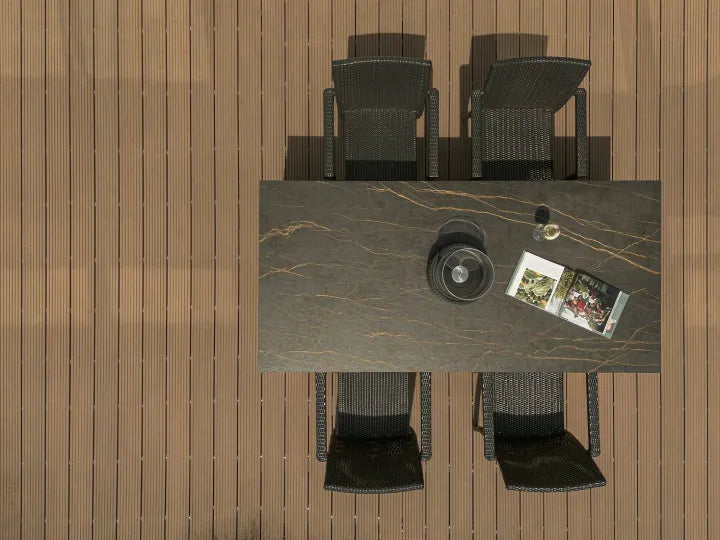


Sintered stone price can mean three very different numbers: the factory price of an unfinished slab, the price of a fabricated countertop, or the final installed price in a local market. Comparing those numbers without checking what is included is the main reason online price ranges appear inconsistent.
How Much Does Sintered Stone Cost?
For a quick 2026 planning answer, installed sintered stone countertops in the United States commonly appear around $60–$200 per square foot. Factory-direct slab prices can be far lower because they normally exclude fabrication, sink and hob cutouts, edges, delivery, local labor, taxes, and installation.
Market ranges are planning references, not quotations. Funtek catalog examples refer to selected 900 × 1800 mm product variants checked July 18, 2026; current price and availability must be confirmed.
Regional boundary: This guide owns the global price framework in USD and common international units. For rupee-denominated material and installed quotes, use the sintered stone price in India guide.
| Market or Quote Type | Typical Reference | What the Number Usually Means |
|---|---|---|
| Funtek factory catalog examples | $35–$171.60 per 900 × 1800 mm slab (about $21.60–$105.93/m²) | Selected product reference prices; excludes fabrication, packing, freight, duties, local delivery, and installation. |
| United States | $60–$200 per ft² | Common consumer-market range for countertop material and installation, according to Angi's July 2026 guide. |
| United Kingdom | £250–£1,000 per m² | Work-surface market range; many projects cluster around £500–£600/m², according to Stonesense. |
| Canada | CAD $100–$200 per ft² | Installed countertop planning range reported by a Canadian stone supplier. |
| Australia | AUD $600–$1,400 per m² | Sintered benchtop reference range cited in an Australian government impact statement. |
Regional price ranges are useful only for budgeting because currency, tax, labor, fabrication scope, brand availability, and installation standards differ between markets.
Sintered Stone Price per Square Foot, Square Metre and Slab
Price per square foot
Price per square foot is common in the United States and Canada, especially for countertops. It often combines material, fabrication, and installation, but not always. Ask whether templating, cutouts, edge work, backsplash, old-counter removal, delivery, and tax are included.
Price per square metre
Price per square metre is common in Europe, Australia, Asia, and international project purchasing. A square-metre factory price may describe raw slab material only, while a local worktop price may describe a finished and installed surface.
Price per slab
Manufacturers and distributors frequently sell complete slabs. The project may pay for the whole slab even when the finished pieces use less area. Slab dimensions and cutting yield therefore matter as much as the nominal price per square metre.
Useful area conversion
1 m² = 10.764 ft² | Price per m² ÷ 10.764 = price per ft²
This converts area only. It does not convert currencies or make a material-only quote comparable with an installed quote.
Current Funtek Slab Price Examples
These live catalog examples show why there is no single universal sintered stone slab price. Even at the same 900 × 1800 mm format, visual series and product positioning can change the reference price.
Selected 900 × 1800 mm Reference Slabs

Marble Look
White Gold Sand
Soft white marble movement with warm gold detail for bright residential and commercial interiors.
- From price
- $35/slab
- Displayed format
- 900 × 1800 mm
- Reference area price
- About $21.60/m²
- Visual category
- Light marble look
Select a surface

Travertine Look
Italian Red Travertine
Warm red travertine movement with linear mineral detail for hospitality, retail and statement interiors.
- From price
- $56.70/slab
- Displayed format
- 900 × 1800 mm
- Reference area price
- About $35/m²
- Visual category
- Red travertine look
Select a surface

Statement Marble Look
Brazilian Black Gold
Deep black marble movement with warm gold veining for dramatic hospitality, retail and premium interiors.
- From price
- $171.60/slab
- Displayed format
- 900 × 1800 mm
- Reference area price
- About $105.93/m²
- Visual category
- Black marble look
Select a surface
Raw Slab, Fabricated and Installed Prices Are Not the Same
| Quote Level | Usually Includes | Usually Excludes |
|---|---|---|
| Factory slab price | Unfabricated slab at the agreed factory or export term | Cutting, edges, cutouts, crating, freight, duties, and installation unless stated |
| Distributor material price | Slab stocked in the destination market | Fabrication, installation, special handling, and project extras |
| Fabricated price | Measured pieces, cutting, edge work, and specified cutouts | May exclude site delivery, fitting, supports, plumbing, and removal |
| Installed price | Material, fabrication, delivery, and fitting under a defined scope | May still exclude tax, demolition, plumbing, cabinetry correction, or complex access |
| Landed B2B cost | Material plus agreed packing and transport costs to a named point | Depends on whether the quote is EXW, FOB, CIF, DDP, or another Incoterm |
Never treat a factory slab price as an installed price; fabrication, cutouts, delivery, labor, and tax can exceed the material amount in some markets.
What Affects Sintered Stone Price?
1. Slab size and thickness
Larger slabs use more material and require more careful handling, but they can reduce seams and improve cutting yield. Thicker slabs normally cost more to manufacture and transport. The correct thickness also depends on the support system and application.
| Thickness | Common Uses | General Cost Direction |
|---|---|---|
| 3–6 mm | Wall cladding, cabinet fronts, furniture skins, renovation overlays | Lower material weight, but substrate and handling still matter |
| 9 mm | Walls, floors, selected furniture and supported surfaces | Mid-range slab cost and broader application flexibility |
| 12 mm | Countertops, vanities, tables, reception counters | Common countertop specification; fabrication affects total cost |
| 15–20 mm | Heavier countertops, furniture, built-up architectural details | Higher material and transport cost; may simplify some edge designs |
2. Color, finish and design complexity
Plain colors and standard stone looks often sit differently from polished surfaces, deep textures, full-body designs, bookmatched sets, continuous veining, or premium exotic-stone patterns. More complex decoration and tighter visual selection can increase price.
3. Brand and source
International brands such as Dekton, Neolith, Laminam, and Lapitec may carry higher local prices because of brand positioning, distribution, stock, warranties, and marketing. Factory-direct products can have a lower material price, but buyers must add international packing, freight, import costs, and local fabrication.
4. Fabrication complexity
Sintered stone needs suitable machinery, blades, feed rates, handling, and experienced fabricators. Sink and hob cutouts, drain grooves, curved pieces, mitered edges, waterfall ends, bookmatching, narrow strips, and complex access all increase labor and risk.
5. Order quantity and cutting yield
A full-container project, mixed-slab wholesale order, single slab, and one small fabricated vanity do not have the same cost structure. A slightly larger slab can sometimes lower total project cost when it reduces waste or avoids buying an additional slab.
6. Packing, freight and destination
Export crates, A-frames, container loading, inland transport, ocean freight, insurance, duties, taxes, port charges, and final delivery can materially change landed cost. Ask suppliers to identify the Incoterm and quote currency.
How Application Changes the Final Price
| Application | Main Cost Drivers | Information Needed for a Quote |
|---|---|---|
| Kitchen countertop or island | Slab count, thickness, sink/hob cutouts, edge profile, waterfall panels, templating and installation | Plan, dimensions, appliance details, edge choice, destination |
| Bathroom wall or vanity | Panel dimensions, wet-area substrate, joints, cutouts, edge finishing and local installation | Elevations, fixture locations, finish, thickness, quantity |
| Feature wall or lobby | Large-format handling, vein direction, bookmatching, panel numbering and access | Wall elevation, design reference, layout and installation height |
| Facade or exterior cladding | Engineering, anchoring system, wind load, access equipment, panel size and local codes | Technical drawings, location, building height and system requirements |
| Furniture and tabletops | Cut-to-size yield, backing, edge design, holes, frames and packing | Shop drawings, finished dimensions, quantity and support structure |
For a countertop or kitchen-island quotation, use Funtek's sintered stone countertops and kitchen islands project page to align slab options with the dimensions, thickness, edge, cutout and supply scope behind the price.
Example: Estimating a Sintered Stone Kitchen
A 40-square-foot kitchen priced at the broad US installed range of $60–$200 per square foot produces an initial budget of approximately $2,400–$8,000. This is only a starting point: islands, full-height backsplashes, waterfall ends, multiple cutouts, complex seams, premium colors, difficult access, and local taxes can increase the total.
Project budget formula
(Finished area + waste allowance) × material rate + fabrication + delivery + installation + tax
For factory purchasing, replace local installation with packing, inland freight, ocean freight, duties, and destination charges.
Use the Sintered Stone Area & Slab Quantity Calculator to estimate material area and slab quantity before requesting a quote.
Is Sintered Stone More Expensive Than Quartz or Granite?
Sometimes, but not always. Installed price ranges overlap. Standard quartz or granite can cost less than a premium sintered stone project, while a factory-direct standard sintered slab can cost less than a premium natural stone. Specialist fabrication can make a sintered countertop more expensive even when its raw slab price is competitive.
| Material | Cost Position | Why the Final Price Changes |
|---|---|---|
| Sintered stone | Mid to premium, with wide factory-to-installed variation | Brand, slab format, specialist fabrication, edges, cutouts, shipping |
| Quartz | Broad budget to premium range | Brand tier, color group, thickness, local fabrication and installation |
| Granite | Broad range from common to rare stone | Stone rarity, slab quality, thickness, yield, sealing and fabrication |
| Marble | Often premium | Origin, block selection, repair, bookmatching, waste and maintenance |
| Porcelain slab | Often overlaps sintered stone | Brand terminology, format, thickness, fabrication and distribution |
For a broader technical comparison, see Sintered Stone vs Other Surface Materials.
Wholesale and Import Buyers: Calculate Landed Cost
B2B buyers should not rank suppliers by factory slab price alone. The usable delivered cost is more important:
- Confirm the product: design, finish, slab size, thickness, faces, batch, and quantity.
- Confirm the trade term: EXW, FOB, CIF, DDP, or another agreed Incoterm.
- Add packing: crate or A-frame, protection materials, loading plan, and breakage allowance.
- Add transport: factory-to-port, ocean or land freight, insurance, port costs, and final delivery.
- Add destination costs: duty, tax, customs clearance, storage, local fabrication, and installation.
- Check usable yield: include cutting waste, vein direction, defects, and spare material.
For imported projects, compare cost per usable square metre delivered to the site, not only cost per nominal square metre at the factory.
How to Compare Sintered Stone Quotes
Ask every supplier or fabricator to quote the same specification. A useful request should include:
- product name, color, finish, and reference image;
- slab dimensions, thickness, and number of faces;
- required quantity plus waste or spare allowance;
- application and finished-piece drawings;
- cutouts, edge profiles, bookmatching, and fabrication scope;
- packing method and shipping destination;
- Incoterm, currency, tax status, lead time, and quote validity;
- installation scope, warranty, and exclusions.
Common Price-Comparison Mistakes
- Comparing a factory price with an installed retail price.
- Assuming per-slab, per-square-metre, and per-square-foot prices are interchangeable.
- Ignoring slab size and paying for poor cutting yield.
- Comparing different thicknesses, finishes, or visual series.
- Leaving cutouts, edges, delivery, supports, taxes, or installation undefined.
- Choosing the lowest material price without checking fabrication capability or breakage risk.
The lowest slab price can become the highest project cost when poor cutting yield, inadequate packing, breakage, or unsuitable fabrication is ignored.
The Bottom Line
Sintered stone can range from a low factory-direct slab reference to a premium installed countertop price because each quote covers a different portion of the project. For a useful comparison, identify the slab, unit, size, thickness, finish, fabrication, installation, shipping, tax, and trade term before judging the number.
Explore all Funtek sintered stone slabs, use the slab quantity calculator, or send a project specification for a current quotation.
Request a Project-Based Sintered Stone Price
Send the application, dimensions, slab format, thickness, finish, quantity, destination, and required delivery date. Funtek can then quote the material and agreed export scope more accurately.