


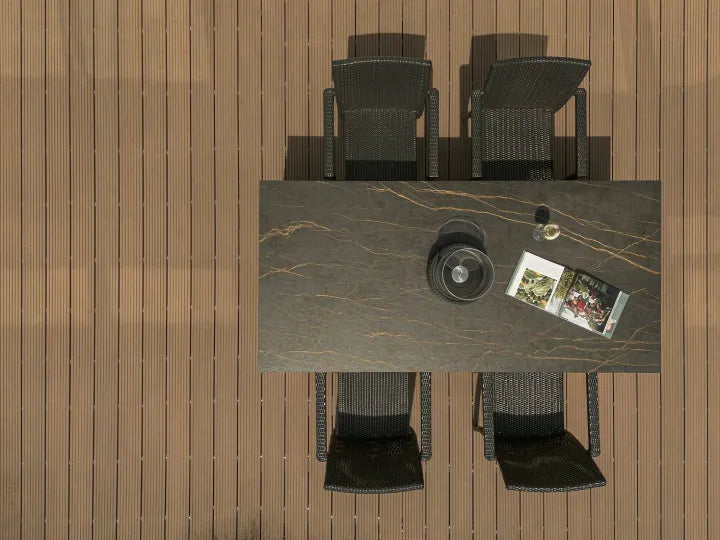


Sintered stone has clear advantages, but it is not a perfect material. The main disadvantages of sintered stone are higher upfront cost, edge chipping risk, limited repairability, professional fabrication requirements, silica dust control during cutting, and application-specific installation risks.
Comparing sintered stone with other materials? This article focuses on the disadvantages and engineering constraints of sintered stone. For a broader side-by-side comparison with quartz, granite, marble, porcelain slab, ceramic tile, laminate, concrete, stainless steel, and facade panels, visit our sintered stone material comparison guide.
Topic boundary: For the material definition, read what sintered stone is and how it is made. For dining tables and custom furniture surfaces, use the sintered stone furniture and tabletop project page. This evaluation remains focused on drawbacks, risks and mitigation.
In the high-end surface industry, sintered stone has gained massive traction for its near-zero porosity, strong heat resistance, UV stability, and large-format design potential. However, a successful project requires more than understanding the benefits. It also requires an objective view of the material's real problems, installation limits, and engineering constraints.
In our experience with B2B slab supply, many sintered stone problems are not caused by the slab alone. They often come from a mismatch between application, thickness, fabrication method, edge detail, handling, and installer experience. This guide explains the disadvantages clearly so buyers can decide whether sintered stone is worth it for countertops, walls, bathrooms, furniture, outdoor kitchens, and facade-related projects.

Sintered Stone Pros and Cons: Quick Comparison
Before looking at each disadvantage in detail, it helps to compare the strengths and weaknesses side by side. Sintered stone is often worth considering when performance matters, but it is not always the best material for every budget, installer, or application.
| Advantages of Sintered Stone | Disadvantages of Sintered Stone |
|---|---|
| Strong heat resistance for kitchens and outdoor areas | Higher upfront material and fabrication cost |
| UV stable for sun-exposed and exterior applications | Edges and corners can chip under sharp impact |
| Very low water absorption for bathrooms and wet areas | Severe damage can be difficult to repair invisibly |
| Large-format slab appearance with fewer joints | Requires experienced fabricators and installers |
| Low routine maintenance compared with porous natural stone | Cutting and grinding require crystalline silica dust control |
| Suitable for countertops, walls, furniture, and some facades | Exterior and facade projects need proper fixing-system design |
Disadvantage 1: Sintered Stone Can Be Expensive
Sintered stone is a premium surface material produced through high-pressure compaction and high-temperature firing. This manufacturing process helps create the dense, low-absorption slab performance buyers want, but it also places sintered stone in a higher price category than many conventional surfaces.
Material price varies by brand, thickness, finish, pattern, and slab size. However, the final project cost is often driven by fabrication and installation. Cutting and finishing sintered stone usually require diamond tooling, water-cooled cutting, careful CNC work, trained operators, and slower fabrication speeds than some standard countertop materials.
Installed cost vs factory slab price: In local installed countertop markets, premium sintered stone projects can reach high per-square-foot costs after fabrication and installation. This is different from factory FOB slab pricing, which depends on thickness, size, finish, quantity, packing, and export terms.
For buyers, the important point is not only the slab price. The total cost should include transport, handling, edge work, cutouts, substrate preparation, installation, possible breakage allowance, and the experience level of the fabricator.
For a deeper cost breakdown, see our sintered stone price guide.
Does Sintered Stone Crack, Break, or Chip Easily?
Sintered stone does not normally crack or break without a cause, but it can chip at exposed edges and can crack when impact, poor support, sharp cutout geometry, fabrication stress, handling damage, or substrate movement concentrates force in one area. Scratch resistance and impact tolerance are different properties: a hard surface can resist abrasion while remaining less forgiving at a thin edge or stressed opening.
A chip is usually localized at an edge or corner after impact. A crack or full break is more likely to involve a cutout, unsupported span, handling event, installation condition, or movement below the slab. The exact risk changes with the selected product, thickness, edge detail, support system, cutout design, and manufacturer instructions.
For sintered stone countertops, the most important risk areas are usually:
- 90-degree exposed corners
- sharp internal sink or cooktop cutouts
- thin unsupported overhangs
- poorly supported cabinet bases
- heavy impact from cookware or tools
- large slabs moved without proper handling equipment
Impact risk: Dropping heavy objects such as cast-iron pans on a sharp 90-degree edge can cause chipping. In poor fabrication conditions, stress may also travel from a chip or cutout into a larger crack.
The practical response is to specify and fabricate the exact slab correctly. Experienced fabricators should follow the product manual, use suitable tooling and support, ease exposed edges where the design permits, and avoid sharp internal corners at sink and cooktop cutouts. Funtek-specific handling, cutting, cutout, edge, support, and installation limits are collected in the Funtek fabrication and installation manual.

Disadvantage 3: Some Slabs Have Surface-Only Patterns
One of the most important aesthetic limitations is pattern depth. In many standard slabs, the decorative design is mainly applied to the top surface. If the slab is chipped, routed, or deeply damaged, the base body color may show through and create a visible contrast.
This matters most for marble-look designs, mitered edges, visible countertop edges, waterfall islands, routed details, and furniture tops. If the project requires a thick stone-block appearance, the fabricator may use mitered edge fabrication. This can create a premium look, but it also adds cost and requires excellent seam workmanship.
Full-body or through-body technologies are becoming more common in premium collections, but not every slab is full-body. Buyers should check the product type before specifying edge details.
If the project depends heavily on marble-style visuals, browse our marble-look sintered stone slabs and confirm whether the chosen slab is suitable for the intended edge design.
Disadvantage 4: Fabrication Requires Skilled Installers
Specifying sintered stone requires more than choosing a beautiful slab. The fabricator’s experience is critical. Standard stone fabrication habits may not be enough for ultra-compact or sintered surfaces.
Incorrect blades, dry cutting, fast feed speed, poor support, sharp internal corners, and rushed handling can increase the risk of chips, cracks, and installation problems. This is especially important for kitchen islands, sink openings, large wall panels, and long countertop runs.
| Constraint | Impact on Project | Technical Requirement |
|---|---|---|
| Structural Weight | 12 mm material weighs around 3–4 lbs/sq.ft. | Requires rigid, flat, and properly leveled support. |
| Visible Seams | Seams may remain visible, especially on large layouts. | Requires accurate layout planning and suitable adhesives. |
| Edge Profiles | Thin slabs have fewer edge-profile options. | Micro-radius, chamfered, or mitered edges should be specified carefully. |
| Cutouts | Sink and cooktop openings can become stress points. | Rounded internal corners and correct support are required. |
| Large Slab Handling | Large-format slabs can crack if transported or lifted incorrectly. | Use proper racks, suction frames, trained installers, and safe lifting methods. |
For installation planning, see our sintered stone installation guide.

Disadvantage 5: Cutting Requires Silica Dust Control
For B2B buyers, fabricators, and commercial contractors, worker safety is a serious concern. Sintered stone is a mineral-based material, and cutting or grinding it can release respirable crystalline silica dust if handled incorrectly.
This risk is not unique to sintered stone. It also applies to many stone, quartz, ceramic, porcelain, and mineral-based surfaces. The real issue is how the material is processed. Dry cutting, poor dust extraction, and inadequate respiratory protection can create dangerous exposure conditions.
Professional fabrication should use wet cutting, dust extraction, suitable PPE, proper workplace controls, and local safety compliance. Buyers should work with qualified fabricators who understand silica control and safe handling standards.
This is also why material selection should not stop at surface performance. For commercial and B2B projects, supplier documentation, fabrication guidance, and installer capability are part of the decision.
Disadvantage 6: Some Finishes Need More Care
Sintered stone is generally low-maintenance, but the selected finish can change the day-to-day experience. A polished finish, matte finish, textured finish, and anti-slip finish can behave differently in cleaning, touch, reflection, and visual appearance.
- Polished finishes: Can show fingerprints, smudges, and reflections more clearly, especially on darker colors.
- Matte finishes: Usually feel more understated and practical, but some marks may still show depending on color and lighting.
- Textured finishes: Can improve grip or visual depth, but may require more careful cleaning than smooth surfaces.
- Tactile comfort: Like many stone-based materials, sintered stone can feel cold to the touch. For bathroom walls and vanity areas, this is usually not a problem, but flooring comfort should be considered.
- Chemical restrictions: Avoid hydrofluoric acid because it can damage silicate-based surfaces.

Disadvantage 7: Outdoor and Facade Projects Need System Design
Sintered stone can be an excellent material for outdoor kitchens, exterior wall panels, and facade-related applications, but exterior projects require more than choosing a beautiful slab. The complete system matters.
For outdoor applications, buyers should check UV performance, water absorption, freeze-thaw suitability, fire classification, fixing method, wind-load requirements, substrate design, and local installation standards.
A slab that performs well indoors may still need project-specific verification for exterior cladding. For more detail, see our sintered stone outdoor facades guide.
Who Should Avoid Sintered Stone?
Sintered stone is not the best choice for every buyer. In some cases, another material may be more practical, easier to fabricate, or more cost-effective.
- Very low-budget projects: Laminate, ceramic tile, or entry-level porcelain may be more practical when lowest upfront cost is the main priority.
- Areas without skilled fabricators: If no local fabricator understands sintered stone or porcelain slab handling, installation risk increases.
- Projects needing heavy on-site modification: Sintered stone is not ideal when many last-minute cuts, repairs, or adjustments are expected on site.
- Designs requiring strong repairability: Acrylic solid surface may be better when seamless repair and reshaping matter more than heat or UV performance.
- High-impact edge abuse: Some busy commercial environments may need thicker edge detailing, stronger support, or a different material strategy.
This does not make sintered stone a poor material. It simply means the material should match the project, the budget, the installer, and the performance requirement.
How to Reduce Sintered Stone Problems
Most sintered stone problems can be reduced with better specification, fabrication, and installation planning. For export projects, we usually recommend buyers confirm slab thickness, edge detail, packing method, and fabrication route before placing a bulk order.
- Choose the right thickness: Match 6 mm, 9 mm, 12 mm, 15 mm, or 20 mm slabs to the real application and support condition.
- Avoid sharp 90-degree exposed edges: Use chamfered, eased, or micro-radius edges where impact risk is higher.
- Round internal cutout corners: Sink and cooktop openings should avoid sharp internal stress points.
- Confirm fabricator experience: Work with installers who understand sintered stone, porcelain slab, or ultra-compact surface fabrication.
- Plan slab handling: Large-format slabs should be moved with proper racks, suction frames, and trained teams.
- Select the right finish: Match polished, matte, textured, or anti-slip finishes to the cleaning and use environment.
- Request technical guidance: Ask the supplier for packing, installation, cutting, and application recommendations before ordering.
Planning a project? Share your application, size, thickness, finish, and destination with Funtek, and we can help review whether sintered stone is a suitable option. Request a project-based recommendation →
When Sintered Stone Is Still the Right Choice
These disadvantages do not mean sintered stone is a poor material. They mean it is a high-performance slab that must be specified and fabricated correctly.
Sintered stone is still a strong choice when the project needs:
- very low water absorption
- high heat resistance
- UV stability for outdoor or sun-exposed spaces
- large-format slab appearance
- modern marble-look or stone-look surfaces
- low routine maintenance
- applications across countertops, walls, furniture, and facades
If your project requires a UV-stable outdoor surface, a low-absorption bathroom wall, or a high-performance kitchen island, these drawbacks are manageable through professional engineering, careful fabrication, and correct application matching.
Not sure if sintered stone fits your application? Compare it with quartz, granite, marble, porcelain slab, and other materials in our material comparison guide, or send your project details for a technical recommendation.
Final Verdict: Are Sintered Stone Disadvantages Dealbreakers?
The disadvantages of sintered stone—higher cost, edge brittleness, limited repairability, fabrication complexity, and safety requirements—are the trade-offs behind its strong performance in demanding applications.
For buyers who only need a low-cost indoor surface, another material may be more practical. But for projects requiring heat resistance, UV stability, low absorption, large-format design, and low maintenance, sintered stone can be a strong long-term choice.
To evaluate the technical performance of different materials side by side, view our sintered stone material comparison guide. You can also compare related materials in our guides on sintered stone vs quartz and sintered stone vs porcelain slab vs granite.
Architectural & Engineering References
- Health and safety guidance for silica dust exposure: OSHA crystalline silica guidance.
- Material hardness and abrasion resistance reference framework: ISO 10545 ceramic tile test standards.
- Fabrication and stone handling context: Natural Stone Institute.