


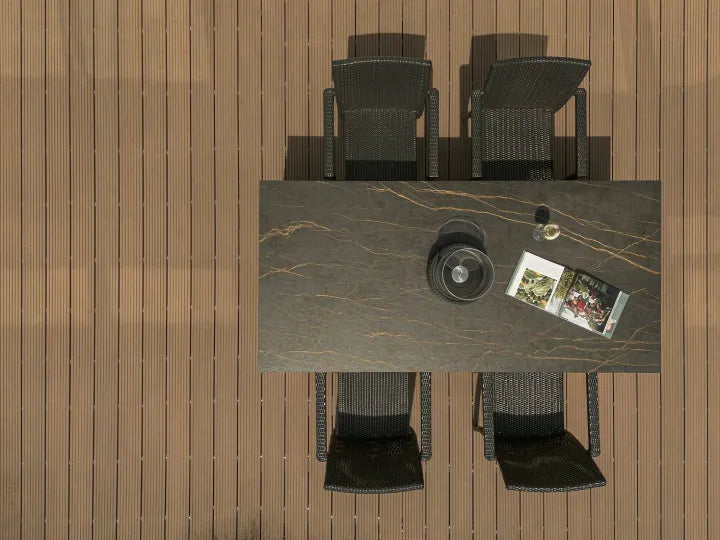


Tiles that look like marble range from economical glazed ceramic wall tile to dense porcelain floor tile and large-format sintered stone panels. They can all reproduce a marble colour direction, but they do not create the same joint pattern, edge detail, performance or installed cost.
If tile is only one route on the shortlist, compare it with the broader marble alternative materials used for countertops, walls and project surfaces.
What Type of Tile Looks Most Like Marble?
Large-format porcelain and sintered stone usually create the most continuous marble effect because a larger face preserves more of the vein and reduces grout lines. High-quality conventional porcelain can also look convincing when it supplies enough faces, rectified edges and a controlled grout plan. Ceramic remains useful for decorative walls, but use the product’s declared rating rather than assuming it performs like porcelain.

Ceramic, Porcelain and Sintered Stone Compared
| Decision point | Ceramic marble-look tile | Porcelain marble-look tile | Marble-look sintered stone |
|---|---|---|---|
| Best starting role | Interior decorative walls and backsplashes | Floors, walls and many wet-area layouts when appropriately classified | Large walls, vanities, furniture, islands and broad premium surfaces |
| Water absorption | Product-specific; non-porcelain ceramic is above the porcelain threshold | 0.5% or less under the porcelain definition | Very low absorption is typical; verify the exact technical sheet |
| Common visual scale | Small to medium modular formats | Mosaic through large-format tile | Large panels and slabs |
| Joint pattern | More joints and repeated modules | Varies with format; rectified options can reduce the grid | Fewer joints across broad visible areas |
| Handling | Familiar tile installation | Suitable cutting and setting for the chosen format | Trained slab handling, fabrication and an approved assembly |
The Tile Council of North America defines porcelain as ceramic tile with water absorption of 0.5% or less under ASTM C373. Low absorption is useful, but it does not replace slip, load, wear, installation or exterior-use requirements.
Choose the Format From the Room
Bathroom and shower walls
Both porcelain tile and thin large-format slabs can create durable marble-effect walls when the substrate and installation system are suitable. Conventional tile gives the installer smaller modules around niches and corners. A large slab reduces grout lines but makes access, cutting, handling and penetrations more demanding. Review Funtek’s bathroom wall slab guidance for full-height panels.
Bathroom and wet floors
Wet floors need an application-specific surface, drainage plan and maintenance regime. Do not select a polished marble look from photographs alone. TCNA’s DCOF and ANSI A326.3 guidance uses product-use classifications and stresses that DCOF is only one part of slip-risk assessment. Small tiles can help form falls and add grout joints; large tiles reduce joints but require careful drainage design.
Kitchen backsplashes
Ceramic and porcelain are both practical starting points because weight and traffic demands are lower than on floors. The design decision is usually format, cleaning, outlet cuts and how the joints relate to cabinets and worktops. If the worktop must look like marble, use the dedicated quartz countertops that look like marble comparison.
Feature walls and lobbies
Large-format slabs become more valuable as the visible area grows. A bookmatched or continuous face set can turn the vein into an elevation-wide composition. The lifting route, substrate, fixing system and face sequence must be designed before ordering. See Funtek’s interior wall application guide.
How Tile Size Changes the Marble Effect
A 300 × 600 mm tile and a 1600 × 3200 mm slab may use a similar palette but create very different rooms. Smaller modules introduce a repeating joint rhythm. Larger faces preserve more movement and make the wall or island read as one surface.
- Draw the finished wall, floor or furniture face.
- Place the real tile or slab dimensions over it.
- Identify cuts, corners, doors, drains, basins and sockets.
- Count visible joints and map the strongest veins.
- Check repeated faces and confirm how the material reaches the site.
For the large-format branch, read Porcelain Tile That Looks Like Marble: A Large-Format Guide.
What Makes Faux Marble Tile Look Convincing?
- Face variation: multiple faces reduce obvious repeats.
- Pattern scale: broad veins need enough visible area.
- Background tone: cool white, warm ivory and pale grey react differently beside lighting and cabinets.
- Grout strategy: joint width and colour can support or break the flow.
- Full-layout approval: the actual room elevation reveals problems a sample cannot.
Carrara, Calacatta and Statuario are visual references, not technical grades. Use the sintered stone pattern guide to define the background and vein direction before requesting products.
Polished, Matte or Textured Finish?
Polished finishes reflect light and can intensify the depth of a marble effect. Matte finishes diffuse light and often feel more restrained. Textured finishes may support specific floor or exterior briefs, but suitability must be documented for the exact product.
Do not translate a finish name directly into a safety claim. “Matte” is not a universal wet-floor approval, and “polished” does not automatically make a product unsuitable for every wall. Use the declared area of use and project risk assessment.
How Much Do Tiles That Look Like Marble Cost?
Material format is only one price variable. Compare tile or slab price, charged quantity, layout yield, spare material, substrate preparation, waterproofing, adhesive, grout, movement joints, cutting, edges, penetrations, access, lifting and installation as one assembly.
Small ceramic tile may have the lowest material entry point but a detailed pattern can add labour. A large-format slab may reduce joints but require specialist handling. Use Funtek’s sintered stone price guide for slab quote scope rather than treating a product-only rate as installed cost.
Three Funtek Marble-Look Slabs for Different Rooms
These active products show how colour, finish and face relationship change the result. Confirm the selected variant, batch and application before ordering.

Silk Road
A light beige marble direction with soft grey movement for warm bathroom walls, feature walls and islands.
View Silk RoadOpen Product →
Italian Cloud Grey
A refined grey field with delicate white and warm-beige movement for broad polished surfaces.
View Cloud GreyOpen Product →
Calacatta Silver
A clear white field with slender grey Calacatta movement for bathroom walls, feature walls and backsplashes.
View Calacatta SilverOpen Product →Current listed formats: 900 × 1800 through 1600 × 3200 mm, with 6, 9, 12 and 15 mm options. Confirm the exact product record. Browse the marble-look sintered stone collection for current choices.
Marble-Look Tile Selection Matrix
| Project priority | Strong starting direction | Why |
|---|---|---|
| Economical decorative wall | Glazed ceramic tile | Broad style choice and familiar wall installation |
| Residential floor | Appropriately classified porcelain tile | Low absorption and broad floor-format availability |
| Wet floor | Product declared for the specific wet-use category | Slip risk and drainage matter more than the marble print |
| Full-height shower wall | Large porcelain tile or thin sintered slab | Fewer joints with system-specific installation |
| Hotel lobby or reception wall | Coordinated large-format slab faces | Vein continuity can be planned across the elevation |
| Marble-look kitchen worktop | Countertop-approved quartz or sintered slab assembly | Edge, cutouts, support and heat exposure need a countertop system |
What to Approve Before Ordering
- product name, manufacturer and material classification
- colour, full face set and finish
- nominal and actual dimensions, calibre, shade or batch requirements
- declared wall, floor, wet, exterior or countertop use
- scaled layout and grout or joint plan
- substrate, installation system and site access
- spare material, replacement strategy, destination and packaging
For a wider discussion of non-tile finishes, use Funtek’s tile alternatives guide.
The Bottom Line
The best tiles that look like marble are selected from the room outward. Ceramic is a practical decorative-wall route. Porcelain adds low absorption and wider floor-and-wall versatility. Large-format sintered stone creates the strongest visual continuity for broad premium surfaces, but it requires slab-scale specification and trained installation. Choose the format, finish and face set that complete the real application—not the product photo that looks most like marble at thumbnail size.
Choose the Marble Look at the Scale of the Finished Room
Send Funtek your elevation, room type, preferred pattern, finish, thickness and quantity. We can shortlist large-format marble-look slabs and prepare samples for project approval.