


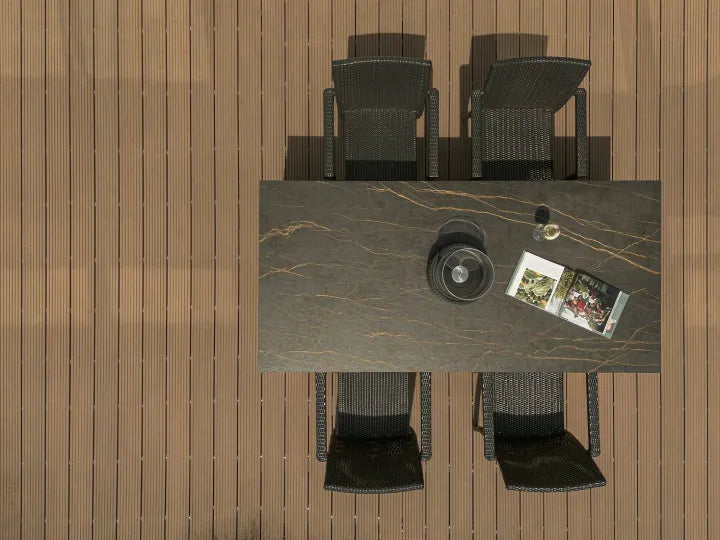


Porcelain tile that looks like marble can reproduce Carrara, Calacatta, Statuario and other stone references without requiring a natural-marble care routine. The important choice is not simply “marble look.” It is the combination of pattern scale, number of faces, tile or slab format, finish, grout layout and approved application.
Still comparing other surface families? Use Funtek’s marble countertop alternatives guide to place porcelain tile beside sintered stone, quartzite, engineered quartz, granite and other options before narrowing the format.
What Is the Best Porcelain Tile That Looks Like Marble?
The best option is the product whose marble pattern remains convincing at the scale of the finished room. A rectified multi-face porcelain tile is a strong choice for modular floors and bathroom layouts. A large-format marble-look porcelain or sintered slab is often better for islands, full-height walls and lobbies where fewer joints preserve the vein composition.

What Counts as Porcelain Tile?
Porcelain is a technical tile classification, not a synonym for every ceramic-looking slab. The Tile Council of North America defines porcelain tile as ceramic tile with water absorption of 0.5% or less when tested by ASTM C373. That definition distinguishes porcelain from more absorbent non-porcelain ceramic tile, but it does not approve a product for every floor, wall, exterior or countertop application.
Large-format terminology is less consistent. A supplier may use porcelain slab, gauged porcelain panel, ceramic slab, compact surface or sintered stone for products that look similar in photographs. Compare the declared standard, body, thickness, finish, application guidance and fabrication system instead of choosing by category name alone. Funtek’s porcelain slab vs sintered stone comparison explains that boundary.
Choose the Marble Reference Before the Format
Carrara look
Carrara-inspired surfaces usually have a softer white or pale-grey background with fine, quiet grey movement. They suit rooms where the countertop or wall should support the rest of the palette rather than become the main feature.
Calacatta look
Calacatta-inspired surfaces use a clearer field and broader, more widely spaced veins. Grey, gold or warm mineral accents can make an island or feature wall the visual focus. Large veins need enough uninterrupted area to read properly.
Statuario look
Statuario-inspired designs usually combine a bright field with defined grey veining and stronger contrast than a quiet Carrara look. These names are design references, not performance grades. Use Funtek’s guide to sintered stone patterns to build a more precise visual brief.
Conventional Marble-Look Porcelain Tile vs Large-Format Slab
| Decision point | Conventional porcelain tile | Large-format porcelain or sintered slab |
|---|---|---|
| Typical visual result | Repeating modules separated by grout | Broader uninterrupted pattern with fewer joints |
| Pattern control | Depends on supplied faces and installation rotation | Depends on the full-face design, cut map and face relationship |
| Best starting uses | Floors, shower walls, backsplashes and modular layouts | Full-height walls, islands, vanities, furniture and focal surfaces |
| Handling | Smaller pieces are easier to carry and replace | Requires slab handling, suitable transport and trained fabrication |
| Buying priority | Carton shade, calibre, face mix and grout plan | Full slab, face set, finish, thickness, cut yield and lifting route |
The larger format is not automatically better. A small shower floor may benefit from more grout joints and easier falls to drainage. A tall reception wall may benefit from one broad face with a controlled vein. Start with the finished assembly.
Size and Grout Lines Determine Visual Continuity
Grout is part of the design. A marble effect loses continuity when a bold vein stops at every joint or the grout colour creates a dominant grid. Rectified edges can support narrower, more controlled joints when the manufacturer, substrate and installer permit them, but grout and movement joints must not be removed where the installation system requires separation.
Draw the wall or floor elevation and place the real dimensions over it. Count joints, locate cut pieces, check door and lift access, and decide whether the feature vein should cross a corner or end before it. Funtek’s current marble-look products list formats up to 1600 × 3200 mm, but listed availability is not automatic approval for every use.
Polished or Matte Marble-Effect Porcelain?
A polished surface increases reflection and can make a white marble look brighter. It also makes lighting, fingerprints, water marks and surface variation more visible. A matte surface diffuses light and can feel quieter and more architectural.
Finish is also a use decision. Do not choose a wet floor from appearance alone. TCNA’s DCOF and ANSI A326.3 guidance uses manufacturer-declared hard-surface use classifications while stressing that slip risk also depends on traffic, contaminants, maintenance, wear and project conditions. Ask for the exact product’s declared use classification rather than assuming every matte tile is safe or every polished tile is unsuitable.
Where Marble-Look Porcelain and Sintered Stone Work Best
| Application | Strong starting format | What to verify |
|---|---|---|
| Bathroom wall | Large porcelain tile or thin large-format slab | Panel joints, niches, penetrations, substrate and cleaning |
| Shower or wet floor | Appropriately classified floor tile | Declared wet-use classification, drainage, texture and maintenance |
| Kitchen backsplash | Rectified tile or slab offcut | Outlet cuts, joint alignment and cleanability |
| Kitchen island | Countertop-approved slab assembly | Thickness, support, edge build-up, cutouts and fabricator capability |
| Lobby or feature wall | Large-format slab or coordinated face set | Elevation, face sequence, lifting route and fixing system |
For wet-area panels, review Funtek’s sintered stone bathroom wall guidance. For reception and feature elevations, use the interior wall application guide.
How to Make Marble-Look Porcelain Look More Realistic
- Count the faces. Too few different faces can make the same vein appear at obvious intervals.
- Review at room scale. Lay out several tiles or use full-face files to test repetition.
- Coordinate the grout. Select joint width and colour with the actual edge and background tone.
- Plan the feature vein. Mark where the strongest movement falls around doors, corners, sinks and furniture.
- Check the edge. A surface-printed design may not continue through the body; approve exposed edges separately.
- Keep one control sample. Shade, finish and batch approval should remain traceable when the order arrives.
Three Large-Format Funtek Marble Looks to Shortlist
These active products illustrate different pattern and finish directions. Confirm the exact batch, finish, size, thickness and assembly in the quotation.

Lipis Calacatta
Broad white-and-grey Calacatta movement in a low-glare matte finish for feature walls, vanities and backsplashes.
View Lipis CalacattaOpen Product →
Golden Veins Calacatta
Warm gold and grey movement with a bookmatched relationship for hospitality walls and bathroom backdrops.
View Golden VeinsOpen Product →
Taj Mahal
Warm ivory, cream and gold cloudy movement with a polished surface and three random faces.
View Taj MahalOpen Product →Current listed formats: 900 × 1800, 900 × 2600, 1200 × 2400, 1200 × 2600 and 1600 × 3200 mm, with 6, 9, 12 and 15 mm options. Confirm the selected variant and finished assembly before ordering. Browse the complete marble-look sintered stone collection for current availability.
What to Put in a Marble-Look Porcelain or Slab RFQ
- Carrara, Calacatta, Statuario or another visual reference
- warm or cool background and preferred vein colour
- tile or slab dimensions, thickness and finish
- number of faces, random match, continuous match or bookmatch requirement
- room elevations, finished cut sizes and visible edges
- floor, wall, vanity, countertop or furniture application
- declared use-classification or technical-document requirements
- quantity, spare material, batch control, sample needs and destination
Use the sintered stone area calculator for early quantity planning, then have the installer or fabricator approve the final cutting and wastage allowance.
The Bottom Line
The best porcelain tile that looks like marble is the one that remains coherent after joints, cuts, lighting and installation are added. Conventional porcelain tile is practical for modular floors and walls. Large-format sintered stone or porcelain-style slabs become more compelling when the project needs broad vein movement and fewer visible joints. Approve the real face set, finish and application—not only the marble name.
Turn a Marble Reference Into a Buildable Slab Specification
Send Funtek your elevation, visual reference, finish, thickness, quantity and destination. We can recommend current marble-look faces and prepare samples for project review.