


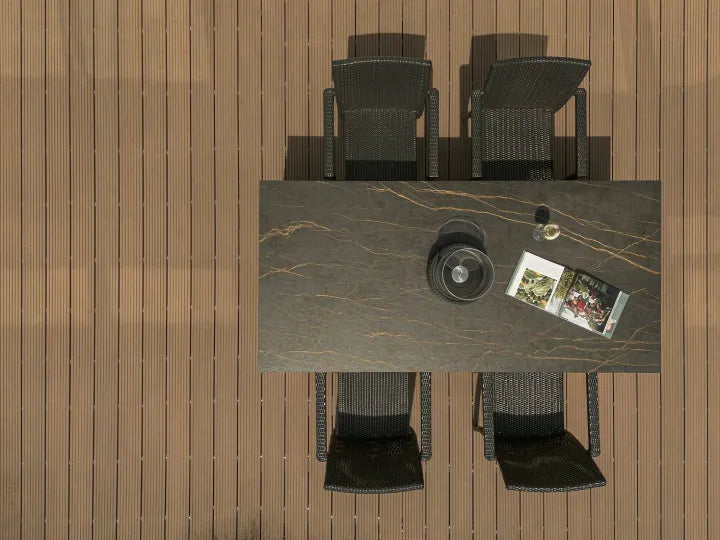


For a new U.S. distributor selling mainly to countertop fabricators, use this 100-slab starter example: six colors, with 85 slabs at 12 mm and 15 at 6 mm. Put 75 slabs into three neutral directions, 20 into supporting grey and dark designs, and five into one trial color.
This assumes your fabricators work with the selected 12 mm product and you already have wall demand for the 6 mm lines. If those assumptions fit, start with the schedule below; otherwise change the main thickness or remove the wall stock. The quantities are a worked example, not U.S. sales benchmarks or a confirmed container load.
A worked first-order mix: 100 slabs, six colors, eight items
The first three colors below represent the strongest customer enquiries in this example. Choose one finish per item. We use 3200 × 1600 mm throughout to make the quantities and areas comparable; the same method works with other slab formats. Match the actual format to your customers’ cutting layouts, then confirm each product code and specification.
Worked example · all lines assume 3200 × 1600 mm. Swipe sideways on a phone; tap a photo to enlarge.
| Color direction | Thickness | Slabs | Area | Reason for stock |
|---|---|---|---|---|
 White / grey veins White / grey veins
|
12 mm | 25 | 128.00 m² | Core countertop jobs |
|
White / grey veins
|
6 mm | 10 | 51.20 m² | Identified wall demand |
 White / gold veins White / gold veins
|
12 mm | 20 | 102.40 m² | Core countertop jobs |
 Warm beige Warm beige
|
12 mm | 15 | 76.80 m² | Core countertop jobs |
|
Warm beige
|
6 mm | 5 | 25.60 m² | Identified wall demand |
 Quiet grey Quiet grey
|
12 mm | 10 | 51.20 m² | Supporting choice |
 Dark / white veins Dark / white veins
|
12 mm | 10 | 51.20 m² | Supporting choice |
 Green statement Green statement
|
12 mm | 5 | 25.60 m² | Small demand trial |
| Total | 85 at 12 mm; 15 at 6 mm |
100 | 512.00 m² | 6 colors · 8 items |
Before using this exact mix, have the supplier approve the item minimums and split or mixed-pallet arrangement. A 100-slab selling plan can change substantially when it becomes a packing list.
Funtek’s 20GP loading guide lists 25 slabs per pallet for its 1600 × 3200 × 12 mm wooden H-frame route. If each of these six 12 mm colors required a full pallet, 85 slabs would become 150 slabs—65 extra, before adding the 6 mm lines. That route’s pallet count is not a universal per-color MOQ. Ask whether the proposed smaller lines can be combined; if they cannot, reduce the color range or revise the quantities before placing the order.
Already have a color list? Send Funtek the colors, thicknesses and slab counts for an availability, minimum-order and packing review before you finalize the purchase order.
The mix gives white/grey 35 slabs, white/gold 20, beige 20, grey 10, dark 10 and green 5. That places 75 slabs in the three colors with the strongest assumed demand, 20 in supporting choices and 5 in a trial. The 75/20/5 split is the result of this example’s choices, not a market benchmark.
At the assumed common size, one slab has a nominal face area of 3.2 × 1.6 = 5.12 m². The order therefore contains 512 m²: 435.2 m² at 12 mm and 76.8 m² at 6 mm. These are purchased face areas. Edge trimming, part geometry, vein direction and fabrication loss determine usable output.
Give each color a clear role in the opening range
The roles matter more than the six names. In this example, the importer has the strongest enquiries for pale neutrals, a smaller need for grey and dark slabs, and one unproven design to test. Use your own enquiries to assign those roles.
- Core neutrals · 75 slabs in this exampleWhite/grey, white/gold and warm beige carry the main stock. A soft quartzite-style neutral, travertine look or solid white could replace one when it answers stronger customer demand.
- Supporting choices · 20 slabsQuiet grey and a charcoal or black direction cover additional requests. Move either into the core group if your buyers order it more often.
- One trial direction · 5 slabsGreen is the example, not a required purchase. A red travertine look, dramatic onyx look or coordinated bookmatched design could fill the trial role. Use samples first if no buyer has a plausible job for it; bookmatched stock needs complete paired sets.
Keep the trial small enough that a slow response will not prevent you from replenishing a core color. There is no requirement to spend five percent on an experimental design: with no credible interest, its stock allocation can be zero.
A second similar white needs a reason to occupy stock. It might offer a warmer background, finer veins or a finish requested by a different customer group. Without that distinction, it divides the quantity available for essentially the same sale. A finish change also creates another item to track, even when the color name stays the same.

Compare physical samples beside the cabinet and wall finishes your buyers use, then review the full slab. A small chip may miss the large vein that dominates an island or the directional bands that affect a wall layout. The color-selection guide develops the undertone and lighting checks; the sample-approval guide explains what to approve at each stage.
For current design directions to test in the opening assortment, use the Cersaie 2026 slab trend review and confirm them against actual samples and local buyer demand.
Choose the main thickness before adding more variants
Ask your first fabricators to confirm the main countertop thickness against the selected slab and their intended support, edge and cutout details. As a named manufacturer example, Neolith recommends 12 mm and 20 mm for its kitchen countertops. Use the documentation for the product you are actually buying to approve its application.
Our example assumes the importer’s fabricators have accepted a 12 mm product route for their countertop work. The importer also has a smaller group of wall enquiries for an approved 6 mm route, so only two colors receive that additional thickness. The example carries no 20 mm stock: there is no identified 20 mm customer requirement in its assumptions. A confirmed 20 mm project would change the order.
For a wall-led dealer, make the approved wall-panel specification the main stock line and buy countertop variants against identified jobs. For a project-led importer, use the signed project schedule to set colors and thicknesses before adding any speculative stock. The customer mix determines which thickness leads.

Record the actual slab thickness separately from the finished edge appearance. A built-up edge and a solid thicker slab require different material and fabrication decisions. Keep the countertop thickness and support review with the fabricator; do not approve unsupported spans or cutouts simply because a slab is thicker.
Set each quantity from job demand and the replenishment gap
Why does the first white/grey 12 mm line receive 25 slabs? Suppose you have 12 slabs committed to jobs, expect to sell another two per week over four weeks, want four in reserve, and need one for a cutting trial:
12 for jobs + (2 per week × 4 weeks) + 4 in reserve + 1 cutting trial = 25 slabs.
That example assumes no usable stock or other incoming supply. Replace its four-week coverage period and four-slab reserve with your actual selling and replenishment plan. Start the coverage period when your first shipment is usable in your warehouse, and end it when the replenishment you plan to rely on becomes usable there. Include the time you will spend reviewing sales before reordering.
To apply the calculation to another item, add the confirmed job slabs, additional forecast sales, reserve and display or trial pieces. Then subtract usable unallocated stock and reliable incoming supply for that same period. Count each item once, round up to whole slabs and never order a negative quantity.
If that same line must cover eight weeks, the calculation becomes 12 + (2 × 8) + 4 + 1 = 33 slabs. The order needs eight more slabs of this item, or fewer slabs elsewhere. Longer replenishment time changes the quantity you need in a selling specification; adding unrelated colors will not cover that gap.
Calculate confirmed jobs from whole slabs and an approved cutting layout. A kitchen with waterfalls or directional veining can require more slabs than its finished area suggests. The whole-slab quantity guide explains that geometry. Keep any reserve tied to its intended product and job, rather than assuming a spare dark slab can replace a white one.
Set a goods budget and keep cash for the first reorder
A 100-slab list needs a dollar ceiling as well as a piece count. First decide how much cash you can commit through arrival and the first selling period. Set aside the costs outside the slab purchase and the reserve you want available when the strongest color needs replenishing.
Suppose you set a $30,000 cash ceiling, provisionally allow $8,000 for packing, transport and destination costs, and keep $4,000 available for replenishment. That leaves:
$30,000 total − $8,000 delivery-related allowance − $4,000 cash reserve = $18,000 for slabs.
These are chosen inputs for the calculation. Replace the $8,000 allowance with itemized current estimates from the supplier, freight forwarder and destination broker, including applicable duties and fees, clearance and local delivery. Check what the goods quotation already includes so you do not count the same charge twice. The $4,000 reserve also needs to fit the timing and deposit terms of your likely reorder.
Now price each row of the shortlist. The quoted slab subtotals must fit the $18,000 goods ceiling in this example. If they total $22,000, reduce or change the order before treating the cash reserve as spare purchase money.
Allocate money using quoted row costs, not slab-count percentages. The example’s 75/20/5 piece split becomes a 75/20/5 spend split only if the average price per slab is equal across those groups. Give the core colors the funding needed for credible jobs, then cost the supporting range and trial separately. This makes an expensive trial visible before it consumes the reorder reserve.
Tell Funtek your budget range and whether it covers slabs alone or the full delivered order. Include the destination and preferred looks so the shortlist and quotation can be reviewed against the same scope.
Test the shortlist with your first customers
A fabricator buying for kitchens needs a different opening range from a dealer supplying wall installers. Before choosing colors, write down the work your first customers expect to do: kitchens and vanities, wall panels, furniture, or named commercial projects. Keep confirmed jobs separate from stock you hope to sell.
For each serious enquiry, record the color direction, finish, slab dimensions, thickness and likely whole-slab requirement. Ask the fabricator which exact products they can cut and install. A preferred appearance is useful evidence of interest; an agreed specification and cutting plan are much stronger evidence for an opening purchase.
If you have no local sales history, start with samples and full-slab photographs, then ask prospective trade buyers to select and price a specific job. A request for “some white marble looks” gives you less to buy against than a customer who has chosen a finish, approved a slab and identified the work it will supply. If demand remains uncertain, reduce the opening commitment or compare a smaller shipment before filling unused space with extra colors.

Turn the shortlist into a confirmed packing plan
Send the supplier one line per exact product, size, thickness and finish, with the required slab count. Ask for the supply status, item-level minimum, batch reference, ready date and proposed crate or rack allocation. A mixed-order total can be acceptable while one of its smaller lines still fails its own minimum.
Funtek’s supplier page states that mixed-design orders can be arranged depending on stock, slab specifications and quantity. Have the actual schedule checked against those conditions. A displayed color does not reserve a quantity or confirm every thickness.

Then reconcile the packing list with the loading plan. Slab weight, rack or crate weight, dimensions, restraint and handling space all matter. For the same area and material density, a 20 mm slab contains about 1.67 times the material volume of a 12 mm slab; replacing pieces one-for-one changes the weight calculation. Use supplier-confirmed weights and the carrier’s route limits for the shipment. Use the loading guide linked below the order table to reconcile the final pack with the shipment.
Use the first sales to decide the second order
Track enquiries, quotations, confirmed orders and slabs released by exact item. Record why an enquiry did not become a sale: unavailable thickness, unsuitable finish, price, pattern, fabrication concerns or timing. Ten requests for a color that never receives an approved quotation are different from ten slabs sold.
For repeat ordering, use the stock you can actually promise. Keep customer reservations, display pieces, damaged material and job-specific reserves out of free stock. One practical trigger is the expected uncommitted demand during replenishment plus a chosen buffer, compared with free stock and reliable unallocated incoming supply.
Suppose the white/grey 12 mm item now sells two slabs per week, replacement takes six weeks, and you retain a four-slab buffer. Its trigger is (2 × 6) + 4 = 16 slabs. With 16 free slabs and no unallocated incoming supply, begin the replenishment process. Recalculate when sales pace, the incoming date or customer commitments change; a first shipment rarely gives you a stable forecast immediately.
After the first selling period, expand the variants buyers actually request and reduce unsupported trials. A statement design can remain in the sample collection until paid demand justifies stock. A core color that sells may deserve a deeper quantity before it deserves another finish.
Get help building your first order
Send Funtek your target market and delivery destination, main applications, budget range and preferred looks. Tell us whether the budget is for slabs or the full delivered order, and add any sizes, thicknesses or quantities you already know. We can help review the slab options and mixed-order conditions as you build the shortlist; you do not need a finished purchase order to start.