




Short Answer
Sintered stone is a manufactured surface made by compacting mineral powders and firing them into a dense slab. It is used for countertops, walls, furniture and other architectural surfaces. The appeal is a stone-like appearance with low water absorption and easy everyday care. The trade-off is that hard surfaces still need careful handling, supported cutouts and well-made edges.
How mineral powders become a sintered stone slab
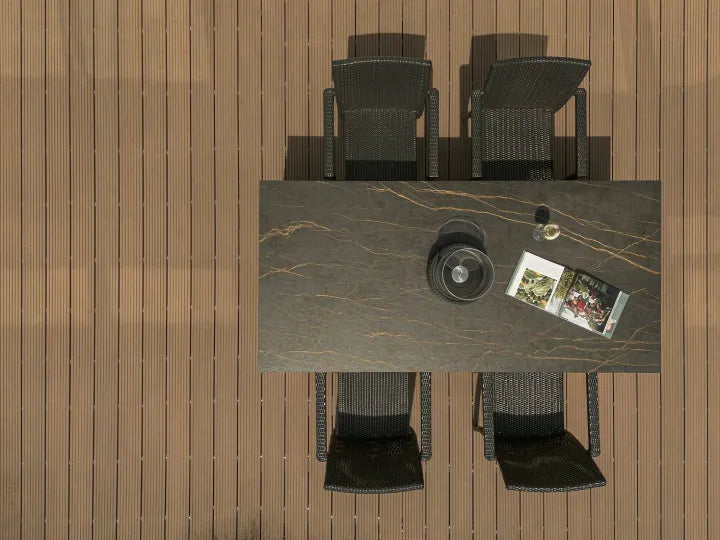
A marble vein on a sintered slab is a manufactured design. The slab begins with a blend of mineral raw materials, including ceramic minerals and pigments, rather than a block cut from a quarry.
The word sintered describes what happens during firing: heat helps the compacted particles bond and the body become denser. The factory controls the recipe and firing cycle for each product; one temperature or ingredient list cannot describe every brand.
In Funtek's manufacturing route, the minerals are ground with water, mixed and spray-dried into granules. Those granules are spread and pressed into an unfired slab, then dried before entering the kiln. Decoration can be added before firing; polishing or other finishing follows where the design requires it.
That sequence explains two things you can see in the finished product. The factory controls the slab's format and surface design, while the decoration method determines whether its visible pattern stays near the face or extends into the body. Our manufacturing guide shows these stages in more detail.


Why people choose sintered stone
Everyday spills are easier to manage
A dense surface with low water absorption gives liquids less opportunity to soak into the slab. Coffee on a worktop is therefore usually a cleaning task, rather than a reason to reseal the whole surface. Wipe spills promptly and use the cleaner recommended for the finish; low absorption does not mean every stain or chemical is harmless.
For a concrete reference, Funtek's technical data sheet reports 0.09% water absorption for its tested sample under ASTM C373. That result belongs to the sample in the report, rather than every product sold under the name “sintered stone.”
Large patterns need fewer interruptions
A large slab lets a marble-look vein run across more of an island or wall before it meets a joint. Funtek's standard printed-body formats extend to 1600 × 3200 mm. Whether a finished surface can use one piece still depends on its dimensions, access and cutting layout.
Finish changes the result as much as pattern. A polished face reflects light sharply; a matte face looks quieter; texture becomes more visible under light from the side. A small sample helps you judge that surface, while a full-slab view shows the scale and direction of the veins. Both matter when selecting a marble-look design.

Heat and outdoor performance can widen the options
Fired mineral surfaces are useful candidates where hot objects or sunlight would limit other finishes. Some product families are intended for outdoor use as well as interiors. Manufacturer technical documentation illustrates how these properties are evaluated. The selected product's thermal and exterior data still matter: a kitchen worktop, fireplace surround and ventilated facade place different demands on the finished assembly.
The disadvantages: edges, fabrication and repair
Scratch resistance and resistance to a sharp impact are different properties. Dragging an object across the face loads the surface differently from knocking a heavy pan against a narrow edge. A hard face can resist everyday abrasion while an exposed corner still chips.
Openings introduce another potential weak point. Imagine a sink cutout with a sharp inside corner: stress concentrates where the direction changes abruptly. A rounded corner spreads that transition. This is why Funtek's fabrication manual calls for radiused openings, clearance around cutouts and independent support for an undermount sink. Buying a thicker slab does not remove those requirements.

The practical disadvantage is the need for an experienced fabricator, suitable tools and a handling plan. A large slab is vulnerable while being lifted, cut and carried, before the cabinetry or wall provides its final support. Installation labor can be a substantial part of the finished cost.
Repair also has limits. Filling a small chip may improve its appearance, but it may leave a visible change in color, gloss or pattern. A repair plan should account for where the damage sits, especially on an exposed front edge.
The face and the edge may tell different stories
On a surface-printed design, a cut edge can reveal a relatively plain body beneath the decorative face. Full-body color means color extends through the thickness; it does not automatically mean every vein continues through it. Through-body veining is a more specific feature.


Before choosing a visible straight edge or a mitered waterfall return, look at a physical cut sample. Funtek's video below explains the distinction using samples and a slab cross-section. Notice the body color as well as the vein itself.
Sintered stone compared with quartz, porcelain and natural stone
Two white, grey-veined samples can look similar while being very different materials. Their appearance tells you the design direction; their composition and technical documents tell you how they behave.
| Material | How it is formed | Useful distinction |
|---|---|---|
| Sintered stone | Prepared mineral body, compacted and fired. | Large-format design and low absorption; edges and openings require careful fabrication. |
| Engineered quartz | Mineral aggregate held together with resin binders. | A familiar countertop option with different heat-care requirements. Caesarstone recommends trivets for hot cookware. |
| Porcelain slab | Prepared ceramic raw materials, formed and fired. | Can overlap with the sintered category; compare actual product data rather than the sales label. |
| Natural marble or granite | Stone quarried in blocks and cut into slabs. | Natural variation extends into the stone; absorption, acid response and care differ by stone type. |
Porcelain deserves particular care in this comparison. Large-format porcelain and products marketed as sintered stone can share mineral ingredients, pressing and firing technology. A different label alone does not establish superior strength or quality. Compare the exact slab's body, finish, thickness, test results and fabrication guidance. Our material comparison page explores the alternatives by application.
Where sintered stone works well
Countertops and kitchen islands
Countertops combine the main attractions: a cleanable face, a large pattern and a choice of edge details. They also bring the main fabrication challenges together—sink openings, cooktop cutouts and exposed edges.
For a waterfall island, a thick-looking edge may be made by joining thinner pieces at a miter. The front view therefore does not tell you the slab's actual thickness. The cutting layout must account for both the horizontal top and the vertical return. Funtek's countertop page connects slab choices with these project details.


Bathroom walls and feature walls
On a wall, the large format makes the pattern and joint layout especially noticeable. A marble-look panel can give a shower or vanity wall a broad, continuous-looking surface with fewer joints than small tiles.
Water still reaches joints, penetrations and the layers behind the slab. Low slab absorption does not replace waterproofing. Plan the panel sizes around the actual room, including niches, corners and the route the installers will use to bring panels inside. Our bathroom wall guide explains those decisions.

Furniture, floors and exterior surfaces
Thin slabs can form the face of a cabinet or a supported furniture top. For floors, texture and the relevant slip and abrasion data matter more than how the sample looks upright in a showroom. Exterior work adds weather exposure, movement and fixing requirements.
These are different applications of the material, not interchangeable installation methods. A finish approved for a wall still needs a separate suitability check before being used on a wet floor.

Thickness, weight and cost: what changes with the specification
Funtek's standard printed-body range includes 6, 9, 12 and 15 mm thicknesses; 20 mm is available through custom production. The data sheet identifies 6 mm for backed wall or furniture panels and 12 mm as a preferred worktop thickness. The final choice also depends on support, openings and finished-piece size.
Thickness has an immediate effect on handling. Using Funtek's planning density of 2450 kg/m³, a 1600 × 3200 mm slab weighs about 75.3 kg at 6 mm and 150.5 kg at 12 mm, before packaging. Doubling the thickness doubles the calculated weight of the same-size slab.
See how thickness changes slab weight
Same slab size: 1600 × 3200 mm. Select a thickness to compare the calculated weight.
12 mm: approximately 150.5 kg per slab.
Calculation: 3.2 m × 1.6 m × thickness in metres × 2450 kg/m³. Uses Funtek's planning density; excludes packing, backing and fittings. All five estimates remain visible above.
That weight is a planning estimate, not a lifting-system rating. Use the slab weight calculator for other dimensions and add packing or frame weight separately.
For an initial U.S. countertop budget, Angi's July 2026 guide gives US$60–$200 per square foot for material and installation. A factory slab quote covers a different purchase: the finished cost also depends on cutting, edge work, packing, transport and fitting. The same budget range should not be carried into another country without local pricing.
For a project quote, the useful distinction is between a raw slab, fabricated pieces and an installed surface. A plain rectangular top and a top with a sink opening, mitered edges and a waterfall return can use the same design yet require different amounts of material and labor. Compare the same finished pieces and inclusions before deciding which quote is cheaper.
Once the material suits the application, choose a few surface designs and discuss the format, finish and sample with the supplier. Funtek supports slab selection, cut-to-size coordination and export packing for project buyers; drawings help turn an early visual preference into a defined supply request.
Find a sintered stone for your project
Tell us where you plan to use it and the look you have in mind. Add approximate dimensions or a drawing if available. We can discuss suitable slab options, sample availability and the supply details needed for a quotation.