


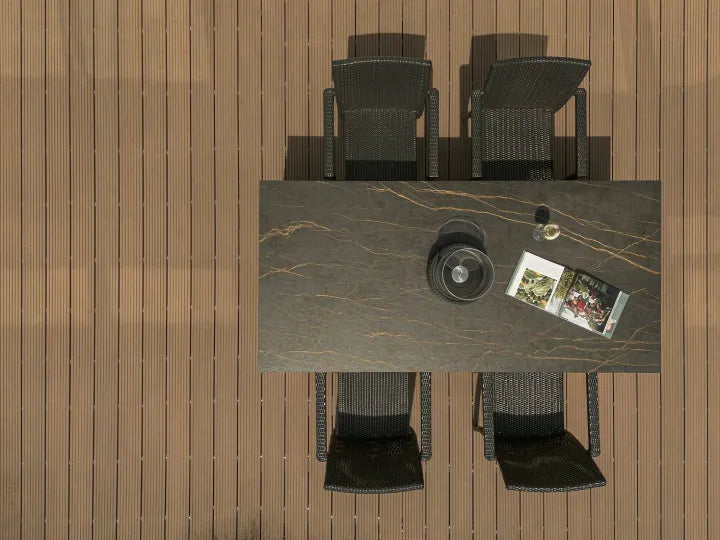


Sintered stone is dense, but “dense” does not automatically mean “the heaviest countertop.” Its real weight depends on thickness and area. A thin 6 or 12 mm panel can weigh less per square foot than a conventional 20 or 30 mm stone top, while a full 1600 × 3200 mm slab can still be far too heavy and awkward for casual manual handling.
Is Sintered Stone Heavy?
Yes at full-slab scale; not necessarily after thickness is considered. Using a typical planning density of 2,450 kg/m³, 6 mm sintered stone weighs about 14.7 kg/m² (3.0 lb/ft²), while 12 mm material weighs about 29.4 kg/m² (6.0 lb/ft²). However, a 1600 × 3200 × 12 mm slab is approximately 150.5 kg (332 lb), so transport and fabrication still require professional equipment and a planned route.
3.0 lb/ft²
6.0 lb/ft²
332 lb
These are planning estimates. Actual product density, dimensions, mesh backing and batch tolerances can change the final weight.
How Much Does Sintered Stone Weigh?
The fastest comparison is weight per square metre or square foot. Once thickness doubles, the material weight for the same surface area also roughly doubles. That is why a quote that says only “sintered stone” is incomplete: a 6 mm wall panel and a 20 mm countertop are very different loads.
| Nominal thickness | Estimated kg/m² | Estimated lb/ft² | 1600 × 3200 mm full slab | Typical planning context |
|---|---|---|---|---|
| 3 mm | 7.4 | 1.5 | 37.6 kg / 83 lb | Thin surfacing and selected wall or furniture applications; support system matters |
| 6 mm | 14.7 | 3.0 | 75.3 kg / 166 lb | Walls, facades, furniture and supported interior panels |
| 9 mm | 22.1 | 4.5 | 112.9 kg / 249 lb | Selected counters, tables and supported surface applications |
| 12 mm | 29.4 | 6.0 | 150.5 kg / 332 lb | Common countertop and furniture specification |
| 15 mm | 36.8 | 7.5 | 188.2 kg / 415 lb | Heavier worktops and project-specific applications |
| 20 mm | 49.0 | 10.0 | 250.9 kg / 553 lb | Thicker self-supporting appearance and selected countertop details |
Method: area × thickness × 2,450 kg/m³. Published manufacturer data show normal variation: the Dekton technical manual lists maximum weights by thickness, while the Lapitec technical sheet lists product density and full-slab weights. Use the exact product datasheet for engineering and shipping.
Why Can a Thin Slab Still Be Hard to Move?
A large sintered stone slab creates a handling problem before it creates a floor-load problem. Even when its weight per square foot is moderate, the slab is tall, wide and rigid. The crew must control both the mass and the flexing forces across a large brittle sheet.
- Area multiplies weight. A 12 mm sample feels manageable; a 5.12 m² slab of the same material does not.
- Cut-outs change the stress pattern. Sink and hob openings create weak zones that need support during movement and installation.
- Access can matter more than the number on the scale. Stairs, narrow lifts, door turns and finished floors can determine whether the piece should be divided.
- Handling equipment is part of the specification. A-frames, clamps, suction systems, lifting frames and protected edge support reduce uncontrolled bending and impact.

Do not choose the number of people from slab weight alone: size, cut-outs, route, equipment and the manufacturer’s handling instructions all affect the safe lifting plan.
Is Sintered Stone Heavier Than Granite or Quartz?
Not automatically. Sintered stone, granite and engineered quartz are all dense surfacing materials. The useful comparison is the same finished area at the actual specified thickness—not a material name against another material name.
For example, 12 mm sintered stone at the planning density above is approximately 29.4 kg/m². A 20 or 30 mm stone top contains substantially more material per square metre, even if the materials have similar density. Edge build-ups can also give a thin slab the visual depth of a thicker top without making the complete surface solid 40 or 60 mm material.
| Comparison question | Useful specification | Misleading shortcut |
|---|---|---|
| Installed dead load | Finished area × actual material thickness, plus substrate and supports | “Sintered stone is lighter” without stating thickness |
| Delivery and lifting | Largest transported piece, cut-outs, access route and lifting equipment | Comparing only weight per square foot |
| Cabinet load | Distributed load, cabinet condition, spans, rails and local support points | Assuming every cabinet layout behaves the same |
| Visual thickness | Solid thickness versus mitred or laminated edge construction | Reading the visible edge as full material thickness |
For a broader material-level decision, use the sintered stone material comparison. It separates weight and thickness from stain resistance, heat performance, fabrication, repair expectations and appearance.
Can Kitchen Cabinets Support Sintered Stone?
Sound, level cabinets designed for a stone surface can often support a properly specified sintered stone countertop. That is not a universal approval. The fabricator or project professional still needs to verify the complete support condition before cutting.
- Check that cabinet boxes are structurally sound, securely fixed and level across the run.
- Confirm whether the selected thickness needs continuous substrate, perimeter rails or local reinforcement.
- Plan support around sinks, hobs, seams, dishwashers, large openings and unsupported spans.
- Engineer islands, seating overhangs and cantilevers for the real geometry and expected live loads.
- Add the weight of backing panels, built-up edges and sinks when evaluating the complete assembly.
The countertop thickness article explains why the thickest option is not automatically the best option. For project detailing, continue to the countertop specification page and the installation requirements.
What Does Weight Change for Walls, Furniture and Facades?
Thin sintered stone is valuable when a large visual surface needs less cladding weight. A 6 mm panel is roughly half the material weight per area of a 12 mm panel, but it is not self-supporting in every application. The backing, adhesive, anchors, frame, panel size, joints, wind load and substrate condition still determine the system.
Wall panels
Confirm substrate capacity, panel layout, fixing or adhesive system, movement joints and installation sequence. Large panels should not be treated as oversized tiles without a compatible system.
Furniture and tables
Calculate the top together with its backing and frame. The base must resist tipping and provide sufficient support during use and transport. A lighter panel can make moving the finished item easier, but edge protection remains important.
Exterior facades
Low panel weight can reduce loads on the subframe, yet exterior design still requires project-specific engineering for anchors, wind pressure, thermal movement, fire requirements and local codes. See the ultra-light large-format sintered stone application for the system-level questions.
Calculate the Weight Before Ordering
A reliable project conversation starts with the exact width, length, thickness and quantity. For shipping, also include the crate or A-frame, protection, accessories and any processed pieces.
Use the Funtek Slab Weight Calculator
Enter custom dimensions and thickness to estimate net slab weight, total order weight and selected packing allowances in metric or imperial units.
Slab weight = width × length × thickness × densityThe calculator is a planning tool, not structural approval. Confirm the actual product datasheet and finished fabrication drawings before booking labour, lifting equipment, packing or freight.
The Bottom Line
Sintered stone can be light per square foot when specified in a thin panel, but a complete large-format slab is still a heavy, awkward and fragile object. Compare weight by area and thickness, then plan the largest fabricated piece, support condition, access route and equipment.
For a 12 mm starting estimate, use about 29.4 kg/m² (6.0 lb/ft²); then replace the estimate with the selected product’s actual data. That single distinction prevents most misleading comparisons with quartz, granite and natural stone.
Project Weight Check
Confirm Slab Weight Before You Quote
Send the slab format, thickness, quantity, processing requirements and destination. Funtek can help confirm the material estimate, packing approach and project quotation.