


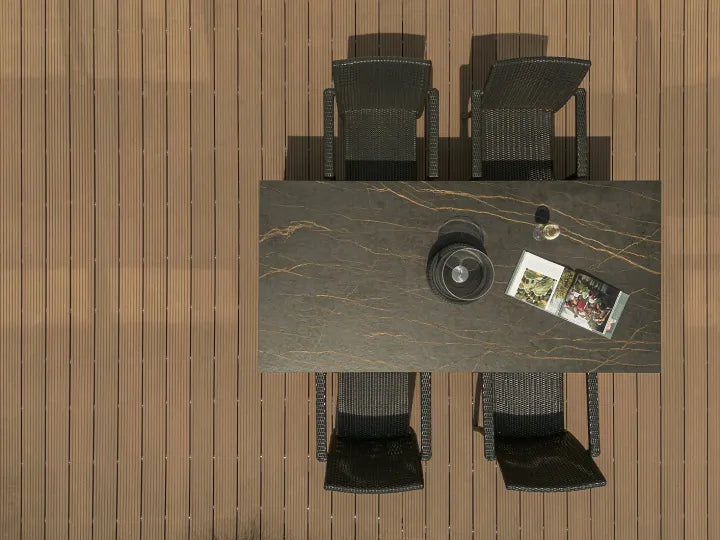


Steel Grey Leathered Granite at a Glance
Steel Grey leathered granite is a natural, medium-to-dark grey countertop stone with dense black and silver mineral grain and a textured, low-reflection finish. The pattern is usually tighter and quieter than strongly veined granite, but the reserved slab still controls the final colour, grain density and surface feel. Choose it when you want real stone variation without a mirror-like polish.
If the specification requires natural Steel Grey granite, approve and buy the actual slab through a granite supplier or fabricator. Funtek does not sell natural granite. If the brief is instead a repeatable grey, low-glare, large-format surface, the verified sintered-stone options below are relevant alternatives rather than copies of the granite.

Grey Low-Sheen Sintered Stone Alternatives
Use this shortlist only when the project can change material. The first two products keep a natural-stone direction; the other two move deliberately toward quieter cement and micro-cement looks. All four current Shopify records list matte finishes, five slab sizes—1600 × 3200, 1200 × 2700, 1200 × 2400, 900 × 2700 and 1200 × 2800 mm—and 6, 9, 12 and 15 mm thickness options. Confirm availability, face selection and fabrication details before ordering.

New Armani Grey
A dark grey, matte, natural-stone-look route for countertops, islands and bathroom walls. It offers a deeper low-glare field without claiming to reproduce Steel Grey’s natural mineral grain.
View New Armani Grey specifications
Rock Grey
A grey matte stone-look slab for projects that want restrained movement and a low-glare surface. Review the full face beside approved cabinet and metal samples.
View Rock Grey specifications
Micro Cement Moderate Ash
A medium-grey micro-cement direction for a more uniform architectural field. It is visually different from natural granite and should be sampled as a separate design decision.
View Moderate Ash specifications
Cement Light Grey
A lighter cement-look alternative for projects that want the room brighter and quieter. It does not imitate Steel Grey granite’s black-and-silver grain.
View Cement Light Grey specificationsHow Steel Grey Leathered Granite Looks
Steel Grey is generally sold as an Indian grey granite with close, small-scale mineral movement. Its charcoal base can read almost black in low light, while silver flecks become clearer under daylight or side lighting. The leathering process removes mirror reflection and leaves shallow relief, so the surface often looks softer and more tactile than a polished piece cut from the same stone.

Leathered, Honed and Polished Steel Grey
Polished Steel Grey has the strongest reflection and usually the deepest-looking contrast. Honed stone is smooth but low sheen. Leathered stone is also low sheen, but adds tactile relief that catches raking light and may hold fine crumbs differently from a smooth finish. The exact feel depends on the fabricator’s tooling and process, so finish names alone are not enough for approval.
If the finish is still open, compare pieces from the same slab family under the project lighting. Do not use samples from different suppliers and assume the only variable is finish. For a deeper process, cleaning and quoting comparison, use our leathered granite countertops guide. For a same-stone three-way sheen decision, see polished vs honed vs leathered granite.

Thickness, Slab Size and Quote Scope
Current Steel Grey supplier examples commonly advertise 20 and 30 mm slabs; another current exporter uses the approximate imperial equivalents 3/4 and 1 1/4 inches. Full-slab examples around 280–330 × 160–220 cm also appear in the market. These figures are useful for early planning, but they do not prove the dimensions or measured thickness of the material available to your fabricator.
Price examples show why scope matters. On 4 September 2026, Colorado retailer Carpet Exchange listed Steel Grey Leathered at US$60.99 per square foot installed. UK supplier Mayfair Worktops listed a 30 mm product at £369.42 per square metre. Compare each offer using its stated unit, destination, fabrication, delivery, installation, tax and validity period.
| Quote field | What to make identical | Evidence to request |
|---|---|---|
| Stone allocation | Slab or bundle IDs, finish, measured thickness and usable area | Full-face photographs and reservation record |
| Fabrication | Cutouts, edge build-up, seams, reinforcement and finish work | Marked shop drawing and written inclusions |
| Installation | Template, delivery, access, lifting, support and site fitting | Site scope, exclusions and change-order basis |
| Commercial terms | Tax, freight, currency, breakage, lead time and warranty | Dated quotation with destination and validity period |
Compare installed scope with installed scope. A raw-slab or small-cutter price cannot be placed beside a templated, fabricated and installed worktop price without normalization.
Cleaning and Sealing a Leathered Surface
The Natural Stone Institute care guidance recommends a neutral cleaner, stone soap or mild dishwashing detergent with warm water, followed by thorough rinsing and drying with a soft cloth. Avoid abrasive creams and acidic cleaners. Blot spills promptly rather than spreading them, and use trivets or mats even though many natural stones tolerate heat.
There is no honest universal “seal every year” rule. The Institute’s granite sealing statement notes that many granite countertops do not need sealing and that an impregnator makes stone more stain-resistant, not stain-proof. Ask the stone supplier whether the reserved slabs were resin-treated, whether the chosen leathered finish needs an impregnator, which product is compatible, and what its manufacturer says about reapplication.
- Before handover: record the exact cleaner and any impregnator used.
- For daily soil: use a soft cloth and a neutral solution, then rinse and dry.
- For texture: test how easily crumbs and cooking residue release from the approved sample.
- For stains or sheen changes: identify the cause before applying a stronger chemical.
Cabinet, Metal and Backsplash Pairings
Pale oak keeps a dark grey counter from feeling severe and repeats the warm side of silver mineral grain. Warm white or off-white cabinets create higher contrast without turning the room clinical. Charcoal cabinetry can work in a large, bright room, but it needs deliberate light surfaces elsewhere so the countertop edge and backsplash remain legible.
Matte black hardware extends the low-reflection direction. Brushed nickel adds a cooler highlight that can pick up silver flecks. Keep the backsplash quieter than the granite: off-white handmade tile, a restrained warm-grey surface or a short granite upstand lets the tight grain remain the main texture. Always place real door, tile and metal samples beside the stone; generic colour names do not control undertones.

What to Approve Before Fabrication
A small chip can confirm general colour and texture, but it cannot approve a kitchen. Check a representative sample under daylight, warm task lighting and the dimmest expected room condition. Wipe it with the specified daily cleaner, let water dry on it, run your hand across it, and test the activities that matter—such as sliding a small appliance or rolling dough on a removable board.
Then move from sample to slab. The fabricator should mark the island, perimeter runs, sink, hob, seams, waterfall ends and backsplash pieces on full-face slab images. Confirm which areas will be removed by cutouts and how any two slabs meet. Sign the slab and piece layout before cutting; approval after fabrication is too late to move a visible mineral patch or seam.

| Approval gate | Pass condition | Owner |
|---|---|---|
| Material identity | Natural granite or sintered stone is explicitly named in the quotation and drawing | Buyer and supplier |
| Appearance | Reserved slab or production face is accepted under project lighting | Designer and buyer |
| Finish | Low-sheen sample has the approved feel, cleanability and edge treatment | Buyer and fabricator |
| Piece layout | Cutouts, seams, direction and visible features are signed off before cutting | Fabricator and designer |
| Commercial scope | Material, fabrication, packing, delivery and installation inclusions are written | Procurement |
If repeatability is the deciding factor, continue with the Funtek sintered stone countertops page and the sintered stone sample guide. Send drawings, application, quantity, destination and the preferred grey direction so the discussion starts with the correct product family.
Compare a Grey Low-Sheen Alternative
If the specification can move from natural granite to sintered stone, send the countertop drawing, quantity, destination and preferred grey direction. Funtek will use the current product records to narrow the sample and slab discussion.