


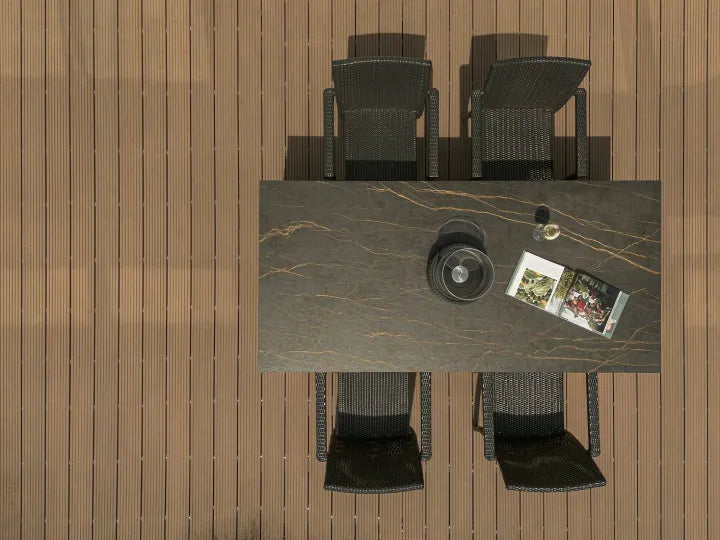


Glossy sintered stone is chosen for the way it reflects light, deepens colour and gives a slab a more polished visual presence. That makes it attractive for feature walls, furniture, islands and reception surfaces—but the word glossy is not a complete technical specification. Product, finish process, batch, lighting, edge construction and intended use still need to be approved together.
What is glossy sintered stone?
Glossy sintered stone is a sintered slab with a light-reflecting face, commonly sold under terms such as polished, high gloss or soft gloss. It can make veining and colour appear more vivid, but finish names are not universal across manufacturers. Buyers should approve the exact product, physical sample and full slab—not rely on the word “glossy” alone.
Glossy, Polished and Soft Gloss Are Not Universal Synonyms
Finish vocabulary can sound precise while still describing different appearances. One supplier may use polished for a mirror-like face; another may use glossy for several reflective levels. Soft gloss often suggests a gentler reflection, but it is not a cross-brand gloss unit.
The production route may also differ by collection. A face can be polished, glazed or built through another proprietary surface process. Funtek’s sintered stone surface technologies guide explains the broader process families and the parameters that belong in a technical approval.

A finish name is a shortlist tool. The approved physical sample, full-slab view and product documentation are the specification.
Glossy vs Matte Sintered Stone
Neither finish is automatically better. Gloss increases reflected light and visual depth; matte reduces sharp reflections and usually feels quieter. The correct choice depends on pattern, colour, viewing angle, maintenance expectations and where the slab will be used.
| Selection point | Glossy or polished face | Matte or low-reflection face | What to approve |
|---|---|---|---|
| Light and reflection | Creates highlights and can brighten a focal surface | Produces a softer, more diffuse appearance | View a sample vertically and horizontally under project lighting |
| Pattern and colour | Can make dark colours, mineral effects and veining look deeper | Can make the same design appear calmer and more tactile | Compare the exact pattern in both finishes, not generic chips |
| Visible marks | Reflections may reveal smudges, dust or wiping trails on some dark or uniform surfaces | Marks may be less visually amplified, although texture can affect cleaning | Handle and clean the actual sample before approval |
| Edges | A reflective face can contrast strongly with a cut edge or substrate | The transition may appear quieter but still needs detailing | Approve edge profile, mitre, body colour and seam position |
| Floor use | Do not assume suitability from the product name | Do not assume a matte face is automatically slip resistant | Request the exact wet/dry slip data required by the project |
For dark glossy slabs in particular, ask the supplier to show the surface after normal handling and cleaning. Fingerprint visibility is an appearance question, not a universal defect, and it varies with colour, lighting and coating. If a client wants a brighter look with less distinct reflection, a soft-gloss option may be the more useful comparison than a fully matte slab.
Where Glossy Sintered Stone Works
Glossy slabs perform best visually where the reflected surface contributes to the design. That can be a large uninterrupted plane, a furniture top or an island viewed from several angles. The final construction still determines suitability.
Feature walls, reception desks and bar fronts
On vertical surfaces, gloss can intensify veining and create movement as people pass. Reception walls and bar counters also benefit from the premium, light-responsive character of polished stone looks. Plan joint positions and lighting early: grazing light can celebrate the finish, but it can also make lippage or surface-plane variation easier to see. See Funtek’s interior wall application guidance for substrate and installation considerations.
Dining tables and other furniture tops
The search for glossy sintered stone often overlaps with finished dining tables. For manufacturers, however, the slab is only the facing or top material. The table system still needs an engineered support, edge treatment, attachment method and impact strategy. Use Funtek’s furniture and tabletop guidance when developing the finished product.
Kitchen islands, countertops and vanity tops
Gloss can give marble-look or exotic patterns a strong presentation on islands and vanity tops. Review reflections from windows and pendants, then confirm cut-outs, seam locations, edge profiles and fabrication instructions. The sintered stone countertop guide covers the wider system decisions beyond finish selection.
Floors
A glossy product should only be specified for flooring when the exact product documentation and required project test method support that use. A product metafield may list floors as an application, but project conditions—wet areas, ramps, public circulation and local codes—can require different evidence. Never substitute visual gloss level for slip-performance data.

Current Funtek Glossy Slabs to Shortlist
The following active Funtek products are currently identified as polished, high-gloss surfaces. They show three different design directions: quiet pale marble, dramatic black-and-white movement and a blue-black mineral effect. Use them to request samples and begin a project shortlist; confirm the selected variant, finish, batch and application in the quotation.

Venus Light Grey
A pale grey marble-look slab with a polished, high-gloss reflective face and restrained movement. It is a useful starting point for buyers who want brightness without a strongly contrasting pattern.
- Pattern: light grey marble look, random match
- Body: standard body
- Listed applications: countertops, bathroom walls and floors

Butterfly Pandora
A high-contrast black-and-white polished surface for projects where the slab is intended to become a visual centrepiece. The large-scale movement suits feature planes and statement furniture.
- Pattern: exotic Pandora look, one face shown, random match
- Body: standard body
- Listed applications: kitchen islands, feature walls and tabletops

New Sapphire
A polished blue-black full-body slab with mineral-like flashes that change under directional light. It is aimed at dramatic hospitality, reception, island and vanity applications.
- Pattern: blue-black mineral effect, one face shown, random match
- Body: full body
- Listed applications: islands, reception and bar counters, feature walls and vanity tops
| Product | Glossy design direction | Current listed formats | Current listed thicknesses |
|---|---|---|---|
| Venus Light Grey | Quiet pale marble look | 900×1800 to 1600×3200 mm | 6, 9, 12 and 15 mm |
| Butterfly Pandora | Dramatic black-and-white movement | 900×1800 to 1600×3200 mm | 6, 9, 12 and 15 mm |
| New Sapphire | Blue-black mineral depth | 900×1800 to 1600×3200 mm | 6, 9, 12 and 15 mm |
Listed sizes and thicknesses are catalogue options, not automatic approval for every use. Confirm availability, exact finish, batch, fabrication route and system suitability when requesting a quotation.
Inspect Glossy Slabs Under Project Lighting
A small sample answers colour and touch questions, but a full slab reveals reflection continuity, pattern scale and how the face behaves across a large plane. Ask for both when the visual outcome matters.
For repeated pieces, such as restaurant tabletops or cabinet panels, agree on the acceptable visual range and orientation. For one-off feature slabs, mark the intended crop, joint and principal viewing direction before fabrication.
Finish, Body and Edge Must Be Approved Together
A polished face does not tell you what a cut edge will look like. Venus Light Grey and Butterfly Pandora are currently identified as standard-body products, while New Sapphire is identified as full body. Even then, do not assume the face pattern, gloss or veining repeats through the thickness.
Specify whether the project uses an exposed cut edge, mitred build-up, laminated edge, framed edge or another fabrication detail. Request a finished edge sample when the edge is visible. This is especially important on dining tables, waterfall islands, vanity fronts and reception counters, where the face-to-edge transition is part of the design.
Do not approve the face and leave the edge until fabrication. A reflective surface makes mismatched body colour, adhesive lines and edge geometry easier to notice.
Cleaning, Marks and Repair Expectations
Routine cleaning guidance should come from the exact product supplier. As a general selection check, test the sample with the water, residue and approved cleaner expected in service, then rinse and dry it to see how the finish presents under light. Funtek’s guide to sintered stone and staining explains why surface, contaminant, dwell time and cleaning procedure must be considered together.
Do not assume an installed glossy face can be machine-polished like conventional natural stone. Repair and repolishing options depend on the product and finish process; unauthorized work can permanently change the appearance. Read can sintered stone be polished? before planning remediation, and obtain the manufacturer’s written method for the selected slab.
That product-specific approach is consistent with published manufacturer guidance. The Dekton technical manual separates finish, cleaning and fabrication instructions, while Caesarstone’s porcelain care guidance provides its own cleaning and polishing restrictions. These are examples for their products—not universal instructions for every sintered slab.
What to Send in a Glossy Slab RFQ
A useful request for quotation describes the visual target and the finished application. This lets the supplier recommend a real product rather than interpreting “high gloss” in isolation.
| RFQ item | What to send | Why it matters |
|---|---|---|
| Product or visual target | Product name, image, colour family and pattern direction | Starts from an identifiable slab rather than a generic finish word |
| Finish reference | Polished, glossy or soft-gloss term plus an approved physical sample if available | Reduces differences in finish terminology between suppliers |
| Application | Wall, table, island, countertop, vanity, floor or another product | Connects the face selection to support, edge, fabrication and test needs |
| Dimensions | Finished sizes, quantity, orientation, cut-outs and preferred slab format/thickness | Supports yield, layout, handling and quotation planning |
| Lighting and viewing | Indoor/outdoor, vertical/horizontal, light direction and typical viewing distance | Helps evaluate glare, reflection and full-slab appearance |
| Edge and fabrication | Edge profile, mitre/build-up, exposed edges, fabricator and assembly scope | Clarifies responsibility and the required face-to-edge approval |
| Performance priorities | Required slip, chemical, abrasion or other project-specific evidence | Prevents appearance language from replacing technical requirements |
| Commercial details | Sample needs, destination, order quantity and required timing | Supports packing, freight and supply planning |
The Bottom Line
Glossy sintered stone is a strong choice when reflection, colour depth and pattern presence are deliberate parts of the design. The safest buying method is to treat glossy as the beginning of the specification: select the exact product, compare it with soft-gloss and matte alternatives, inspect a physical sample and full slab under project lighting, and approve the face, body, edge and intended use together.
Shortlist a glossy slab for your project
Tell Funtek where the slab will be used, the colour and reflection level you want, your finished sizes and edge concept. We can help you compare current polished products, arrange samples and prepare a quotation-ready selection.