


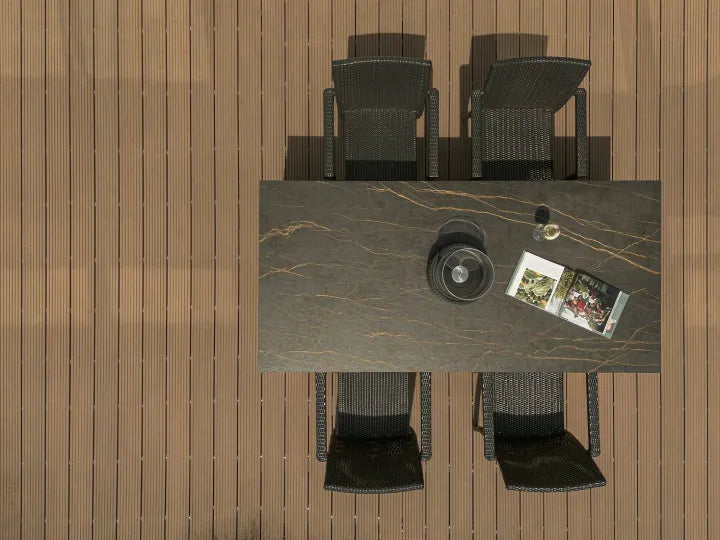


Silestone is a strong starting point for an indoor kitchen when you want a manufactured surface without a sealing routine. Granite is the stronger starting point when the character of a particular natural slab matters most. Neither choice removes the need for hot-pan protection. Compare the actual finish, care requirements and complete installed quote before deciding.
What Is the Difference Between Silestone and Granite?
Silestone is a Cosentino brand; granite is a natural stone category. You are therefore comparing a named manufacturer's range with stones supplied from many quarries, each with its own appearance and properties.
Older comparisons often describe Silestone using one fixed quartz percentage. Cosentino's current Silestone range uses low-silica mineral formulations and recycled materials, with formulation labels that vary across the range. For a new purchase, use the selected colour's current documentation. An older countertop may belong to a different product generation.
Granite is cut from natural stone blocks. Some slabs receive factory resin treatments to fill small fissures; that treatment does not make the stone an engineered quartz surface. Its natural pattern, absorption and treatment history still need to be considered slab by slab.


Choose the Appearance at Full-Slab Scale
Silestone gives you a named colour and finish to specify across a kitchen. That is useful when coordinating cabinet fronts, flooring and backsplash materials. It does not mean every unit is visually identical: shade, gloss and pattern can vary, and a small sample cannot show the entire composition of a large veined design.
With granite, the slab itself is central to the choice. A sample may show the background colour while missing a large mineral cluster or a change in movement elsewhere. If one island face matters most, select the actual slab and review where that piece will be cut. The same stone name on another supplier's quotation is not enough to establish a visual match.


Look at both candidates beside the cabinet finish under daylight and the kitchen's evening lighting. Include a finished edge in the comparison: the visible side, sink opening and any joined return are part of the result. A busy pattern can make small crumbs less obvious, but that does not mean it is cleaner or more resistant to stains.
| Decision | Silestone | Granite |
|---|---|---|
|
Appearance
|
Named colour and finish; inspect full design. | Choose the actual natural slab. |
 Sealing Sealing
|
No sealing routine. | Need varies with the stone and treatment. |
 Hot cookware Hot cookware
|
Use a trivet. | Use a trivet. |
 Outdoors Outdoors
|
Not recommended by Cosentino. | Confirm stone and installation suitability. |
 Price Price
|
Exact colour and complete installed scope. | Exact slab and complete installed scope. |
Care: Silestone Avoids Sealing, but Granite Varies
For Silestone, start with neutral soap, water and a soft cloth, then rinse and dry. Cosentino advises against adding sealants or water repellents to create shine. Stain resistance still leaves room for dried residue, limescale and marks that require the appropriate cleaning method. Our Silestone cleaner guide covers those separate problems.
Do not assume every granite countertop needs sealing every year. The Natural Stone Institute's sealing guidance explains that many granite countertops do not require sealing, while others benefit from it. Ask the supplier whether the selected stone is treated, whether an impregnator is recommended, and how its need for renewal should be assessed. This is a condition of the chosen slab and its use, rather than a universal calendar rule.

An impregnating sealer reduces absorption; it does not make stone stain-proof. For everyday granite care, blot spills and use a suitable mild cleaner, then rinse and dry. The Natural Stone Institute's care guidance also recommends coasters, cutting boards and trivets. Ask for these care instructions with the quote so you can judge the work involved before paying a deposit.
Also inspect the proposed edge and sink opening. A hard countertop can still chip at an exposed corner; a claim of scratch resistance does not promise immunity to impact. Ask the fabricator how damage would be assessed and repaired, rather than assuming a small chip will disappear invisibly.
Heat and Outdoor Use Can Change the Shortlist
Use a trivet for hot cookware on either material. Silestone's maintenance instructions warn against sudden temperature changes and recommend protection from hot objects. Granite's reputation for heat resistance is not a reason to ignore the care of the stone, treatments and surrounding joints. Neither category provides a universal safe temperature for every installed countertop.
For an outdoor kitchen, Silestone drops out of this comparison: Cosentino does not recommend outdoor use because of UV exposure. Granite can remain a candidate, provided the supplier confirms the particular stone, finish and installation for the local exposure. A covered patio still needs that discussion; a roof alone does not establish outdoor suitability.
Inside, check the instructions for countertop ovens and other appliances that release heat through their base. Plan the protective surface and clearances with the appliance and countertop suppliers before the kitchen is finished.
Compare the Installed Cost, Including Missing Work
There is no reliable rule that Silestone always costs more than granite. Colour selection, slab yield, edge work, cutouts, access and local installation charges can outweigh the category difference.
For US retail context, Home Depot's countertop installation cost guide lists granite at $43–$140 per square foot and quartz at $59–$130. The quartz range covers a category, not a Silestone-specific offer. The overlap is useful; treating either endpoint as your project's quote is not. Obtain a current price for the exact Silestone colour and granite slab you are comparing.
Suppose two quotations cover the same 40-square-foot layout. In this hypothetical example, the granite quote is $85 per square foot, including fabrication and installation, but excludes $350 for removal and $250 for a sink cutout. The Silestone quote is $95 per square foot and includes those two items. Both quotes otherwise cover the same work.
Granite: 40 × $85 + $350 + $250 = $4,000
Silestone: 40 × $95 = $3,800
The higher unit price produces a total that is $200 lower once the missing work is included.
This result comes from the quoted scope, not an inherent price advantage for Silestone. If both suppliers included the same extras in their unit rates, the comparison would change. Put the same plan, edge profile, sink model, backsplash extent and installation address in both requests. Have each supplier identify removal, plumbing reconnection, supports, delivery, tax and any work excluded from its total.
Confirm how seams will be placed and how the pattern will meet across them. A lower quote that assumes a different layout may buy a visibly different kitchen. Resolve that difference before using the totals to choose a supplier.
Make the Final Choice with the Supplier and Warranty in View
Choose Silestone when a particular manufactured design fits the room, indoor use suits the project, and avoiding a sealing routine is valuable to you. Choose granite when you prefer the actual natural slab and are comfortable with its confirmed care requirements. If both pass those tests, the finished sample, proposed seams and complete installation offer usually provide a more useful decision than a generic durability score.
Keep the material warranty separate from installation responsibility. Cosentino's June 2026 warranty terms provide 25 years for qualifying residential Silestone manufacturing defects, with registration within six months of purchase. For a countertop fabricated by another company, covered slab replacement excludes fabrication, removal and reinstallation costs. Confirm who addresses an installation defect and retain the purchase and registration records.
For granite, ask the selling fabricator for its written material and workmanship terms. A stone category has no single brand-wide warranty. Compare the practical remedy and responsible business, as well as the duration on the page.
If neither surface meets your priorities, the broader countertop material comparison adds other options. Buyers considering sintered stone can then review Funtek's countertop supply options, including samples and discussion of drawings, cut-to-size pieces and export packing.

Considering a Sintered Stone Countertop?
Share your preferred finish, countertop plan and project location. Funtek can help you review sintered stone samples, piece requirements and supply scope.