


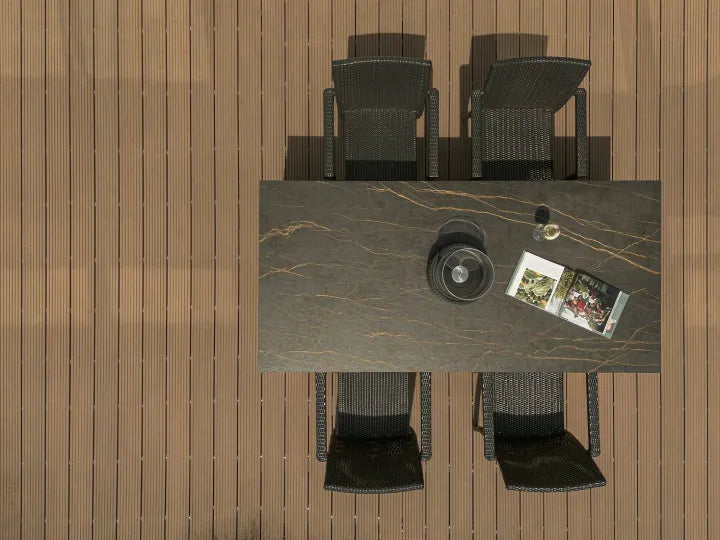


No—if you are identifying the exact product by Caesarstone’s current classification, 513 Striata is a porcelain surface. Caesarstone’s official US, Canadian and UK product pages label it Porcelain, while the German page uses the local term Keramik. Some retailers place porcelain, ceramic and sintered stone under one broad compact-surface category, which explains the mixed wording in search results. For a specification or quotation, use “Caesarstone 513 Striata Porcelain” and attach the official product page for your market.
The Practical Answer
Do not approve it from the words “sintered stone,” “ceramic,” or “engineered stone” alone. Confirm the manufacturer, product code, regional slab size, thickness, finish, application and current availability. The United States and United Kingdom pages already show why this matters: they list different size and thickness combinations for the same design.
What Material Is Caesarstone 513 Striata?
Caesarstone identifies 513 Striata as Porcelain in its current US technical details. The design belongs to the Supernatural Ultra collection and has a smoky grey, weathered-rock direction with dark veins, chalky white streaks and burnt-orange mineral markings. Its specified finish is Ultra Rough.
The official UK product page reaches the same material conclusion. Caesarstone Germany calls it Keramik, the local ceramic-category wording. Those regional labels are more reliable for procurement than a distributor category or a search snippet because they connect the model code to a current manufacturer specification.

Use the product identity in this order: manufacturer → model code → regional technical page → material → finish → size and thickness. A broad category label should never come first.
Why Do Some Sellers Call Striata Sintered Stone?
Porcelain slab, ceramic slab, sintered stone and ultra-compact surface overlap in showroom language, especially when sellers group large-format, heat-fired mineral panels by application rather than by the manufacturer’s exact taxonomy. In that context, “sintered stone” may describe a broad sales family, not Caesarstone’s official material name for 513 Striata.
This does not mean every seller is describing a different physical product. It means the label is too imprecise for a contract, warranty review, customs document, safety sheet or fabrication handoff. If your team needs the deeper category explanation, read Funtek’s porcelain slab vs sintered stone comparison. That guide owns the generic material question; this article stays with the named Caesarstone design.

Do not confuse a similar product name with the Caesarstone brand. Funtek’s Caesar Silver Travertine is a Funtek grey travertine-look sintered stone; it is not manufactured by Caesarstone and it is not 513 Striata.
The current Caesar Silver Travertine Sintered Stone Slabs page is primarily tagged for wall and floor directions, so the shared word “Caesar” should not be used as evidence of brand, material or countertop equivalence.
513 Striata Sizes, Thicknesses and Applications
The correct Striata specification depends on the sales market. Do not combine dimensions from two regional websites into one universal data sheet.
| Official market page | Material | Finish | Listed thickness | Listed slab size | Application |
|---|---|---|---|---|---|
| United States | Porcelain | Ultra Rough | 6 mm and 12 mm | 124.5 × 61.5 in, ±1% | Indoor and outdoor |
| United Kingdom | Porcelain | Ultra Rough | 12 mm and 20 mm | 1600 × 3200 mm | Indoor and outdoor |
| Germany | Keramik | Ultra Rough | 12 mm | 1600 × 3200 mm | Indoor and outdoor |

Canada’s current technical page also presents the design as porcelain and shows the North American jumbo format. Caesarstone Australia lists Striata within its porcelain range and gives 1600 × 3200 mm as the porcelain surface size. Availability can change independently of website structure, so request the current regional data sheet and stock confirmation before a drawing is released.
A built-up 20, 30 or 40 mm-looking edge does not necessarily mean the base slab has that thickness. Fabricators can create a mitred or laminated edge profile. The quote should separate slab thickness from finished edge thickness and identify who is responsible for the edge sample, support and joint detail.
What the Ultra Rough Finish Changes
Striata is not simply a grey printed face. Its Ultra Rough finish is part of the design identity. A reseller page that calls the finish “matte” may be simplifying the appearance and can understate the tactile difference. Before purchase, compare the official finish name, a physical sample and a full slab or slab image under the project’s actual light.
Caesarstone’s product page gives a straightforward care direction: use warm soapy water for routine cleaning, wipe away spills and splashes, keep the surface dry, and use an approved cleaner for stains. A textured finish should be tested with likely kitchen contaminants before final approval, especially if the project expects a perfectly smooth wiping experience.
Images and small samples also do not reveal the complete pattern. The official product information notes natural-looking variation, and Caesarstone’s design resources show multiple face variants for parts of the porcelain range. Ask which faces or slabs will ship, then map seams, waterfall ends, backsplashes, bookmatching expectations and focal veins before fabrication.

Is 513 Striata Right for Your Project?
Choose the exact Caesarstone product when the brand, official design, regional warranty, sample approval and local Caesarstone fabricator or dealer network are part of the brief. The smoky geological pattern and Ultra Rough texture are the reason to specify it—not merely the word “grey.”
Look for an alternative when one of these conditions leads the decision:
- the exact design is not available in the required market, thickness or lead time;
- the buyer wants a quieter grey stone direction or a much darker volcanic statement;
- the project requires a broader format or thickness matrix across counters, walls and furniture;
- factory-direct supply, batch planning, packing and international logistics matter more than the named brand;
- the client accepts a different design as long as the application and visual brief are met.
Use Funtek’s broader surface material comparison if the decision has expanded beyond one branded porcelain design. If the route is already sintered stone, the sintered stone slab size guide helps turn island and countertop dimensions into a slab-yield plan.
Three Funtek Alternative Directions
These are project alternatives, not Striata copies. They are current Funtek sintered-stone products selected to show three ways a smoky geological brief can change. The correct choice depends on which visual attributes and specifications must remain fixed.
| Current Funtek product | Design direction | Current listed sizes | Current listed thicknesses | Choose it when |
|---|---|---|---|---|
| Rock Grey | Cool grey, mineral movement, restrained low-contrast stone character | 900 × 1800 to 1600 × 3200 mm | 6, 9, 12 and 15 mm | You want a quieter geological surface that is easier to coordinate across larger areas. |
| Italian Volcanic Rock | Charcoal base with copper and burnt-amber geological movement | 900 × 1800 to 1600 × 3200 mm | 6, 9, 12 and 15 mm | The rust and weathered-rock drama matters more than matching Striata’s grey balance. |
| Dior Grey | Warm greige-grey cement direction with subtle cloudy movement | 900 × 1800 to 1600 × 3200 mm | 6, 9, 12 and 15 mm | You prefer a calmer, warmer background for wood, cream and black metal. |
Rock Grey: the Quieter Geological Route
Rock Grey Stone Look Sintered Stone Slab uses a cool-grey field with restrained mineral movement. It does not reproduce Striata’s central dark veins, chalky streaks or burnt-orange marks. That difference can be useful when a designer wants the same grounded stone mood with less visual competition at seams, cutouts and wall junctions.

The stronger rust-and-charcoal route
Italian Volcanic Rock Sintered Stone Slab
This is the more dramatic direction. Its charcoal-black field, copper and burnt-amber mineral textures echo weathered geology, but the composition is darker, more directional and bookmatched. It belongs on a shortlist for feature islands, bar faces and walls when the client wants a statement rather than a close visual substitute.
- Five current formats up to 1600 × 3200 mm
- 6, 9, 12 and 15 mm options currently listed
- Actual sample, face set, finish and batch require approval
Dior Grey: the Softer Greige Route
Dior Grey Cement Look Sintered Stone Slab moves away from fossil-like veining toward a warm, cloudy cement surface. It is the practical design pivot for projects that like Striata’s earthiness but find the pattern too active or the Ultra Rough identity too dominant.
All three current product pages list five slab formats—900 × 1800, 900 × 2600, 1200 × 2400, 1200 × 2600 and 1600 × 3200 mm—with 6, 9, 12 and 15 mm options. Treat those as a current product-page matrix, not an automatic promise that every combination, finish and batch is ready for immediate shipment. Confirm the exact SKU, finish, face set, quantity and schedule in writing.
Compare the Exact Product, Not the Category Name
An alternative should be evaluated at three levels:
- Visual fit: background undertone, contrast, vein direction, rust or white accents, finish, face count and full-slab scale.
- Specification fit: material label, exact size, usable size, thickness, application, edge and cutout rules, support, cleaning and current technical documents.
- Supply fit: market stock, batch, sample, slab allocation, packing, freight, fabricator capability, remake responsibility and lead time.
A surface can win the visual comparison and fail the slab-yield plan. Another can meet the size requirement but require a finish the client does not accept. Use the same drawings and inclusions for every quote, then compare the finished system rather than the slab price alone.
Send This Six-Field Brief Before Requesting Samples or Quotes
- Market and destination: country, city and required delivery date.
- Exact identity: Caesarstone 513 Striata or the named alternative product and SKU.
- Application: countertop, island, backsplash, wall, furniture, floor or exterior element.
- Dimensions: drawings, finished pieces, slab size, usable size, thickness and edge build-up.
- Visual approval: finish, physical sample, full-slab or face images, batch and seam/vein plan.
- Responsibility: fabrication, cutouts, reinforcement, packing, freight, installation, breakage and remake.
If your project needs factory-direct coordination, Funtek’s factory-direct sourcing process explains the sample, specification, inspection, packing and shipment checkpoints. Buyers who are still choosing the application route can review current sintered stone countertop options.
The Bottom Line
Caesarstone 513 Striata is officially presented as a porcelain surface. Calling it sintered stone may be understandable showroom shorthand, but it is not the safest product identity for a specification. Use the exact model and your regional Caesarstone page, because the US, UK and European dimensions and thicknesses are not identical.
Choose the branded product when its exact pattern, finish and manufacturer system are required. Choose an alternative only after deciding what can change: brand, material label, pattern intensity, finish, slab format, thickness, supply route or budget. Then approve the physical sample, full-slab appearance, current documents and equal-scope quote.
Need a Project Alternative to the Striata Design Direction?
Send the application, drawings, quantity, preferred grey/rust direction, finish, thickness, destination and schedule. Funtek can check current sintered-stone samples, face images, slab formats, batch planning, packing and factory-direct quotation scope.