


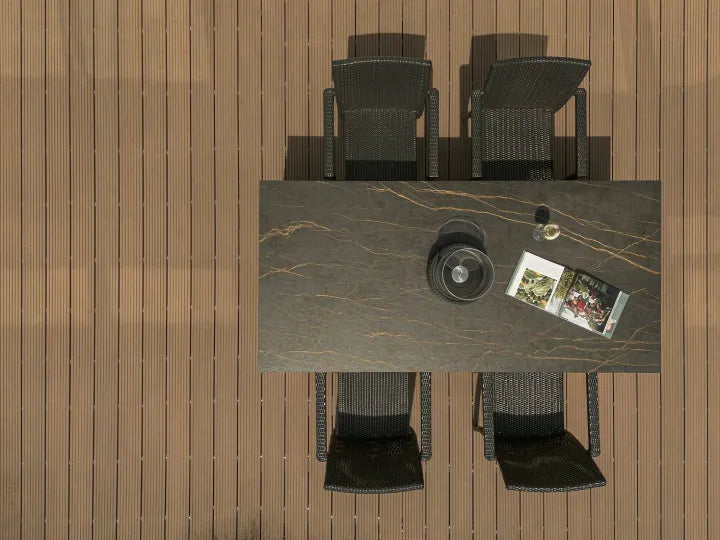


Porcelain slab and sintered stone are not always two cleanly separated material families. The names can overlap, manufacturers use different terminology, and two products with different labels may be technically closer than two products sold under the same label. When I help a buyer compare them, I do not begin with “Which category is better?” I begin with a simpler question: What does each exact slab allow us to do safely?
My short answer is this: choose the product with the clearer evidence package, the right thickness and support system, a fabricator who has handled that exact material, and an installed appearance you have actually approved. The category name is useful for discovery. It is not a purchase specification.
Why “Porcelain Slab vs Sintered Stone” Is Harder Than It Sounds
A common exchange in my inbox goes like this: one supplier quotes a “large-format porcelain slab,” another quotes “sintered stone,” and the buyer assumes the second must be a newer or stronger material. Sometimes it is a meaningfully different product. Sometimes the two slabs use closely related mineral ingredients, pressing and high-temperature firing routes. The label alone does not settle the question.
There are at least three reasons for the confusion. First, terminology changes by manufacturer and market. Second, “sintering” describes a production process, while “porcelain tile” is also connected to formal ceramic-tile classifications and test methods. Third, branded categories such as ultracompact surfaces may use their own formulation, technology and technical language.
ISO 13006 classifies and marks ceramic tiles and points to ISO 10545 test methods. Separately, the European EAD 090142-00-0404 covers a defined scope of full-bodied sintered-stone slabs for specified construction uses. These documents are useful, but I would not use either one as a universal dictionary for every slab advertised online. The correct move is to ask which standard, assessment or test method applies to the named product.
| Question | Porcelain slab | Sintered stone | What I verify |
|---|---|---|---|
| Is it a precise universal label? | Often connected to ceramic-tile terminology, but “slab” products still vary widely. | Used for several engineered mineral-surface products; definitions can vary by brand and market. | Named product, manufacturer and applicable documentation. |
| Can it be used for countertops? | Many products can, when approved, fabricated and supported correctly. | Many products can, when approved, fabricated and supported correctly. | Countertop approval, thickness, cutout rules, edge and support. |
| Is one always stronger? | No responsible category-level answer covers every product, thickness and installation condition. | Relevant test data plus the real installed system. | |
| Is one always more expensive? | No. Brand, size, finish, yield, freight, fabrication and breakage risk change the final number. | Total installed cost, not price per slab alone. | |
My Rule: Compare Two Product Files, Not Two Marketing Labels
Before I give a recommendation, I want what I call a seven-file evidence pack. A supplier who cannot produce it is asking the buyer to make a technical decision from a color name and a showroom sample.
- Product datasheet: exact dimensions, thickness, finish, weight and declared properties.
- Applicable standards and test reports: with test methods, values and the product identification—not only a logo sheet.
- Fabrication manual: blade and cutting guidance, hole and cutout geometry, minimum radii, edge details and handling rules.
- Installation or support manual: substrate, adhesive or frame requirements, overhang limits and movement-joint guidance.
- Warranty and exclusions: especially fabrication, thermal shock, impact, outdoor use and commercial applications.
- Current slab and batch evidence: full-slab photos, labels, shade or batch identifiers and finish confirmation.
- Real edge sample: an unfinished edge, polished edge or mitered build-up that shows what the finished project will actually look like.
This approach also prevents a subtle procurement mistake: approving a small face sample while never approving the body color, edge build-up or full-slab pattern. On a waterfall island, those three details may be more visible than the center of the slab.

What Actually Changes the Result
1. The body and the edge—not just the printed face
Ask to see the top, the raw side and the finished edge together. Some surfaces have a decorated face that does not continue through the body. That is not automatically a defect; it simply affects edge design. A mitered apron can create the appearance of a thick slab, but the fabricator must align the pattern and manage the joint. A simple exposed edge makes body color and edge finishing more important.
2. Thickness only makes sense with support
A thin slab bonded to a suitable substrate is a different system from a thicker self-supporting-looking top. I never approve “9 mm,” “12 mm” or “20 mm” in isolation. I want to know the cabinet condition, span, overhang, sink weight, cooktop cutout, seam positions and access route. If you are selecting a kitchen surface, our separate countertop thickness article explains why nominal thickness cannot replace a support plan.
3. Fabrication risk concentrates around openings and edges
The center of a slab rarely worries me. Sink corners, cooktop openings, faucet holes, narrow strips, inside corners and site handling do. A technically excellent surface can fail because the opening geometry, cutting sequence, support or transport was wrong. “Scratch resistant” and “heat resistant” do not mean “immune to edge impact” or “safe with any unsupported cutout.”
Before awarding the job, I ask whether the fabricator has cut the exact brand and thickness, whether they will make a test cut, how they handle internal corners and whether sink and appliance supports are independent of the slab where required. This is why I regard fabrication compatibility as part of the material—not a service to think about later.
4. Finish changes daily ownership
A polished, matte and deeply textured surface can behave differently under fingerprints, greasy light, hard-water residue and cleaning. I prefer to test the actual sample with the mess the client really has: cooking oil, coffee, marker, soap residue or outdoor dust. Then I clean it according to the manufacturer’s instructions and inspect it under side lighting. A five-minute sample test tells me more about daily satisfaction than a generic “easy to clean” claim.
Which One Would I Choose for Each Application?
| Application | My starting point | What can change my decision |
|---|---|---|
| Kitchen countertop or island | Choose the exact product with countertop approval, a clear fabrication manual and a qualified local fabricator. | Cutout density, sink support, edge design, overhang, slab yield and access. |
| Bathroom or interior wall | A thinner approved large-format panel can reduce weight and joints. | Substrate flatness, wet-area system, fixing method, handling and replacement access. |
| Floor | Use a product specifically classified and specified for flooring. | Slip resistance, traffic, substrate, lippage control, thickness and installation system. |
| Furniture or cabinet facing | Prioritize weight, bond system, edge detail and repeatable fabrication. | Door hardware, panel movement, transport, corner impact and repair strategy. |
| Exterior facade or outdoor kitchen | Require explicit exterior approval and a designed fixing/support system. | Wind load, thermal movement, UV exposure, climate, fire requirements and local code. |
If the question is simply “Which is better for a kitchen?”, I would choose the lower-risk complete system, not the more impressive category name. For more application context, see our sintered-stone countertop guide and countertop application page.
Three Real Slabs to Use as an Inspection Exercise
The products below are Funtek sintered-stone examples, not proof that every sintered product outperforms porcelain. Open each product and look beyond the color: inspect the face pattern, format, thickness options, edge expectation and intended application. That is the same product-level discipline I recommend when comparing any two quotes.
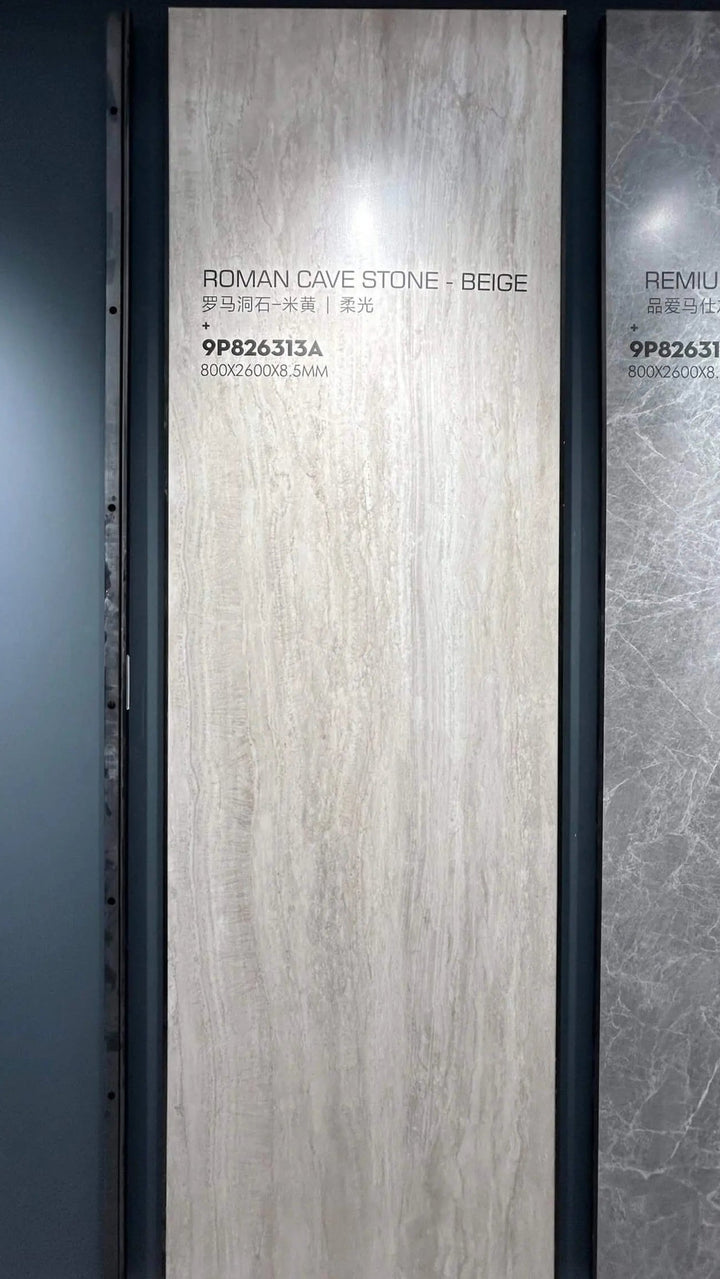
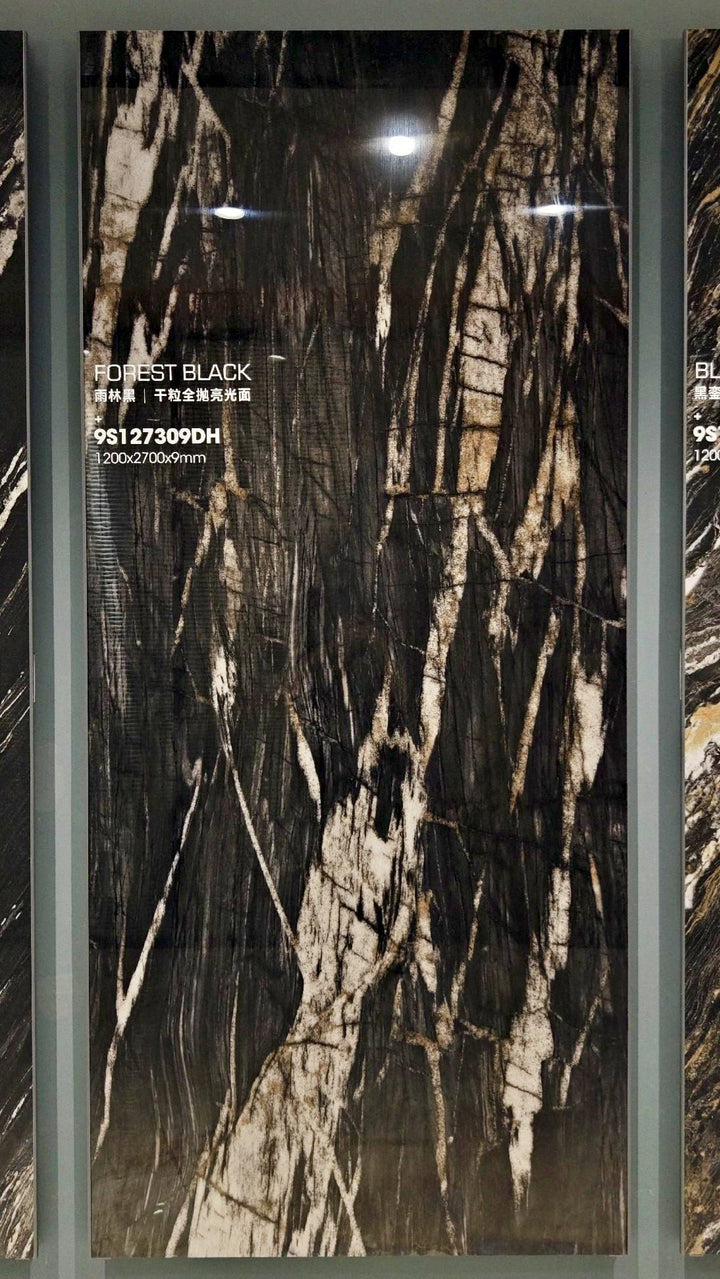
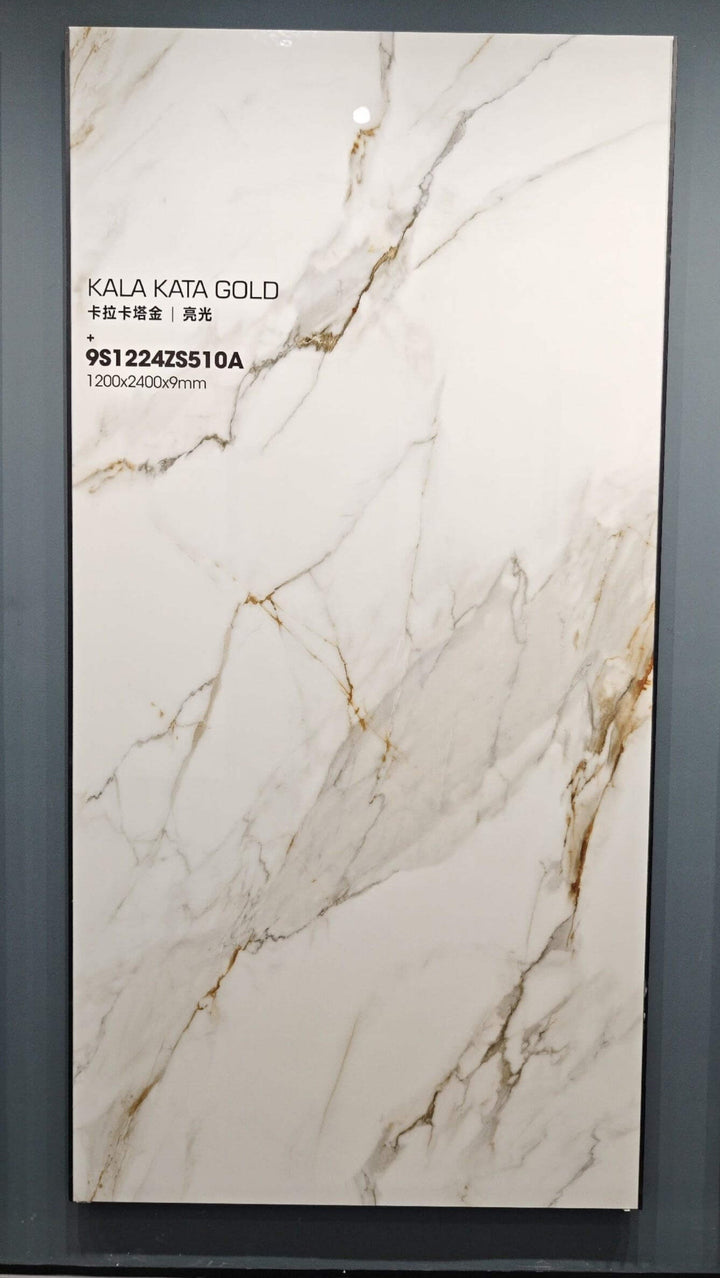
On mobile, each image and product name remains a single clickable card leading to the corresponding product page.
The Installed-Cost Question Buyers Usually Ask Too Late
Price per square metre is useful for an early screen, but it is not the project price. I calculate slab yield first: how many full slabs are required after pattern direction, seams, defects, cutouts and breakage allowance? Then I add edge build-up, reinforcement or substrate, fabrication difficulty, crating, freight, site access and installation.
A cheaper slab can become the expensive choice if its dimensions create poor yield or the local fabricator adds a risk premium. A more expensive slab can be economical if one slab completes the layout with fewer seams. Ask both suppliers to quote against the same drawing, quantity, destination and scope. Otherwise you are comparing two different projects.
What I Check Before the Shipment Leaves
For B2B or project orders, material selection is only half the work. I want the order documents and physical cargo to tell the same story.

- Product code, finish, nominal and actual size, thickness, quantity and batch or shade identifier.
- Full-slab and label photos for the production batch—not only the original showroom sample.
- Flatness, surface and edge inspection under agreed acceptance criteria.
- Crate or A-frame method, protective separation, loading plan and package count.
- Damage-recording procedure before unloading and before signing the delivery record.
- A retained reference sample if future color or batch questions are likely.
This is also where the distinction between porcelain and sintered stone often becomes less important than supplier discipline. A correctly specified material in a poorly documented shipment is still a procurement risk.
Five Claims That Make Me Slow Down
- “Sintered stone is always stronger than porcelain.” Ask: which test, product, thickness and loading condition?
- “This slab is completely unbreakable.” No large brittle panel should be handled as if edges and cutouts cannot be damaged.
- “Any fabricator can cut it.” Ask for relevant experience, equipment and a fabrication plan.
- “It works everywhere.” Countertop, floor, wall and facade approvals are not interchangeable.
- “It is the same as a famous brand.” Similar appearance or a shared category does not establish identical formulation, tests, warranty or fabrication behavior.
Answers to the Questions Buyers Actually Ask
Are porcelain slab and sintered stone the same?
Not as a universal rule. The terms can overlap in materials and manufacturing concepts, but brands use them differently. Compare the exact product documentation instead of assuming either complete sameness or complete separation.
Which is stronger?
There is no reliable category-wide winner. Strength in the project depends on the exact product, thickness, geometry, support, fabrication and installation. Ask for relevant test values and then evaluate the installed system.
Is Dekton porcelain or sintered stone?
Dekton is marketed by Cosentino as an ultracompact surface made with its proprietary particle-sintering technology. I would use the manufacturer’s own technical documentation and application manuals rather than forcing every branded product into a casual two-word category.
Can both be used for kitchen countertops?
Many products in both groups can be used for countertops, but only when the named product is approved and the thickness, support, openings, edge, fabrication and installation are correctly planned.
Which costs more?
Neither label guarantees the higher price. Brand, finish, slab dimensions, freight, local availability, slab yield and fabrication risk usually decide the installed difference.
My Final Decision
I would not reject a strong porcelain slab because another quote uses the words “sintered stone,” and I would not approve a sintered-stone slab because the name sounds more advanced. I choose the product that can prove its suitability, arrive consistently, be fabricated locally and produce the approved edge and layout with the lowest total project risk.
If you are still learning the categories, start with what sintered stone is and what a porcelain slab is. If you already have two quotations, remove the supplier names and compare their evidence packs line by line. The gaps become obvious very quickly.
Comparing Two Slab Specifications?
Send us the application, drawings, required size and thickness, edge direction, quantity, destination and the two technical sheets. We can help identify the questions your supplier and fabricator should answer before you approve the material.
Request a Product-Level ComparisonTechnical References
Primary references used for the terminology and verification approach: ISO 13006:2018, Ceramic tiles—Definitions, classification, characteristics and marking; ISO 10545-3, water absorption and porosity test method; EOTA EAD 090142-00-0404 for full-bodied sintered-stone slabs within its stated scope. Product selection must still follow the named manufacturer’s current technical and installation documents.