


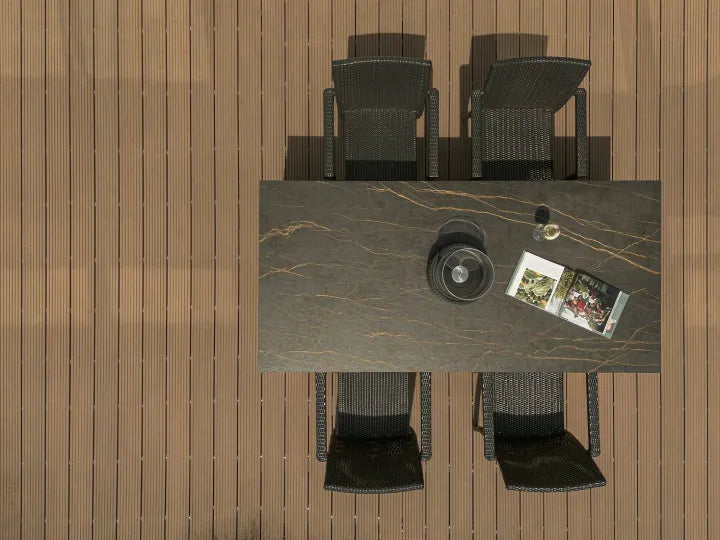


Sintered stone can be used around swimming pools. It is a practical material route for pool surrounds, coping, steps and selected adjacent outdoor surfaces, with large-format continuity and fabricated-edge options among its strongest design advantages. The specification task is not to debate whether the category can work; it is to select the correct exterior finish, thickness and installation system for the real pool zone.
Can sintered stone be used around a swimming pool?
Yes. Sintered stone is a proven material route for pool surrounds and coping. Use an exterior surface with suitable wet/barefoot slip evidence, confirm UV and climate requirements, select the structural thickness and support for the installation route, and approve coping fabrication on a full-size sample.
Not every finish serves the same zone: a polished slab may suit a sheltered wall while a repeatedly wet walking surface needs a verified exterior texture. Use the pool material Pillar only when the project is still comparing travertine, porcelain, concrete and other routes.
Why the Answer Is Yes
Named sintered-stone manufacturers already document the application at product level. Lapitec's current pool and spa guidance shows paving, pool edges, steps and even selected immersed uses for its own surfaces, with multiple edge profiles and textured finishes. Specialist fabricators and suppliers also offer bullnose, L-shaped and custom pool edging in sintered materials. This is established application evidence—not a speculative use.
The product-level distinction still matters because a category includes polished, satin and structured surfaces, several thicknesses and different fixing routes. Funtek can match a pool brief against current slab options and available documents; the local designer and installer then approve the selected finish and assembly for the jurisdiction.
The conclusion is clear—sintered stone can be used around a pool. The remaining question is which finish and system suit each wet, structural and climate zone.
Fast Decision: When Sintered Stone Is the Right Choice
Choose sintered stone for the pool surround and coping when you want a premium large-format stone look, low face absorption, repeatable design and fabricated edge continuity. It is especially compelling for villas, hotels and spas that connect interior floors, terraces, walls and the water edge in one visual language.
Start with a light structured exterior finish for exposed barefoot traffic. Use darker polished or satin directions on shaded walls and accents, not as the default wet walking surface. For coping, issue the profile and support detail before pricing so the quote includes the real fabricated package.
| Documented thickness | Practical starting conversation | Important limit |
|---|---|---|
| 12 mm | Fully supported or manufacturer-approved cladding/lining routes | Do not treat a thin slab as a dry-laid paver without approval. |
| 20 mm | Exterior paving or supported surround systems where the manufacturer permits | Support, span, traffic and edge conditions still govern. |
| 30 mm | Heavier paving or fabricated coping/surround routes in documented systems | Greater thickness does not replace drainage, joints or safe handling. |
These are not invented universal sizes: Lapitec publishes 12, 20 and 30 mm slabs in its technical data sheet. Its Ca’ Miane pool case used 12 mm Satin material at the pool base and 30 mm Vesuvio material at the surround, showing how one named manufacturer assigned different thicknesses and finishes by zone. Use that as a documented market example—not as automatic approval for another brand or installation.
Approve Seven Product-Level Checks
| Check | Evidence or decision required | Why it matters |
|---|---|---|
| Exact identity | Manufacturer, SKU, batch, thickness and finish | Category names can hide different constructions |
| Wet grip | Relevant wet/barefoot report for the supplied finish | Polished and structured surfaces behave differently |
| Exterior exposure | Written exterior/UV suitability and appearance limits | Outdoor use is not inferred from indoor samples |
| Climate | Required absorption and freeze-thaw evidence | Water, edges and thermal cycling act together |
| Pool chemistry | Named chemical/cleaning guidance | Face, grout, sealants, adhesives and metals are exposed |
| Structural route | Thickness, format, support and load approval | Dry-laid, pedestal and bonded systems differ |
| Coping | Full-size fabricated edge and joint mock-up | Returns, miters and curves control comfort and durability |
Separate the Pool Into Application Zones
“Around a pool” is not one technical condition. Divide the drawings before selecting the surface:
- Deck or surround: repeatedly wet pedestrian surface where slip evidence, drainage and barefoot temperature lead.
- Coping: exposed edge where grip, sitting comfort, profile, support and movement lead.
- Steps and ramps: higher-risk transitions that may need a more demanding texture or classification.
- Walls and feature panels: exterior exposure and fixing dominate; the walking-surface slip requirement may not apply.
- Submerged or waterline areas: waterproofing, adhesive, chemical exposure and manufacturer approval form a separate system.
A finish appropriate for a vertical feature wall should not be copied automatically onto a barefoot ramp, and a deck product should not be assumed suitable underwater. A coordinated collection can still create one visual language while using different finishes and construction details by zone.
Finish Is the First Safety Decision
Do not describe sintered stone as “non-slip” without naming the surface. A polished slab is not automatically suitable beside water; a structured finish still needs evidence and a cleaning plan. Use the anti-slip pool surface specification guide to match R, barefoot, PTV or local evidence to the use zone.

Barefoot Heat Depends on Color and Exposure
Heat resistance means the material tolerates temperature; it does not mean the sunlit surface stays comfortable. Start with light beige, off-white or light grey samples for exposed walking areas, then test them beside alternatives in the real site sun. Dark dramatic slabs may be better suited to shaded walls or design accents than a large barefoot deck.
Large Format Helps Visual Continuity, Not Drainage
Large pieces can reduce visual fragmentation and connect a lobby, spa, terrace and pool surround. They also require a flat substrate, coordinated falls, drains, movement joints, safe handling and a layout that avoids weak cuts. Fewer grout lines do not remove the need to drain the surface or accommodate movement.
Plan the Layout From Drains and Edges, Not From the Center
A large-format pool surround is governed by fixed interruptions: pool geometry, coping rhythm, channel drains, gullies, thresholds, columns, cover tracks and movement joints. Start the slab map from these conditions. A centered decorative layout can create thin slivers at a drain or unsupported notches at a curve, while a technically led module can preserve stronger pieces and more consistent joints.
Before fabrication, issue a numbered cutting plan showing piece dimensions, face orientation, pattern direction, drain cuts, miters, replacements and packing sequence. Confirm the minimum practical width around penetrations and the permitted site-trimming scope. Large slabs reduce visible joints only when the geometry, handling route and substrate flatness support the intended module.
Pool Coping Requires Fabrication Approval
Sintered coping may use eased edges, bullnose pieces where available, mitered returns or drop faces. Check visible body, vein/pattern relationship, edge comfort, joint locations, underside support and water direction. Compare it with porcelain, stone and concrete routes in the pool coping materials guide.
Fabricated Coping Needs Its Own Shop Drawing
For a mitered or drop-edge detail, show the top width, return depth, overhang, joint, adhesive line, edge radius, support and visible underside. Veined or directional designs need a declared pattern rule at the return: continuous visual flow, deliberate bookmatch or a controlled non-matching joint. Curves may require segmented pieces, CNC fabrication or a different standard component.
Ask the fabricator to produce a full-size corner and a representative straight piece. Wet the top, grip and sit against the edge, view the miter in sun and inspect the body at cutouts. The mock-up should also test packing and handling because a long fabricated return can be more vulnerable before it is fully supported than after installation.
Thickness Is a System Decision
There is no universal pool thickness. A fully supported bonded assembly, pedestal system, dry-laid paver and fabricated coping return impose different loads and edge conditions. Obtain the manufacturer's approved use and have the responsible designer and installer confirm the substrate, support, fixing, joints and movement strategy. Funtek's installation workflow helps organize the handoff but does not replace the pool-system design.
What the Installation Submittal Should Show
The pool package should contain more than a slab data sheet. Require coordinated drawings and documents for the substrate, waterproofing boundary where relevant, adhesive or pedestal/support system, back-buttering or coverage requirement, movement joints, drainage falls, coping support, sealants, grout, penetrations, protection and curing before service.
LATICRETE's technical manual for tiled swimming pools, fountains and spas explains that thermal, moisture and differential movement remain active in pool structures and that designed joints must continue through the finish. The final system must follow the responsible manufacturer's and local professional's details, but the manual is a useful check against proposals that treat the slab as an isolated layer.
Chlorine and Saltwater Are System Questions
Sintered surfaces are often selected for low absorption and chemical resistance, and named pool products publish chlorine and water-treatment claims. Still, splash and evaporation concentrate residues at joints and edges. Ask for compatibility across the face, grout, setting material, sealant, waterproofing interface, drain and any metal trim. Saltwater pools also require attention to corrosion and efflorescence outside the slab itself.
The cleaning plan should name permitted chemicals, dilution and contact time, plus how deposits are rinsed from textured surfaces. A powerful cleaner may be unnecessary for the slab yet harmful to grout or sealant. A complete approval protects the visual system as well as the material face.
Compare Sintered Stone With the Closest Alternative
If the design is a travertine look, compare the actual sintered sample against natural travertine and exterior porcelain, not against a generic “stone” idea. The porcelain versus travertine pool comparison clarifies the maintenance, heat, variation and coping tradeoffs that remain relevant.
What Funtek Can Confirm Before Sampling
Pool suitability should be confirmed at SKU and finish level. Funtek can match the project brief against current slab options, surface finishes, thicknesses and available test documentation before sampling and quotation. Final approval should be based on the exact product, project requirements and local installation system.
Send the pool area, coping perimeter, destination, water-treatment type, climate, expected traffic, design direction, installation route and required test standard. Mark which pieces are deck, coping, steps, walls or submerged; do not group every zone as “pool tile.”
The Bottom Line
Yes, sintered stone can be used around swimming pools. It is well suited to pool surrounds and fabricated coping when the project wants low-absorption, large-format visual continuity and controlled stone-look design. Select the exterior finish for the wet zone, test barefoot comfort in the real climate, engineer the thickness and support, and approve the coping and joint details before fabrication.
The application conclusion is affirmative; product matching is the next step. Funtek can shortlist current sintered-stone options, finishes, thicknesses and available technical documents against the pool plan before sampling and quotation.
Discuss a Sintered Stone Pool Package
Send the pool area, coping perimeter, location, finish direction and required documents. We can help shortlist current slab options for sampling and project-level review.