


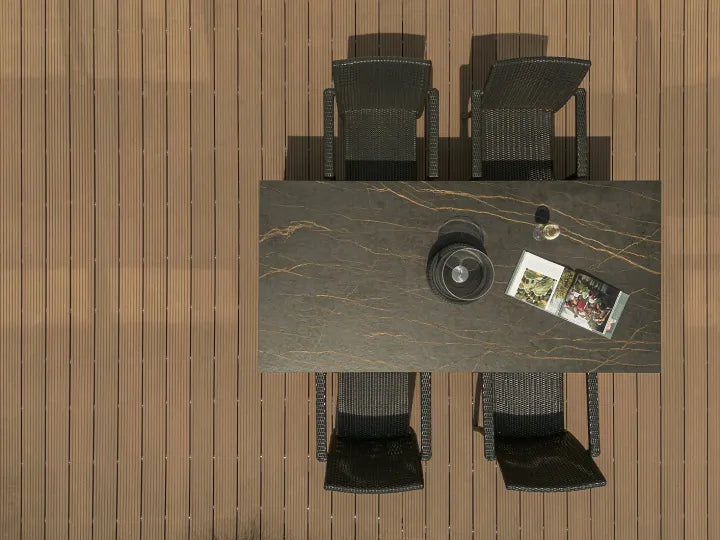


Design Takeaway
Ocean Blue quartzite works best as a room-defining surface: approve the actual slab first, then make the cabinets, backsplash and floor support its blue-grey direction. Current slabs sold under this trade name range from long blue-grey bands to clouded blue, green, white and warm mineral movement, so a web thumbnail or small chip cannot set the final palette.
Use it for an island or a controlled countertop-and-backsplash composition when natural variation is the goal. If repeated faces, tighter visual consistency or future matching matter more, compare a clearly identified blue sintered-stone alternative after defining the colour and movement you want.
What Ocean Blue Quartzite Actually Looks Like
Ocean Blue is a commercial name, not a guarantee that every supplier is selling the same geological source. Better Marble shows a Brazilian 2 cm slab with blue, gunpowder, patina and white tones. Primus lists a Brazilian stone with blue, grey and taupe. Rossittis currently uses the name for a blue-grey banded South African stone that it identifies petrographically as gneiss but says is traded as quartzite. The practical result is simple: the reserved slab and its documents matter more than the label.
Across those listings, the recurring visual signal is cool blue-grey movement with lighter and darker mineral areas. Some slabs read in long directional bands; others are cloudier and contain green, taupe, amber or gold. Directional slabs look architectural on a long island, while clouded slabs create a more painterly field. Neither effect can be judged from one cropped close-up.

Treat “Ocean Blue” as a starting name and approve the allocated slab, origin and material classification before fabrication.
Where the Pattern Works Best in a Kitchen
A large island gives directional movement enough uninterrupted area to read from end to end. If the slab has one strong blue band or a concentrated dark zone, place that feature where it remains visible rather than losing it inside the sink or hob cutout. A waterfall end can continue the movement down the side, but only when the fabricator maps the turn on the actual slab.
Using Ocean Blue on both countertop and full-height backsplash can form one continuous composition. This works when the selected faces connect and the room can carry the pattern. If the island already has strong movement, quiet perimeter counters and a low-contrast backsplash prevent the kitchen from becoming a set of competing focal points.

Cabinet Colors for Ocean Blue Quartzite
Warm white is the most flexible cabinet direction because it keeps the stone bright without adding another strong colour. Natural oak and medium walnut pull forward taupe, amber or gold minerals and can stop a blue-grey slab from feeling cold. Pale greige works when its undertone appears in the slab; a green-grey cabinet can clash when the stone is distinctly blue rather than blue-green.
Navy or charcoal cabinets create a darker, more enveloping room. Use that route only after viewing the slab and cabinet door together under daylight and installed task lighting. The 2026 Houzz and Reddit discussions around blue quartzite repeatedly show why: a slab that looks balanced at the stone yard may turn cooler, dustier or more rust-dominant beside a warm cabinet.
| Cabinet direction | What it does | What to check beside the slab |
|---|---|---|
| Warm white or ivory | Keeps blue-grey movement clear and the room bright | Confirm the white does not turn yellow beside cool mineral bands |
| Natural oak | Repeats taupe or amber areas and adds warmth | Compare the wood’s orange/red cast with any rust or gold in the slab |
| Walnut | Creates deeper contrast and supports a statement island | Check that dark stone zones remain legible under evening light |
| Greige or soft grey | Builds a quieter tonal palette | Match undertone, not the generic colour name |
| Navy or charcoal | Creates a saturated, moody composition | Review room size, daylight and the balance of light surfaces |
Backsplash, Floor and Metal Pairings
When the countertop carries broad movement, a quiet backsplash is usually easier to control than another veined material. Warm-white handmade tile, low-contrast plaster-look porcelain or the same reserved quartzite are three distinct routes: tile adds fine rhythm, a quiet slab-look wall recedes, and same-stone countersplash extends the natural pattern. Select the backsplash after the countertop layout is fixed, because seams and cutouts change which colours remain visible.
Keep the floor one step calmer than the worktop. Pale oak, muted limestone tones and restrained warm-grey concrete looks can support the stone without repeating its veins. Brushed nickel reinforces the cool mineral direction; aged brass or bronze can repeat warm inclusions. Put the metal finish on the same physical sample board so reflected light is part of the decision.

Polished, Honed and Leathered Finishes
Polish deepens blue, green and dark-grey minerals and makes the stone’s internal contrast more visible. It also reflects windows, pendants and under-cabinet lights, so a high-gloss sample should be checked flat and vertical. Honed or other low-sheen finishes reduce mirror reflection and can make a high-movement slab feel softer, while a leathered texture adds shadow and tactile variation.
Finish names are supplier-specific, and not every current Ocean Blue lot is offered in every finish. Compare full-size samples from the selected supplier. The finish changes appearance and cleaning feel, but it does not resolve uncertainty about the stone’s identity, porosity or reaction to household chemicals.

Approve the Exact Slab and Piece Layout
A sample proves only the colour and finish in a small area. The Natural Stone Institute’s stone-selection guidance recommends viewing the actual natural-stone slabs and taking cabinet, paint, backsplash and fixture samples to the yard. For Ocean Blue, request full-face photographs with a scale reference, slab or bundle IDs and close-ups of filled areas, fissures and colour transitions.
Before cutting, the fabricator should place the island, perimeter runs, sink, hob, seams, backsplash pieces and waterfall returns on the slab photographs. Review the direction of every long run, the feature zones removed by cutouts and the way two slabs meet. Current supplier examples range from about 125–128 by 76 inches to 330 by 195 cm, so a room drawing must be reconciled with the reserved slab rather than a catalogue maximum.
- Full-face evidence: one uncropped image of each reserved slab with ID and scale.
- Close-up evidence: finish, filled areas, fissures and mineral changes under side light.
- Piece map: cutouts, seams, edges, waterfalls and backsplash sections marked on the slab.
- Room check: cabinet, floor, backsplash and metal samples photographed beside the stone in project lighting.

What 2 cm and 3 cm Mean for the Project
Current Ocean Blue supplier records include both 2 cm and 3 cm slabs: Better Marble lists 2 cm, Primus lists 3 cm, and Global Stone advertises both. A historical Lowe’s sample lists 1.18 inches, approximately 3 cm. These are market formats, not a complete support specification.
The fabricator must coordinate thickness with cabinet support, spans, sink and hob cutouts, seam locations, edge build-up, waterfall details and local practice. Ask the supplier to state the measured thickness of the reserved slabs and the fabricator to show the support and edge detail on the project drawing. Do not transfer density or strength data from a different supplier’s Ocean Blue listing to the allocated material.
Care Expectations for Natural Quartzite
The Natural Stone Institute care guidance recommends neutral stone cleaner or mild dish soap, prompt blotting of spills and thorough rinsing and drying. It describes impregnating sealers as repellents that increase stain resistance rather than making stone stain-proof. Whether the selected slab needs treatment, and when it should be renewed, depends on that stone, finish, previous treatment and sealer instructions.
Use cutting boards and trivets, and avoid acidic or abrasive cleaners. A newly installed dark area around a wet edge, a stain and a change in surface sheen need different responses. The quartzite countertop care article covers routine care, while the quartzite water-mark guide owns diagnosis of water-like darkening.
Compare Ocean Blue Quartzite Quotes on the Same Scope
Raw supplier listings checked on 4 September 2026 span a wide advertised range. StoneContact examples include US$45–74 per square metre for 1.8–2 cm slabs and US$135–165 per square metre for a 1.8 cm lot; Global Stone lists US$376.92 per square metre for 2 cm, and another current listing reaches US$472 per square metre. Those figures describe different suppliers, lots, grades and trade terms before a common fabrication and installation scope is added.
| Quote field | What must match | Evidence to request |
|---|---|---|
| Allocated material | Slab IDs, origin/classification, grade, finish and measured thickness | Reserved-slab photographs and supplier documents |
| Yield and layout | Finished area, unusable zones, pattern direction, seams and waterfall pieces | Marked slab layout tied to the room drawing |
| Fabrication | Cutouts, edge build-up, polishing, reinforcement and shop treatment | Written inclusions and approved edge/cutout details |
| Delivery and installation | Packing, freight, access, lifting, support, setting and final sealing | Incoterm, destination, site scope and change-order basis |
When a Blue Sintered Stone Alternative Fits
Natural Ocean Blue is the right route when the project values a one-off geological composition and the team can approve each slab and cut. A blue sintered-stone surface can fit repeated rooms, multi-unit projects or future matching when planned faces and listed formats carry more value. It is a manufactured material with its own finish, fabrication and care requirements, not Ocean Blue quartzite.
Funtek’s current catalogue has two relevant but distinct directions. New Sapphire is a polished blue-black full-body slab with navy, charcoal, smoky grey and sapphire mineral flashes; its current product record lists kitchen islands, reception counters, bar counters, feature walls and vanity tops. Smirakin Gold has a pale blue-grey base with amber-gold, copper and dark movement; its listed applications include dining tables, kitchen islands, reception counters, bar tops and feature walls.

New Sapphire Sintered Stone
Choose this darker route for navy, charcoal and bright sapphire mineral movement on a polished surface. The current product record lists one face shown with random matching and size options from 900 × 2700 mm to 1600 × 3200 mm.
View New Sapphire
Smirakin Gold Sintered Stone
Choose this warmer route when pale blue-grey needs amber, copper and dark branching accents. The current product record lists one face shown with random matching and the same five slab-size options.
View Smirakin GoldUse the sintered stone versus quartzite comparison when the project needs a material-level decision. For direct countertop slab discussion, move next to the Funtek countertop surface page with drawings, application, quantity and destination.
Compare the wider exotic stone-look slab options if the project can consider mineral colours beyond the two blue references.
Compare a Repeatable Blue-Stone Direction
Share the Ocean Blue slab character you want, countertop drawings, preferred colour balance, finish, quantity and destination. Funtek can review current blue sintered-stone faces and prepare a focused sample discussion for your fabrication team.