


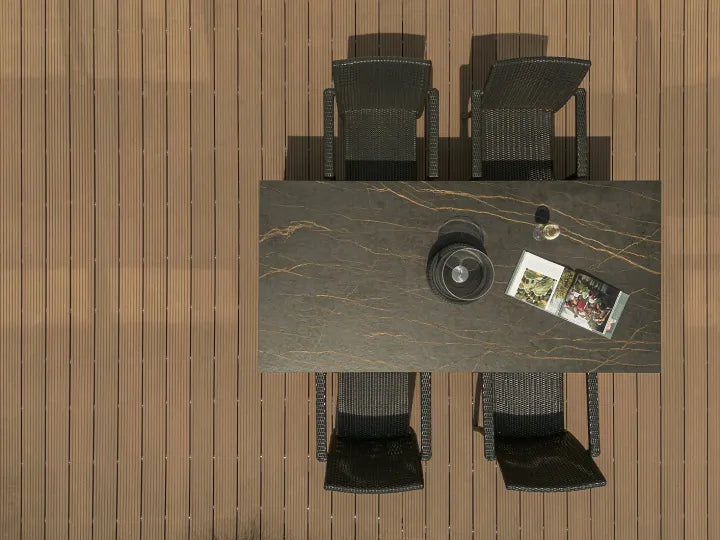


Quick Answer: What Is the Best Outdoor Kitchen Countertop?
For most fully exposed outdoor kitchens, exterior-approved sintered stone or porcelain slab and a well-chosen dense granite are the strongest all-around countertop options. Choose sintered stone or porcelain when low water absorption, UV stability and minimal sealing are priorities. Choose granite when you want natural stone, broad local fabrication availability and a strong balance of cost and durability. Quartzite is a premium natural-stone alternative.
Standard engineered quartz, laminate and most wood countertops are poor choices for full sun and rain unless the exact product is specifically documented and warranted for exterior use. Material still matters, but so do the grill clearances, drainage, support, cutouts, seams and cabinet below it.
Best low maintenance: exterior-approved sintered stone or porcelain slab
Best natural stone value: dense granite suited to the climate
Best premium natural stone: quartzite selected slab by slab
Best custom shape: reinforced, properly sealed cast concrete
Best utility surface: correctly specified stainless steel
Best budget route: an exterior porcelain-tile system with maintainable grout
Outdoor Kitchen Countertop Materials Compared
The table below is a first-pass buying guide, not a substitute for product data. “Excellent” means that suitable products are widely available in that material family. The exact slab, finish, thickness, fabrication manual and warranty still control the project.
| Material | UV | Heat | Water | Freeze-thaw | Maintenance | Typical cost | Best fit |
|---|---|---|---|---|---|---|---|
| Sintered stone | Excellent* | Excellent* | Excellent* | Excellent* | Low; usually no sealer* | $$$ | Fully exposed, low-maintenance projects |
| Porcelain slab | Excellent* | Excellent* | Excellent* | Excellent* | Low; usually no sealer* | $$$ | Modern thin profiles and full exposure |
| Granite | Excellent | Excellent | Good | Good* | Periodic sealer may be needed | $$–$$$ | Natural stone value and local fabrication |
| Quartzite | Excellent | Excellent | Good | Good* | Periodic sealer may be needed | $$$ | Premium natural-stone projects |
| Concrete | Good | Good* | Conditional | Conditional | Sealer and crack monitoring | $$–$$$ | Custom shapes and a cast appearance |
| Stainless steel | Excellent | Excellent | Excellent | Excellent | Low, but shows marks | $$$ | Grill, prep and commercial-style zones |
| Soapstone | Excellent | Excellent | Very good | Good* | Optional oiling; accepts scratches | $$$ | Dark, tactile natural stone |
| Porcelain tile | Good* | Good* | Good* | Conditional | Grout cleaning and repair | $–$$ | Budget-led projects |
*Confirm the exact product, thickness, support method and current exterior-use documentation. Cost key: $ budget, $$ mid-range, $$$ premium.
What Makes a Countertop Suitable for Outdoor Use?
Outdoor suitability is more than “heat resistant.” A fully exposed counter must keep its color in UV, tolerate wetting and drying, resist staining, and work through the local temperature range. In cold climates, absorbed water and repeated freeze-thaw cycles matter. Near pools or the coast, chemical and salt exposure join the brief. Dark surfaces in full sun can also become uncomfortable to touch even when the slab itself remains sound.
The assembly matters just as much as the face. A weather-resistant slab over an indoor particleboard cabinet is not an outdoor system. The support, adhesive, joints, fasteners, cabinet, appliance clearances and drainage route all need to suit exterior service.
For the adjoining patio, the patio tile guide develops floor layout and outdoor finish details separately from the countertop. The covered outdoor kitchen guide develops the cover, layout and surface coordination of the whole outdoor kitchen.

1. Sintered Stone
Best for: fully exposed kitchens, low-maintenance hospitality projects and buyers who want a thin large-format surface. Sintered stone is made from mineral ingredients consolidated under heat and pressure, but products differ by manufacturer. Exterior-approved ranges can offer very low water absorption, UV stability, stain resistance and no routine sealing.
Advantages
- Low routine maintenance
- Large slabs reduce visual interruption
- Stone-, concrete- and marble-look designs
- Useful for coordinated counters, walls and cladding
Watch-outs
- Edges and cutouts need an experienced fabricator
- Impact can chip an exposed edge
- Thin profiles need the specified support
- Outdoor approval is product-specific
Common countertop formats include 12 mm and 20 mm slabs, depending on the collection and structural design. Mitred or built-up edges can create a thicker appearance without turning the entire top into a heavy block. Ask for the exact slab size, thickness, finish, technical sheet, fabrication manual and exterior warranty before release.
2. Porcelain Slabs
Best for: modern outdoor kitchens that need a slim profile, low absorption and a broad range of surface visuals. Porcelain slab and sintered stone are sometimes grouped together in the market, but the names are not a performance specification. Compare the actual test data and fabrication instructions rather than assuming every product with either label behaves the same way.
Advantages
- Suitable exterior products offer strong UV and stain resistance
- Usually does not need sealing
- Available in light colors that stay more comfortable in sun
Watch-outs
- Large thin slabs demand careful transport and handling
- Edge build-ups and seams require precise workmanship
- Not every tile product is approved as a countertop slab
The Cosentino technical-document register is a useful example of the product-level documents a buyer should expect: technical data, countertop design guidance, use and care, and warranty information.
3. Granite
Best for: buyers who want a proven natural stone, good heat resistance and broad fabricator availability. Many dense granites have a long exterior record. The Natural Stone Institute notes granite's durability and exterior use, but granite is a family of stones, not one uniform product.
Advantages
- Natural UV stability and strong heat performance
- Many colors, finishes and price levels
- Widely understood by stone fabricators
Watch-outs
- Some stones are more absorptive or resin-treated than others
- Sealing needs vary
- Dark slabs can become very hot in direct sun
Inspect the exact slab for resin, fissures, fill and color movement. Ask how the chosen finish weathers, whether a sealer is recommended, and whether the stone has a suitable history in the local freeze, salt or pool environment.
4. Quartzite
Best for: premium natural-stone projects that want strong pattern and a harder surface than marble. True quartzite can be a strong outdoor candidate, but trade names are unreliable: some stones sold as quartzite behave more like marble or dolomitic stone.
Advantages
- Natural UV stability
- Strong heat performance
- Distinctive veining and depth
Watch-outs
- Usually a premium material and fabrication tier
- Porosity and sealing vary by stone
- Identity should be confirmed before relying on the category name
Approve the actual slab, finish and treatment. If water darkening, sealer care or stain diagnosis is part of the decision, see our quartzite countertop care guide.
5. Concrete
Best for: custom shapes, integrated drainboards and projects that accept genuine cast character. Concrete is not automatically a cheap option: molds, reinforcement, finishing and an exterior sealer can make a custom counter labor-intensive.
Advantages
- Highly customizable geometry, color and texture
- Can be cast around unique layouts
- Fits contemporary and landscape-led designs
Watch-outs
- Hairlines, pinholes and tonal change may remain visible
- Sealer maintenance is part of ownership
- Freeze-thaw, standing water and movement need deliberate design
Concrete performance depends on the mix, reinforcement, curing, joints, support and sealer working together. For that full system, use our outdoor concrete countertop guide.
6. Stainless Steel
Best for: high-use grill and prep zones, commercial aesthetics and projects that value cleanability over a pristine appearance. Stainless steel does not need sealing and is unaffected by freeze-thaw, but the grade, gauge, backing and seam construction matter.
Advantages
- Non-absorptive and easy to clean
- Excellent around heat when appliance details are correct
- Can integrate sinks and upstands
Watch-outs
- Shows scratches, fingerprints and water spots
- Can become hot in full sun
- Coastal and pool projects need grade-specific corrosion review
7. Soapstone
Best for: buyers who like a dark, soft-touch natural surface and are comfortable with patina. Soapstone is nonporous, UV-stable and heat tolerant, so it avoids some of the sealing questions associated with other natural stones.
Its softness is the trade-off. Edges can bruise and the top will scratch, although many marks can be blended or left as part of the surface character. Mineral oil is optional and mainly changes the color; it is not a weatherproofing treatment. Confirm slab quality, thickness, support and local availability because soapstone supply and fabrication experience vary by market.
8. Tile
Best for: budget-led counters, small projects and designs that intentionally use a tiled surface. Exterior-rated porcelain tile can handle sun and water well, but the countertop is only as reliable as the substrate, waterproofing, edge, grout and movement joints.
Tile creates more joints to clean. Grease and food residue collect at grout lines, and freeze-thaw damage often starts in the assembly rather than the tile face. Use an exterior system, keep water out of the substrate and plan how chipped tile or failed grout will be repaired later.
Materials to Avoid for Fully Exposed Outdoor Countertops
Standard Engineered Quartz
Most indoor engineered quartz contains resin and pigments that may change under UV. Heat guidance also comes from the exact manufacturer. Some purpose-built outdoor quartz ranges exist, so “avoid” does not mean every product is impossible. It means the written outdoor declaration and warranty must come before the color selection. Caesarstone's current FAQ, for example, distinguishes its outdoor-suitable collection from its indoor products.
Marble
Marble can be used outside architecturally, but an outdoor cooking surface adds grease, wine, citrus, sauces and metal tools. Etching, staining and weathering are more visible on a countertop than on many exterior walls or floors. Choose it only when the owner accepts that changing appearance and the maintenance plan.
Wood and Butcher Block
Wood moves with moisture, checks in sun and requires regular coating or oiling. It can work as a replaceable, covered accent away from the grill and sink, but it is a high-maintenance choice for a fully exposed main worktop.
Laminate
Laminate, its bonded edges and its core are generally intended for protected interior service. Heat, water and UV can attack different layers. Do not assume an exterior cabinet makes a standard laminate countertop weatherproof.
Simple rule: if the supplier cannot produce current exterior-use documentation for the exact product, treat it as an indoor surface.
Best Outdoor Countertops by Climate
| Exposure | Strong starting choices | Key checks |
|---|---|---|
| Hot, full sun | Light-colored sintered stone, porcelain, granite or stainless in shaded utility zones | Surface temperature, UV declaration, thermal movement and appliance clearances |
| Freeze-thaw winters | Low-absorption exterior-approved slab, dense granite, stainless steel | Water absorption, drainage, winterized plumbing, joints and cabinet substrate |
| Coastal or poolside | Exterior-approved mineral slab, suitable granite, grade-specific stainless steel | Salt/chlorine exposure, metal grade, fasteners, cleaners and rinse-down access |
| Humid, wet shade | Low-absorption slab or stainless steel | Standing water, algae, cabinet ventilation, seams and cleanability |
| Covered outdoor room | More options, including selected natural stone and documented outdoor quartz | Wind-driven rain, reflected UV, roof ventilation and whether the space is truly weather-protected |
Coverage changes exposure; it does not automatically turn an outdoor room into an indoor one. Record direct-sun hours, prevailing rain, seasonal temperature range, pool or coastal chemicals, grill and pizza-oven models, winter shutdown and the owner's realistic cleaning routine.
Outdoor Kitchen Countertop Costs
Installed US pricing varies sharply by region, slab yield, fabricator experience and appliance cutouts. The ranges below are only an early planning allowance for material, fabrication and normal installation. Complex access, cranes, mitred build-ups, integrated sinks and remote freight can push a project outside them.
| Material | Rough installed planning range (USD/sq. ft.) | Main cost drivers |
|---|---|---|
| Porcelain tile | $20–$70 | Substrate, waterproofing, edge and grout |
| Granite | $60–$200 | Stone tier, slab yield, finish, edges and cutouts |
| Concrete | $75–$150+ | Molds, reinforcement, finish and sealer system |
| Quartzite or soapstone | $80–$200+ | Slab rarity, yield, fabrication and freight |
| Porcelain or sintered slab | $85–$200+ | Brand, thickness, edge build-up, support and specialist fabrication |
| Stainless steel | $100–$200+ | Grade, gauge, backing, welded seams and integrated details |
These bands overlap current US cost guides; for example, Angi's outdoor-countertop guide gives broad installed ranges for granite, concrete and stainless steel. Use them to set a budget, then compare written local quotes on the same finished scope. Do not compare a slab-only price with a templated, fabricated and installed countertop.
Heat Around Grills and Pizza Ovens
Heat resistance is a system question. The countertop data sheet does not replace the appliance manual. Record the exact grill or oven model, required clearances, insulation jacket, ventilation and combustible-material rules. Coordinate those dimensions with the slab manufacturer's minimum bridge widths, cutout geometry and support instructions.
Keep narrow strips away from hot openings where possible. Use radiused internal corners when required, provide continuous bearing, and allow the grill body, countertop and cabinet to move without forcing one another. Dark surfaces in sun and metal appliances may operate at very different temperatures even before the grill is lit.

Drainage, Freeze-Thaw and Standing Water
Show the finished fall where drainage is intended, keep standing water away from seams and cut edges, and detail the counter-to-cabinet interface so trapped water can leave. Exterior-grade support, adhesives and fasteners are part of the specification. Particleboard or an indoor cabinet top cannot become weatherproof because a durable slab sits above it.
At the sink, define faucet penetrations, drainage, plumbing access and winterization. At the grill, provide grease-cleaning access without creating a water trap. In freezing climates, the best material choice can still fail if water remains inside a joint, saturated substrate or un-drained plumbing line.
Fabrication: Edges, Cutouts, Seams and Support
The shop drawing should identify slab IDs, thickness, finish, pattern direction, joints, overhangs, cutouts, inside-corner radii, edge treatment, support, appliance clearances, drainage, exposed backs and site access. Add the product documents that govern fabrication. A rendering shows appearance; it does not release the pieces for cutting.
Transport matters too. Large L-shapes and narrow appliance bridges may look clean on the drawing but be fragile to lift and impossible to carry through a side gate. Piece size and seam location should be checked against the route from truck to cabinet. Plan overhang brackets and cabinet correction before the slabs arrive.

How to Compare Outdoor Countertop Quotes
Ask every bidder to price the same material and product, thickness, usable slab count, finish, fabrication, edge, cutouts, sink work, reinforcement or subtop, crating, access equipment, template, installation, appliance coordination, sealers and tax. State who owns cabinet correction, plumbing and final appliance hookup.
A low square-foot number is not comparable when it excludes the second slab, specialist edge work, crane, exterior support or delivery. Ask for exclusions, lead time, breakage responsibility, replacement process and the documents that will be handed over at completion.
When Sintered Stone Makes Sense
Sintered stone is a strong shortlist candidate when the project needs a low-absorption surface, large-format pattern control, coordinated countertop and wall pieces, and minimal routine sealing. It is especially useful for buyers managing multiple villas, hospitality sites or export packages where drawings, piece labels, inspection and packing need to be coordinated.
The three Funtek products below show light, neutral and concrete-look visual directions that are commonly considered for outdoor kitchens. They are color-discovery links, not blanket exterior approvals. Confirm the selected SKU, thickness, finish and current technical data against the actual exposure before ordering.


Planning an Outdoor Kitchen Project?
Send Funtek the countertop dimensions or marked plan, exposure conditions, grill and sink models, preferred finish, quantity and destination. We can shortlist relevant sintered stone options, review slab format and thickness, coordinate fabrication drawings and prepare a quotation for the defined scope.
Explore sintered stone countertop supply and project support.