




Design Takeaway
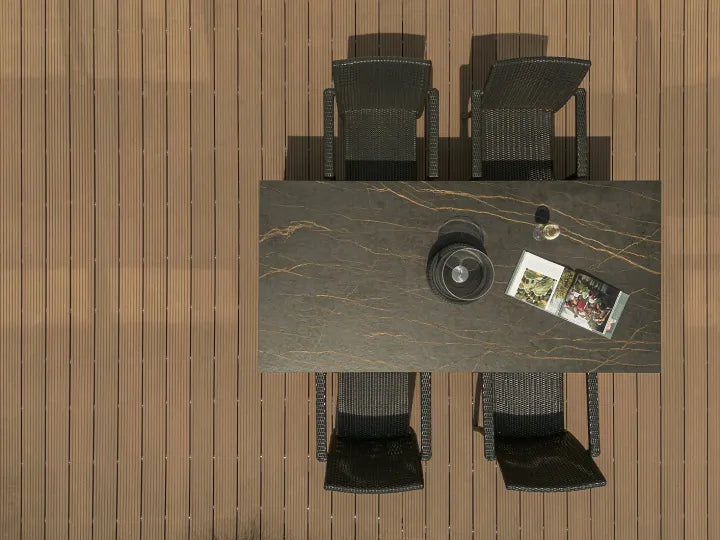
Choose black marble countertops when the actual slab's veining and natural patina are part of the design, not when the brief requires a uniform dark surface that should stay visually unchanged. White-veined black marble creates sharp graphic contrast; gold or brown movement warms the room; a near-solid black field depends more on finish and lighting than on vein pattern.
For a kitchen, approve the slab, finish and cut layout only after the owner accepts acid etching, reflected marks and natural variation. If the project needs a designed face repeated across several pieces, compare a black marble-look sintered stone as a separate manufactured option after the natural-marble direction is clear.
Three Black Marble Visual Directions
Black marble countertops describes a colour family rather than one repeatable stone or grade. Trade names such as Nero Marquina, Portoro and black-and-gold marble can help a buyer search, but the allocated slab controls the installed background, vein density, warm or cool cast, fissures and tonal variation.

| Visual direction | What reads first | Useful setting | Approval risk |
|---|---|---|---|
| Black with white veins | High-contrast linear movement | Feature islands, pale kitchens, compact bars | A sink, seam or waterfall return can interrupt the dominant vein |
| Black with gold or brown veins | Warm mineral movement | Walnut, warm oak, brass and hospitality counters | Busy timber or patterned tile can compete with the stone |
| Near-solid black or graphite | Surface depth and reflected light | Minimal kitchens, vanities and architectural counters | Dust, fingerprints and mineral residue gain contrast on the dark field |
Where Black Marble Works
A large island gives white or gold veining enough uninterrupted area to become the room's focal surface. Light cabinets and walls preserve the silhouette of the island; walnut or warm oak can connect with brown-gold mineral movement. When the counter and full-height backsplash are both dark and strongly veined, review them in one elevation so that one surface leads and the other does not multiply the same visual weight.


A bathroom vanity or reception counter reduces food-acid exposure, but it does not remove water residue, cosmetics, cleaning-product or edge-detail questions. Near-solid black can suit a small vanity when the mirror light grazes the surface without producing harsh glare. For a bar or hospitality counter, the sample review should include the actual ambient light because polished black changes character as reflections move across it.

Polished or Honed Black Marble
Polishing deepens the apparent black and sharpens the contrast between the field, veins and reflected light. Honing reduces mirror-like reflection, softens the colour and can make small finish changes less abrupt. The choice is visual and operational: a polished island behaves like a reflective plane, while a honed top reads more as a continuous dark mass.

The Natural Stone Institute's Use Natural Stone resource explains that marble containing calcite or dolomite reacts with acids, and that sealing does not prevent etching. A honed finish may make etch marks less visible than a polished finish, but it does not stop the reaction. The honed marble countertop comparison owns the full finish decision.
Review the Actual Slab in Project Light
A hand sample answers base colour, finish and immediate vein contrast. It cannot show how the main white or gold line crosses an island, whether a cloudy zone lands beside a sink, or how two slabs relate. Reserve the actual slab, photograph it square-on, and have the fabricator place the measured countertop pieces, cutouts, seams and waterfall returns on those images before cutting.

Review the sample flat under the project's daytime and artificial light, then inspect it at a low angle. Dark surfaces can hide a mark in a front-facing photograph and reveal it under grazing light. Ask whether the slab contains visible fills, reinforcement or repaired areas, and mark which face and orientation the approval covers. The custom marble countertop article carries the complete template, cutout, edge, seam and fabrication-scope workflow.
A stone name and a small chip cannot approve the vein path, cutout positions or reflected appearance of a full black marble slab.
| Approval item | Record before release | What it prevents |
|---|---|---|
| Allocated slab | Slab ID and full-face photographs | Substitution with a materially different vein field |
| Piece layout | Counter, cutout, seam and return outlines on the slab image | Removing the intended focal vein or creating an abrupt seam |
| Finish | Named finish and retained sample viewed flat | Unexpected black depth, glare or surface texture |
| Thickness | Purchased slab thickness and support/edge detail approved by the fabricator | Treating a common market format as a universal support rule |
| Quantity | Nesting plan from measured pieces on usable slab areas | Guessing slab count from countertop area alone |
A Natural Stone Council fact sheet lists 2–3 cm as common marble slab thicknesses. That range is a market reference, not a substitute for the fabricator's support, opening, edge and handling decision for the purchased slab.
Daily Wear Is More Legible on a Dark Surface
Acid etching changes the finish and usually appears as a dull patch or ring when light crosses the surface. Absorbed staining changes colour within the stone. Mineral residue sits on the surface and often collects near taps or repeated splash zones. These are different conditions, so a cleaner, poultice, sealer and refinishing process are not interchangeable fixes.

A penetrating sealer can reduce liquid absorption; it does not prevent the acid reaction that creates an etch. Use a pH-neutral cleaner intended for natural stone, wipe food and drink spills promptly, and use boards and trivets instead of cutting or placing hot cookware directly on the surface. Resealing should follow observed absorption and the selected product's instructions rather than a universal annual calendar. The marble countertop upkeep workflow explains cleaning, mark diagnosis, sealing checks and professional restoration boundaries.
Compare Black Marble Quotes on the Same Scope
Angi's July 2026 US overview places marble around USD 40 to above USD 100 per square foot depending on variety and grade, while listing removal, edge work and sealing as additional cost drivers. That range is not specific to black marble and cannot normalize two local offers by itself.
Put the same inputs on every quote: allocated slab or allowance, thickness, finish, measured area, expected slab count, cutouts, edge profile, seams, backsplash and waterfall pieces, visible-side finishing, delivery, site access, old-top removal, installation and sealing. A quote that includes a rare gold-veined slab and a full-height splash cannot be compared with a material-only square-foot rate for a common black stone.
When a Sintered Stone Alternative Fits
Choose natural black marble when geological variation, mineral depth and a changing patina are part of the accepted design. Consider black marble-look sintered stone when the project benefits from a designed face, listed format options and a repeatable selection process across several pieces. The materials are not the same: natural marble is quarried stone, while sintered stone is a manufactured surface. The material identity explainer covers that boundary in detail.
Compare the full product face, not one cropped vein. Record the product name, current face count or pattern relationship, finish, size, thickness and intended application, then approve a physical sample and current face images. For a broad comparison that includes granite, quartzite, engineered quartz and porcelain, use the marble countertop alternatives article.
Three Verified Funtek Black Directions
Current Funtek product records provide three different manufactured routes. Brazilian Black Gold uses a black-and-white Nero Marquina visual direction; Laurent Black Gold uses warm gold movement; Pure Black removes the vein pattern. Each current record lists countertop or kitchen-island use, a matte finish, several slab formats and 6, 9, 12 and 15 mm thickness options. The final choice still requires current face images, a sample and fabrication review.

Brazilian Black Gold Sintered Stone Slab
Black with a white Nero Marquina visual direction. The current product record lists a matte finish, random-match face and countertop, kitchen-island and feature-wall applications.
Listed formats: 1600 × 3200, 1200 × 2800, 1200 × 2700, 1200 × 2400 and 900 × 2700 mm; 6, 9, 12 and 15 mm.
View White Vein
Laurent Black Gold Marble-Look Sintered Stone Slab
Black with warm gold movement. The current product record lists a matte finish, random-match face and countertop, kitchen-island and feature-wall applications.
Listed formats: 1600 × 3200, 1200 × 2800, 1200 × 2700, 1200 × 2400 and 900 × 2700 mm; 6, 9, 12 and 15 mm.
View Gold Vein
Pure Black Sintered Stone Slab
A solid black direction without marble veining. The current product record lists one face, a matte finish and countertop, kitchen-island and feature-wall applications.
Listed formats: 1600 × 3200, 1200 × 2800, 1200 × 2700, 1200 × 2400 and 900 × 2700 mm; 6, 9, 12 and 15 mm.
View Solid BlackBuild a Black Surface Sample Brief
Share the target white, gold, brown or solid-black direction, project light, countertop drawings, finish, quantity and destination. Funtek can review current black sintered-stone faces and prepare sample options for your local fabrication team.