


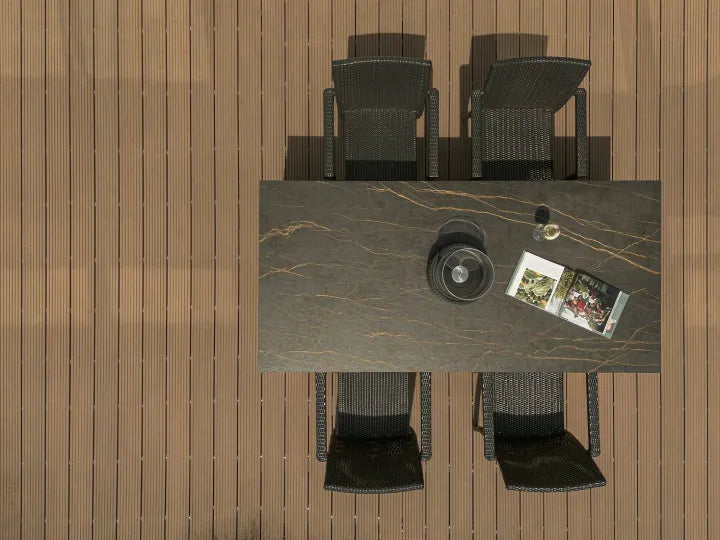


Black Galaxy granite is a natural black stone with gold-to-bronze mineral flecks. Funtek supplies this material for project enquiries. Start by choosing the amount of sparkle and the surface finish you want, then approve the proposed slabs and countertop layout before ordering.
A polished surface gives the strongest reflection. A honed or leathered finish changes how the black background and metallic flecks appear, so the finish sample should be part of the selection.
Black Galaxy Granite from Funtek
A dark, relatively even background holds the small reflective particles. It suits a countertop that should read as black from across the room but reveal more detail at close range. Unlike a strongly veined slab, its main visual choice is the size and distribution of the flecks.

- Material
- Natural Black Galaxy granite
- Appearance
- Black background with gold and bronze mineral flecks
- Selection
- Choose the fleck pattern, finish and proposed slab dimensions
- Enquiry
- Send the application, dimensions, quantity and destination; specify the finish and thickness you need
For a supply enquiry, use the Black Galaxy granite quotation form. Funtek can respond to enquiries for the natural material. Ask for the proposed slab information and quotation scope together, so the material you approve is the material named in the order.
What the Gold Flecks Look Like
The gold is part of the rock. It is not glitter scattered into a manufactured surface. In their 2024 petrographic study of Galaxy Granite, Geological Survey of India researchers describe gabbro and norite from the Chimakurti area of Andhra Pradesh and identify bronzite as the mineral producing metallic lustre when polished. “Granite” is the established commercial name; the geological description is more specific.

Under directional light, individual flakes become brighter as you move around the surface. Under soft, diffuse daylight, the same slab can look much quieter. A showroom close-up under a spotlight can therefore look more glittering than the same stone in a kitchen.
Compare the background as well as the sparkle. Look for the black tone you want, any pale patches or bands, and whether larger flakes collect in one area. A slab with fine, evenly spread particles will read differently from one with fewer, larger bronze inclusions. Fleck size is a visual preference, not a universal quality grade.
Choose fleck density at full-slab scale. A sample shows the mineral detail, but a large island needs an even appearance across its complete outline.
For a kitchen with several separate runs, view the proposed slabs together. Natural variation can become conspicuous where two otherwise quiet black pieces meet. Numbered full-face photographs help the fabricator relate the chosen stone to each part of the cutting plan.
Polished, Honed or Leathered?
Polished Black Galaxy is the clearest starting point if the bronze flecks are the reason you chose the stone. The gloss reflects windows and lamps, and the mineral particles remain prominent. MSI lists polished Black Galaxy; Zenith C also lists alternative finishes on request. Confirm the finish offered for the material being quoted.
Swipe sideways on a phone to compare; tap a photo to enlarge.
| Finish | Visible effect | Selection point |
|---|---|---|
 Polished Polished
|
Clear surface reflection; prominent metallic flecks. | Choose it when sparkle and the deep black gloss are the priority. Expect visible fingerprints and dried droplets. |
 Honed Honed
|
Smooth, low sheen; the ground can read charcoal-black. | Choose it when you want a quieter plane. Approve the dry black tone and any enhancer with the actual sample. |
 Leathered Leathered
|
Shallow brushed texture; softer reflected light. | Choose it for tactile grain. Compare the brushing depth and cleaning feel on the proposed finish. |
A honed sample may appear more charcoal than jet black. The particles are still present, but reduced surface reflection changes their contrast. A leathered sample adds texture that you need to judge by touch as well as by photograph. Brush depth and any colour-enhancing treatment can change the result.
Put the sample beside the cabinet finish under both daylight and the proposed task lighting. Check it clean and dry. An attractive wet sample does not establish the dry appearance of the countertop you will use every day.
For a fuller explanation of how the three treatments differ, see polished, honed and leathered granite finishes. Select the actual finish here before comparing quotations; a supplier’s finish name alone does not make two samples identical.
Cabinets and Backsplashes That Work with Black Galaxy
White cabinets make the countertop edge and black background easy to read. A quiet white or warm off-white backsplash lets the mineral flecks remain the small-scale detail. Match the white paint and tile in the room: a cold white can look noticeably different beside a creamy cabinet door.

Wood changes the balance. A light oak or medium warm timber picks up the bronze tone without repeating the stone’s particles. Keep the timber grain and backsplash pattern restrained if the chosen slab is densely flecked. A busy tile mosaic, strong wood grain and a sparkling counter can compete across a small kitchen.

In a Bauhaus-inspired interior, the black surface can anchor simple cabinet blocks, tubular metal chairs and a small primary-colour accent. A red seat or blue cupboard gives the room a clear colour decision; the stone does not need gold handles and gold lighting everywhere to justify its warm flecks.
For the backsplash, choose between a continuous Black Galaxy surface and a quieter contrasting material. The same stone creates a dark horizontal-to-vertical connection, but a tall black splash also reflects more of the room and lighting. A pale splash keeps the countertop visually separate and makes a compact kitchen feel less enclosed. See the full-height backsplash selection article if the wall is part of the slab order.
Slab Sizes, Thickness and Countertop Layout
There is no single standard Black Galaxy slab size. Natural blocks, processing and supplier inventory determine the usable dimensions. MSI’s Black Galaxy range includes 2 cm and 3 cm polished slabs, as well as prefabricated pieces. These are useful market formats to ask about, rather than dimensions to copy onto a cutting drawing without checking the proposed slab.
A 2 cm slab is 20 mm thick; a 3 cm slab is 30 mm. Specify the actual stone thickness separately from a built-up edge. A mitred apron can make a counter look thicker while the horizontal slab remains the originally selected thickness.

For example, a 2,400 × 1,000 mm island requires a usable rectangle of that size after damaged edges, trimming and any areas excluded from the design have been considered. A slab’s advertised overall length and width are only the first check. The fabricator also needs space for the saw cut, edge work and the preferred pattern placement.
Place the sink or hob opening, joints and seating edge on the same drawing. Keep support around openings and coordinate any extended seating edge with the cabinet or frame below it. A thicker natural slab still needs an appropriate load path; do not approve an unsupported projection merely because the stone is described as hard.
The countertop overhang article explains the distinction between cabinet projection and usable knee space. Its material-specific support figures must be read for the material they describe; the Black Galaxy fabricator should confirm the support arrangement for this natural-stone assembly.
Black Galaxy’s granular pattern usually makes a seam less dependent on aligning a large vein, but the seam can still show through different fleck density, reflection or adhesive colour. View the adjoining pieces in their planned orientation before cutting. For more on joint placement, continue to countertop seams and layout.
Vanity Tops, Floors and Other Applications
A Black Galaxy vanity works especially well beside a white basin and a simple mirror. The contrast makes the basin outline readable, while the mineral particles keep the top from appearing completely flat. Confirm the basin template, tap position, exposed edges and any short upstand before fabrication.

Polished black also makes dried water droplets easy to see. If the room has hard water, a routine rinse and dry matters more to its day-to-day appearance than a glossy catalogue photograph suggests. Choose a surface you are willing to keep looking clean around the tap.
The material is also sold for walls, floors and outdoor use, but the application needs its own specification. For a floor, confirm finish-specific slip performance for the expected wet or dry conditions. A polished countertop sample is not enough to choose a shower floor or entrance. Tiles also need coordinated thickness, edge calibration, joints and installation details.
For an outdoor counter, review the selected stone’s treatments and the proposed exposure with the supplier. Dark stone in direct sun can become uncomfortable to touch. The support, drainage, grill clearances and local weather remain part of the design; the material name does not resolve them.
Cleaning, Water Marks and Sealing
Use a neutral stone cleaner or mild detergent as directed, rinse away the residue and dry with a soft cloth. On a black polished surface, excess soap can look like a cloudy finish. Start by removing the cleaning film before assuming that the stone needs a stronger chemical or a new coat of sealer.
The Natural Stone Institute’s care guidance recommends neutral cleaners, careful rinsing, drying and trivets. Use a cutting board and lift abrasive objects instead of dragging them. Granite’s suitability for kitchen use does not make every edge, treatment or contact condition damage-proof.
Polishing and sealing are separate operations. Sealer can improve stain resistance where the stone needs it; it does not create the polished finish or remove a water deposit.
Do not put Black Galaxy on an automatic annual sealing schedule. Equally, do not treat “never needs sealing” as a promise that applies to every slab and finish. The Natural Stone Institute’s sealing position explains that many granite counters need no sealer, while others benefit from one. Follow the supplier’s recommendation for the chosen stone, finish and any existing treatment.
A surface that will not absorb the applied product can be left with a film if residue is allowed to dry. If treatment is recommended, approve it on a sample first and follow the product’s removal and curing instructions. Use a product specified for the intended food-preparation area.
A pale ring may be a surface deposit, cleaner residue or a change in the finish. A darker area may indicate absorbed moisture or oil. These require different responses. Avoid vinegar, acid descalers and abrasive pads as a general remedy for black stone; ask a stone-care professional to identify a persistent mark before attempting restoration.
Compare Prices and Approve the Proposed Slabs
A Black Galaxy slab price and an installed countertop price cover different work. On 6 October 2026, Stone Depot in the Philippines displayed ₱4,700 per square metre for supply-only Black Galaxy: 18 mm thick, polished, with natural unpolished edges. Its fabrication, delivery and installation are separate quotation items. Retain those details when using the number in a comparison.
For your project, request the same material thickness, finish, piece schedule and delivery scope from each supplier. Ask whether material is charged by purchased slabs or finished pieces, how edges and openings are priced, and whether the quote includes packing, freight, unloading or site installation. Then compare the totals.

Before releasing the order, confirm these details against the drawing:
- Identify the proposed slabs or lot and review their complete faces, with close-ups of any area that needs a decision.
- Approve the finish and disclose any resin, colour enhancer or sealer included in the proposed surface.
- Confirm usable dimensions, actual thickness and the finished edge profile.
- Mark the cut pieces, openings, joints, visible edges and support details on the fabrication drawing.
- Keep the approved stone information and the agreed supply scope with the quotation and order.
If the first photograph shows more sparkle than you want, ask for a quieter fleck distribution before changing the whole kitchen palette. If gloss is the problem, compare the finish samples first. Name the change you want in the enquiry: fewer flecks or less reflection.
Send Funtek the application and approximate dimensions to start a natural Black Galaxy enquiry. Add quantity, destination, required thickness and preferred finish when known. A reference photograph is useful for the fleck pattern; the proposed slabs should still be approved for the actual order.
Enquire about Black Galaxy
Funtek supplies natural Black Galaxy granite. Send your application, dimensions, quantity and destination, with your preferred finish and thickness. Request the proposed slab details and supply quotation.