


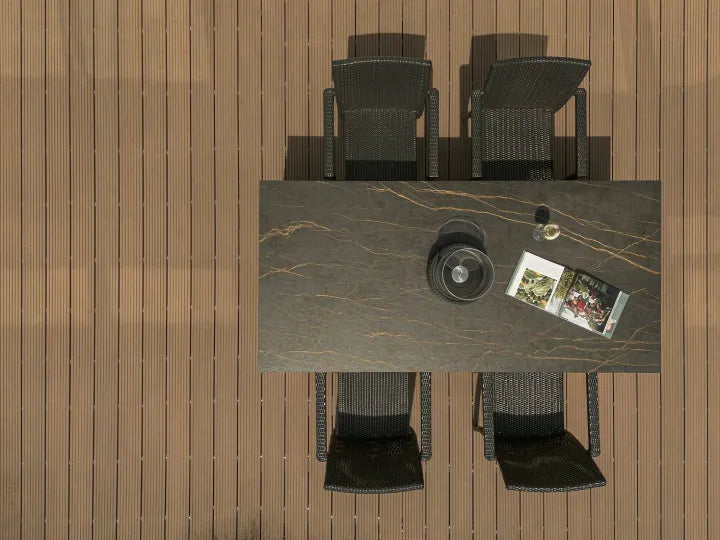


Granite is usually the more forgiving choice for a frequently used kitchen; marble suits buyers who value its natural veining and accept visible wear. Marble scratches more readily and can develop dull marks from acidic food and drink. Granite generally resists those everyday exposures better, although its exact stone, finish and treatment still matter.
Compare the actual slabs and the same fabrication scope before deciding on price. A particular granite can cost more than a particular marble, and a sealer will not give marble granite’s resistance to acid etching.
Marble and granite look different at the scale of a countertop
Marble often has a broad background crossed by veins, while granite often shows a closer mix of mineral grains. There are quiet and strongly patterned versions of both. A material name alone will not tell you whether a finished island will look calm, busy, warm or cool.
With white marble, look at the amount of gray in the background as well as the darkest vein. That background occupies most of the surface and can change how white cabinet fronts appear beside it. With granite, step back far enough for the individual crystals to merge visually. A sample that looks strongly speckled in your hand may read as a fairly even tone across a kitchen.


Then inspect the selected slab in full. A broad vein may cross the proposed sink opening, disappear into the cutout and resume on the other side. The result can be quite different from a small sample. A continuous, fine-grained pattern may make that interruption less prominent, but neither material guarantees an invisible seam.


Keep the material description with the sample. Marble-look quartz, porcelain and sintered stone are manufactured surfaces; a marble pattern does not make them natural marble. If your shortlist includes other quarried stones, our natural stone countertop guide compares the wider families.
Staining and acid etching are different problems
A stain is a discoloration associated with a substance absorbed into the stone; removable surface residue can look similar. An etch changes the surface itself. On polished marble, a dull patch where a drink stood can be an etch even when there is no colored ring left to clean.
Marble contains acid-sensitive carbonate minerals. Lemon juice, wine and vinegar can react with that surface. Granite’s predominantly silicate minerals are generally more resistant to everyday kitchen acids, though acidic cleaners are still unsuitable for routine care. The Natural Stone Institute’s care guidance explains that mineral distinction.
This changes the purchase decision. If a pale, unmarked polished counter is a firm requirement in a busy drinks or food-preparation area, marble brings a care burden that sealing will not remove. If you like the appearance of worn marble, the same surface changes may be acceptable.
Both materials can stain. Ask about the selected stone’s absorption and existing treatment instead of assuming every granite is stainproof or every marble absorbs liquids at the same rate.
Scratches, heat and chipped edges need separate comparisons
Marble is more easily scratched than granite. Use Natural Stone’s comparison describes how marble develops scratches and finish variation as it is used. A cutting board protects the surface and your knives; choosing granite does not make the worktop a substitute for one.
Hardness measures resistance to scratching. It does not establish how much weight an overhang can carry or whether a narrow strip beside a sink will survive an impact. Geologist Karin Kirk separates those properties in her stone-shopping guide. Avoid turning a hardness score into a claim that one countertop is “twice as strong.”

For either stone, discuss the exposed corners, sink opening and support with the fabricator. A tight corner on an aisle has a different impact exposure from a straight edge against a wall. The sample edge should show the intended shape, not just the surface color.
Use a trivet under hot cookware on both materials. Natural stone can tolerate heat, but that does not establish a universal hot-pan temperature for a finished countertop, including its treatments, joints and cutouts. The Natural Stone Institute recommends trivets or mats.

Sealing and finish change the care routine
A penetrating sealer helps slow absorption. It does not stop the chemical reaction that etches marble. A topical protective coating is a different treatment with its own appearance, maintenance and warranty conditions; do not confuse it with ordinary penetrating sealer.
There is no useful universal instruction to reseal every marble twice a year and every granite once a year. The Natural Stone Institute’s sealing position notes that many granites do not require sealing, while some gain additional stain resistance from it. Ask the supplier which treatment is already on the slab and which maintenance instructions apply to it.

Daily cleaning should remain simple: remove spills promptly, use a suitable gentle cleaner, rinse and dry. Stronger cleaning is not a way to restore a chemically dulled finish. For existing marks and a fuller routine, see marble countertop upkeep.
Honed marble can make wear less conspicuous
Honed marble has a matte or satin appearance. The smaller contrast between the overall finish and a dull mark can make etching less noticeable than on a polished surface. It remains acid-sensitive. View the finish beside a window or under the lighting planned for the counter, where reflections make differences easier to see.

Decide whether you want to retain an even polish or accept a gradually changing surface. That expectation affects the care commitment more than the word “marble” alone. Use Natural Stone’s marble-care article discusses refinishing when visible wear becomes objectionable; a fixed restoration schedule would miss that personal threshold.
Marble vs granite countertop costs: compare the same work
For a U.S. installed-cost reference, Marble.com’s comparison, updated January 2026 and checked September 15, lists granite at US$40–100 per square foot installed and marble at US$50–150 per square foot installed. The bands overlap: granite is not automatically cheaper for every pair of slabs.
A 40-square-foot comparison
Suppose the project has an 8 × 3 ft island and a separate 8 × 2 ft straight counter. Their combined outline area is:
(8 × 3) + (8 × 2) = 40 sq ft
Applying the supplier’s installed ranges gives US$1,600–4,000 for granite and US$2,000–6,000 for marble.
This calculation compares an equal surface area. Your chosen slab, cutouts, edge work, delivery and local installation scope determine where the actual quotation lands. Have the fabricator state how sink openings and chargeable area are handled; do not silently subtract openings from an installed-rate calculation.

Finished area and purchased material area can differ
Suppose the fabricator charges 48 sq ft of material for that 40 sq ft layout because of the chosen cuts and pattern placement. The material quantity is 48 ÷ 40 = 1.20, or 20% above the finished outline area. That increase applies to the material quantity in this example. It is not a reason to add 20% to every labor or delivery line, or to a quotation that already includes slab yield.
Use the same drawing for both offers and compare these items:
- The exact stone, selected slab, finish and nominal thickness.
- How much slab material is charged, including the proposed pattern layout and remnants.
- Edge profiles, sink and tap openings, joints and any agreed reinforcement.
- Templating, delivery, installation, initial treatment and taxes.
- Separate work such as removing the old counter or reconnecting plumbing.
A low slab-only figure and a higher installed total cannot tell you which material makes the less expensive finished kitchen. Once the missing work is priced on the same basis, the difference becomes useful.
Which material fits your kitchen or bathroom?
| Use and priorities | Starting choice | What changes the decision |
|---|---|---|
|
Frequent cooking and drinks
|
Start with granite | Lower tolerance for acid marks and scratches favors granite. Check the actual slab and cleaning instructions. |
|
A chosen marble pattern
|
Consider marble | Accept the finish changes that come with use. A honed sample helps you judge whether softer reflections suit the design. |
 Bathroom or mixed-material project Bathroom or mixed-material project
|
Choose by the actual activities | Compare products used on the surface, finish expectations and care responsibilities; a room label alone does not settle the choice. |
Choose granite when routine cooking, drinks and a lower tolerance for visible wear drive the decision. Choose marble when the selected slab’s appearance is the priority and everyone using or maintaining the space understands how it will change.
A bathroom can favor marble because the use differs from a food-preparation counter, but cosmetics and cleaning products still deserve attention. A kitchen island is not automatically a low-exposure location either: if it is where you prepare citrus or serve drinks, it faces those same conditions.
Mixing materials can work when the activities are genuinely separated. A marble serving or pastry surface beside granite preparation counters needs a deliberate color, edge and height relationship. It also needs a household or cleaning routine that keeps the different care instructions clear.
Before ordering, take the decision back to the actual slab. Review its overall pattern, the proposed sink and seam positions, the edge sample and the maintenance instructions together. Use Natural Stone’s kitchen-selection guidance describes the variation that makes individual slabs different. The purchase decision should therefore follow the selected slab, not only the sample name.
If natural marble’s care requirements rule it out but you want to keep a veined appearance, you can also compare manufactured sintered stone with natural materials. Keep that material change explicit. Funtek’s sintered stone countertop supply covers slab and cut-to-size project discussions, drawing review, fabrication coordination and export packing.
Considering a Sintered Stone Countertop?
Share the look you want, the room and rough dimensions. Discuss Funtek slab options and samples, then confirm the selected material and fabrication scope for your project.