


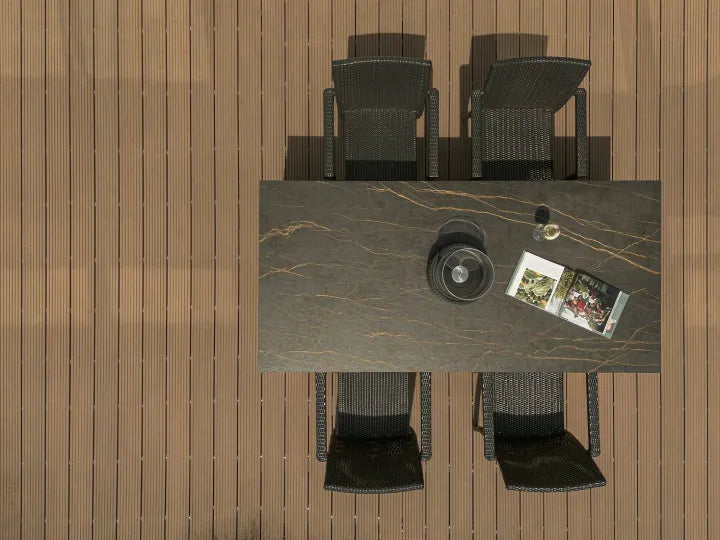


Calacatta sintered stone is best chosen as a slab programme, not from the pattern name alone. Background warmth, vein scale, face matching, finish, slab format and the finished assembly all affect what the installed surface will look like.
Warm or cool white, grey or gold veining, quiet movement or a dramatic focal vein.
Random-match, bookmatched and four-way layouts create very different installed compositions.
Send the application, cut sizes, edge concept, thickness, quantity and destination—not only a colour name.
What Is Calacatta Sintered Stone?
Sintered stone is made by compacting mineral-based raw materials and firing them at high temperature. The Calacatta description refers to the surface design: typically a light background with broad, spaced veining. Within that family, one slab can be soft and architectural while another is high-contrast and decorative.
That distinction matters commercially. A buyer searching for “sintered stone Calacatta” usually needs to see viable slab options, compare patterns and confirm whether a product can support the intended countertop, vanity, wall or furniture programme. This guide is organised around those decisions.
Choose the Calacatta Pattern Before the Specification
Shortlist the visual direction first, then confirm the technical variant and fabrication system. Use these five checks when you compare products:
- Background tone: a crisp white reads differently from a warmer ivory beside cabinets, flooring and lighting.
- Vein colour and scale: grey veining is usually quieter; gold or warm brown accents can become a stronger design feature. Large veins need enough visible area to read properly.
- Face relationship: random faces suit dispersed movement, while bookmatched faces are selected to form a deliberate mirrored composition. A four-way set expands that idea across four coordinated faces.
- Finish: matte surfaces diffuse light; polished or higher-sheen options amplify contrast and reflections. Confirm the finish that is actually offered on the selected product.
- Viewing scale: a hand sample is useful for tone and finish, but a full-slab image or physical slab is needed to judge vein placement and cut yield.

Current Funtek Calacatta Slabs to Shortlist
These active Funtek products cover three useful visual and matching directions. Treat them as a starting shortlist; confirm the exact finish, face set, batch, size, thickness and application with the quotation.

Calacatta Gold
A white field with warm gold movement for countertops, islands and bathroom wall schemes.
View Product
Golden Veins Calacatta
Warm gold veining with a bookmatched layout for bathroom walls, feature walls and hospitality interiors.
View Product
Royal Karakata
A white-and-grey Calacatta direction supplied as a four-way bookmatched composition.
View Product| Product | Visual direction | Face relationship | Good starting applications |
|---|---|---|---|
| Calacatta Gold | White with warm gold veining | 1 Face Random Match | Countertops, kitchen islands, bathroom walls |
| Golden Veins Calacatta | White with expressive gold movement | Bookmatched | Bathroom walls, feature walls, hospitality interiors |
| Royal Karakata | White with grey veining | 4-Way Bookmatch | Countertops, kitchen islands, bathroom walls |
Availability note: the product pages currently list 900 × 1800, 900 × 2600, 1200 × 2400, 1200 × 2600 and 1600 × 3200 mm formats, with 6, 9, 12 and 15 mm thickness options. A listed option is not automatic approval for every application. Confirm the selected variant, batch and finished assembly before ordering.
Where Calacatta Sintered Stone Works
Calacatta patterns are most effective where the slab face remains visible enough for the veining to read. The right pattern scale changes with the application:
- Kitchen countertops and islands: map the feature vein across the largest visible surfaces and decide how it should meet at corners, seams and splashbacks. See the sintered stone countertop range.
- Bathroom vanities and walls: check how the basin, tap penetrations, niches and panel joints interrupt the design. Explore bathroom wall applications.
- Feature walls and hospitality interiors: bookmatched faces can make the vein composition the focal point, but the elevation should be designed from the supplied face set. Review interior wall applications.
- Furniture and tabletops: select a vein scale that still reads after smaller parts are cut, and coordinate the slab with the supporting frame or panel. See furniture and tabletop applications.

Choose Size and Thickness From the Finished Assembly
Slab size helps reduce joints and improve cut yield, but “largest available” is not always the best purchasing answer. Start with the finished dimensions, repeats, cut-outs, lifting route and fabrication capability. Then nest the parts on an available slab format.
Thickness is also an assembly decision. A wall-facing panel, supported furniture skin and countertop edge do not use the slab in the same way. The substrate, support spans, edge build-up, hardware clearances, transport and installation method must be resolved with the fabricator or system designer. For early quantity planning, use Funtek’s area calculator and weight calculator, then confirm the actual cutting plan.
Calacatta Sintered Stone vs Natural Calacatta Marble
The two materials can share a visual reference, but they are not interchangeable specifications. Choose between them according to the project brief rather than the name.
| Decision point | Calacatta sintered stone | Natural Calacatta marble |
|---|---|---|
| Origin | Manufactured mineral-based slab with a designed surface | Quarried natural stone |
| Pattern planning | Selected from defined products and supplied face relationships | Each block and slab is naturally unique |
| Care brief | Follow the product supplier’s cleaning and fabrication guidance | Natural marble care commonly includes attention to sealing, staining and acid sensitivity |
| Selection priority | Exact product, face set, finish, body type and variant | Exact slab, natural variation and stone-specific assessment |
For a deeper material distinction, read Is sintered stone marble? If the goal is to compare alternatives for a countertop brief, use the marble countertop alternatives guide.
Plan Full-Slab Layout, Seams and Edges
Approve the full slab or coordinated face set before cutting. Mark the visible zones, seam positions, cut-outs and orientation on the elevation or cut map. For bookmatched work, also define the meeting line and the sequence of the supplied faces. This prevents a small sample from becoming the only visual approval for a large installed surface.
Edge appearance needs a separate decision. Do not assume a marble-look surface has the same pattern through the body. The three products above are currently described as Standard Body, so the edge concept should be reviewed with the actual slab and fabricator. A mitred build-up, exposed edge or other profile changes both appearance and fabrication. Compare options in the countertop edge profile guide, and review the difference between random and coordinated layouts in the bookmatched sintered stone guide.
What to Send in a Calacatta Slab RFQ
A quotation becomes more useful when the supplier can price the actual slab programme instead of guessing from “Calacatta white.” Include:
- Exact product or two acceptable alternatives
- Preferred finish and face relationship
- Required slab size and thickness
- Application and finished dimensions
- Drawings, elevation or preliminary cut plan
- Edge, cut-out and fabrication responsibility
- Quantity, batch consistency needs and sample request
- Destination, packaging needs and required timing
If pricing is still at feasibility stage, the sintered stone price guide explains the variables that influence a finished quotation.
The Bottom Line
The best Calacatta sintered stone is not simply the whitest slab or the boldest vein. It is the product whose background, face set, format, finish and edge strategy fit the installed area. Shortlist the visual direction, approve it at full-slab scale, and send an RFQ that describes the finished assembly.
Source Calacatta Slabs for Your Project
Tell Funtek the visual direction, application, dimensions, thickness, quantity and destination. We can help you shortlist products, request samples and prepare a quotation-ready slab selection.