


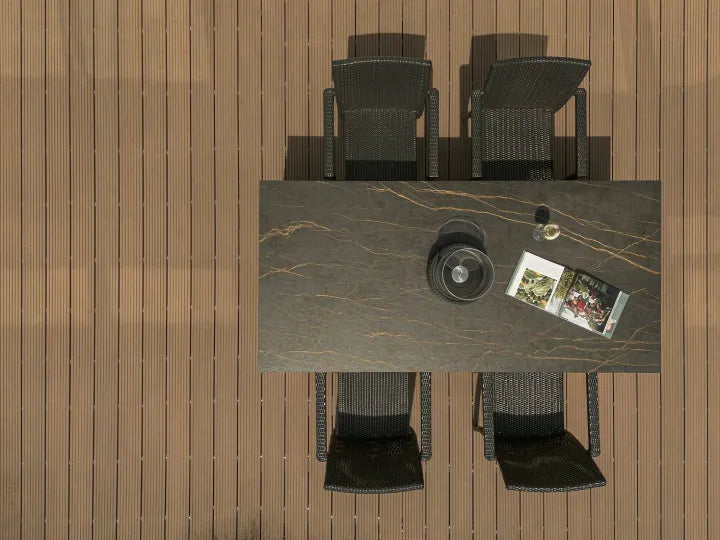


When buyers compare sintered stone slabs for countertops, bathroom walls, table tops, stairs, furniture panels, or commercial interiors, one question often comes up:
Is sintered stone full body, or is the pattern only printed on the surface?
This is a smart question. It affects how the slab looks after cutting, whether the edge color will match the surface, and whether the material is suitable for applications with visible edges.
But the answer is not simply “yes” or “no.” Sintered stone can be full body, body-matched, or surface printed, depending on the product series and production technology.
30-second answer: Not all sintered stone is full body. Many marble-look and decorative sintered stone slabs use advanced surface printing. This does not mean they are low quality. For countertops, table tops, stairs, waterfall islands, and exposed edges, buyers should check the slab edge, body color, cutouts, and mitered-edge option before ordering.
Watch the 2-minute guide
Watch: How to Check the Slab Edge
See a real sample comparison and learn why the surface pattern alone does not tell you whether a sintered stone slab is full body.
Prefer YouTube? Watch the video there.
In real buying decisions, the better question is not only whether the slab is full body. The better question is:
Will the cut edge, side view, sink cutout, table edge, stair edge, or mitered detail look right in the actual project?
This guide explains the difference between full body, body-matched, and surface printed sintered stone, and shows what buyers should check before confirming samples or bulk orders.
What Does Full Body Sintered Stone Mean?
Full body sintered stone means the color, tone, or visual character continues through the body of the slab, not only on the top surface.
If the slab is cut and the edge is exposed, the internal body should look visually consistent with the surface. This can make the finished edge look more natural, especially when the project does not use a mitered edge.
Full body or body-matched sintered stone is often preferred for applications where the edge is visible or frequently touched, such as:
- Kitchen countertops
- Waterfall kitchen islands
- Table tops
- Furniture panels
- Stair treads
- Reception desks
- Commercial counters
- Visible side panels or return edges
However, buyers should also understand one important point: full body does not always mean every marble vein runs perfectly through the whole slab. Some products have a consistent body color. Some have through-body effects. Some are better described as body-matched, where the body color coordinates with the surface background but does not repeat every vein.
Buyer note: Do not judge only from the words “full body” in a product description. Always ask for a cut-edge photo, cross-section photo, or real sample piece before confirming a large order.
What Does Surface Printed Sintered Stone Mean?
Surface printed sintered stone means the decorative pattern is mainly applied to the visible top surface of the slab.
This is common for marble-look, onyx-look, travertine-look, wood-look, cement-look, metal-look, and other decorative sintered stone slabs. Advanced surface printing can create realistic stone movement, detailed veining, soft cloudy effects, and consistent decorative patterns.
Surface printed sintered stone is widely used because it offers:
- More design choices
- More realistic marble and natural stone patterns
- Better control of visual consistency between slabs
- More flexible price options for different project levels
- Good suitability for walls, bathrooms, furniture, countertops, and commercial interiors
Surface printing does not automatically mean the slab is low quality. Many high-end marble-look sintered stone designs rely on surface decoration because complex marble veining is difficult to reproduce perfectly through the whole body.
Surface printed sintered stone is not automatically bad. The real issue is whether the edge detail is suitable for the application.

Full Body vs Body-Matched vs Surface Printed Sintered Stone
These three terms are often mixed together in sales conversations. For buyers, it is helpful to separate them clearly.
| Type | What It Means | Edge Appearance | Best Used For |
|---|---|---|---|
| Full body sintered stone | The color or visual character continues through the slab body. | The cut edge usually looks more consistent with the surface. | Countertops, tables, stairs, furniture, exposed edges, commercial counters. |
| Body-matched sintered stone | The slab body color is designed to coordinate with the surface background. | The edge may not repeat the surface pattern, but the color difference is usually less obvious. | Countertops, table tops, wall returns, furniture panels, moderate exposed-edge applications. |
| Surface printed sintered stone | The decorative pattern is mainly on the visible top surface. | The cut edge may show a different body color after cutting. | Bathroom walls, interior walls, decorative panels, many countertops with proper edge planning. |
Full Body vs Surface Printed: Key Differences Buyers Should Know
| Factor | Full Body / Body-Matched Sintered Stone | Surface Printed Sintered Stone |
|---|---|---|
| Pattern depth | Color, tone, or body character continues through the slab or coordinates closely with the surface. | The decorative pattern is mainly on the visible surface. |
| Cut edge appearance | The edge usually looks closer to the surface color. | The edge may show a different body color after cutting. |
| Marble-look realism | Depends on the product technology. Through-body veining may not repeat natural marble perfectly. | Often very realistic on the surface because complex graphics can be printed in detail. |
| Design range | Usually more limited, depending on the series. | Very wide range, especially for marble, onyx, travertine, wood, cement, and metal looks. |
| Edge planning | Straight polished, beveled, or chamfered edges may work well depending on the body color. | Mitered edges or careful edge treatment may be recommended for visible edges. |
| Buyer should check | Cross-section, body color, through-body effect, available thickness, and edge finish. | Surface design, body color, edge sample, cutout appearance, and mitered-edge option. |

Is Surface Printed Sintered Stone Lower Quality?
Not necessarily.
A surface printed slab can still be a high-quality sintered stone product. The quality depends on the raw materials, firing process, density, surface finish, stain resistance, heat resistance, scratch resistance, and production control.
For many decorative applications, surface printed sintered stone is the normal and practical choice. It allows more realistic marble, travertine, cement, wood, and onyx designs.
The real problem happens when a buyer uses a surface printed slab in an exposed-edge application without checking the edge appearance first.
For example, a bathroom wall panel may look excellent because the main visible area is the surface. But a table top or stair tread may need more attention because the edge is visible from the side.
The question is not “printed or not printed.” The question is whether the slab, edge profile, and fabrication method match the project.
Does the Sintered Stone Pattern Go Through the Whole Slab?
Sometimes yes, sometimes no.
Some sintered stone products have full-body color or through-body effects. Some products are body-matched. Many decorative designs have their main pattern on the surface.
This is especially common for marble-look sintered stone. Natural marble has complex veins, color changes, and movement. Repeating that exact pattern through the entire slab body is technically difficult and often unnecessary for many applications.
For this reason, buyers should not rely only on product photos taken from the top surface. The top view may look beautiful, but the edge view tells you whether the body color and surface design work well together.

Before ordering, ask the supplier for:
- Top surface photo
- Cut edge photo
- Side-view photo
- Cross-section photo
- Real sample piece
- Finished project photo using the same design
Why Many Marble-Look Sintered Stone Slabs Use Surface Printing
Marble-look sintered stone is designed to create a natural stone appearance. Popular designs often include soft clouds, grey veins, gold veins, high contrast lines, bookmatched patterns, and natural movement.
Surface printing allows these details to be controlled more accurately. This is why many marble-look sintered stone slabs use advanced surface decoration instead of relying only on through-body material effects.
This does not make the product wrong. It simply means the buyer should understand where the visual pattern is located and how the slab should be fabricated.
For marble-look sintered stone, the most important checks are:
- Does the body color match the surface background?
- What does the cut edge look like?
- Will the edge be straight polished, beveled, chamfered, or mitered?
- Will the design be used on a wall, countertop, table, stair, or waterfall island?
- Will the visible side need to continue the surface pattern visually?
What Happens to the Edge After Cutting?
After cutting sintered stone, the edge may reveal the slab body. If the body color is close to the surface background, the edge may look natural. If the body color is very different, the edge may look less consistent.
This is why edge planning matters.
Depending on the project, the fabricator may use:
- Straight polished edge
- Small chamfer
- Beveled edge
- Eased edge
- Rounded corner
- Mitered edge
For a simple wall panel, the edge may not be very visible. For a countertop, table top, stair tread, or reception desk, the edge becomes part of the final design.

Does Sintered Stone Need a Mitered Edge?
Not always.
A mitered edge is a 45-degree edge detail used to create a thicker or more continuous visual effect. It is often used on countertops, waterfall islands, table tops, and reception counters.
A mitered edge can be useful when:
- The surface pattern is very important
- The body color is different from the surface
- The client wants a thicker countertop appearance
- The project includes waterfall sides
- The edge is highly visible
- The slab has strong marble veins
However, not every sintered stone project needs a mitered edge. If the body color matches well, or if the edge is not a major visual area, a polished, beveled, or chamfered edge may be enough.
The best edge solution depends on slab design, thickness, body color, edge visibility, and fabrication method.

Buyer Decision Guide: Which Type Should You Choose?
For most buyers, the right choice depends on the application. A bathroom wall, kitchen countertop, waterfall island, table top, and stair tread do not have the same edge requirements.
| Application | Full Body Needed? | What to Check |
|---|---|---|
| Bathroom wall | Usually no | Surface finish, color, grout lines, exposed niche edges, wall returns, and cleaning needs. |
| Interior feature wall | Usually no | Large-format visual continuity, bookmatch direction, lighting, and visible side returns. |
| Kitchen countertop | Sometimes | Edge profile, body color, sink cutout, cooktop cutout, slab thickness, and fabricator experience. |
| Waterfall island | Often important | Mitered edge, vein direction, slab matching, side panel, and visible joint quality. |
| Table top | Important | Edge polish, corner radius, body color, backing support, thickness, and touch comfort. |
| Stair tread | More important | Full body or body-matched effect, anti-slip finish, exposed edge, thickness, and installation detail. |
| Reception desk | Often important | High-visibility edges, mitered details, maintenance, impact areas, and long-term appearance. |

Which Type Is Better for Countertops?
For countertops, both full body and surface printed sintered stone can work. The better choice depends on the design, edge profile, body color, and fabrication method.
If the countertop has visible straight edges, a full body or body-matched slab may look more natural. If the slab has dramatic marble veins, a mitered edge may create a better visual result.
For kitchen countertops, buyers should confirm:
- Slab thickness
- Body color after cutting
- Edge profile
- Sink cutout position
- Cooktop cutout position
- Whether a mitered edge is recommended
- Whether the fabricator has experience with sintered stone
For countertop projects, edge treatment often matters as much as the slab type.
Which Type Is Better for Bathroom Walls?
For bathroom walls, surface printed sintered stone is often suitable because the main visible area is the front surface.
Bathroom wall projects usually care more about:
- Large-format visual continuity
- Water resistance
- Easy cleaning
- Fewer grout lines
- Color matching with vanity tops, floors, and fixtures
- Matte, honed, or soft-touch surface options
Full body material is not always necessary for bathroom walls. However, if the design includes exposed niches, floating shelves, window returns, vanity tops, or visible side returns, the buyer should still check the edge appearance.
Which Type Is Better for Table Tops and Furniture?
For table tops and furniture panels, the edge is usually visible and frequently touched. This makes body color and edge finishing more important.
For sintered stone table tops, buyers should confirm:
- Finished size
- Thickness
- Edge profile
- Corner radius
- Body color
- Surface finish
- Backing support
- Packaging method for export
Full body or body-matched slabs can be helpful for table tops. Surface printed slabs can also work well if the edge profile is designed properly.
Which Type Is Better for Stairs?
For stair treads, edge visibility and slip resistance are both important. The front edge of the step is visible, exposed, and used frequently.
For this reason, full body or body-matched sintered stone is often more suitable for stair applications. Buyers should also confirm the anti-slip finish, stair nosing detail, thickness, and installation method.
If a surface printed slab is used for stairs, the edge detail must be planned carefully before production.
Supplier View: How We Usually Answer This Question
In real project communication, we usually do not answer only “yes” or “no” when a buyer asks whether a slab is full body.
We first check the application, edge visibility, thickness, and whether the project needs straight polished edges or mitered edges.
For some wall projects, surface printed slabs are completely suitable because the main visible area is the front surface. For table tops, stairs, reception desks, and waterfall islands, we usually recommend checking the edge sample before production.
If the slab body color is close to the surface background, a simple polished or beveled edge may work well. If the design has strong marble veins and the edge is highly visible, a mitered edge may create a more premium result.
A reliable supplier should not push every buyer toward the same answer. The right recommendation depends on the actual project, not only on the product name.
How to Check Before Ordering
The most reliable way to check whether sintered stone is full body, body-matched, or surface printed is to look at the actual edge and cross-section.

Before confirming samples or bulk orders, ask for:
- A cut-edge photo
- A side-view photo
- A cross-section photo
- A real sample piece showing both surface and side edge
- Technical specifications
- Available thickness options
- Fabrication recommendations
- Finished project photos using the same design
A small edge sample can prevent a much larger project problem later.
Questions to Ask Before Buying Sintered Stone Slabs
Before ordering sintered stone slabs for countertops, walls, table tops, stairs, or commercial interiors, buyers can ask these questions:
- Is this slab full body, body-matched, or surface printed?
- Does the pattern go through the whole slab?
- What does the cut edge look like?
- Is the body color close to the surface background?
- Can you provide a side-view or cross-section photo?
- Can the sample show both surface and edge?
- Is this design suitable for countertops or table tops?
- Is a mitered edge recommended?
- What edge profile works best for this slab?
- What thickness is available for this design?
Final Answer: Is Sintered Stone Full Body or Surface Printed?
Sintered stone can be full body, body-matched, or surface printed. It depends on the product series and manufacturing technology.
Some sintered stone slabs are designed with through-body color or body-matched effects. Many marble-look, travertine-look, onyx-look, wood-look, and cement-look slabs use advanced surface printing to create more realistic decorative patterns.
Surface printed sintered stone is not automatically low quality. For many wall, bathroom, and decorative applications, it can be a very practical and attractive choice.
For countertops, table tops, stairs, waterfall islands, and exposed-edge applications, buyers should check the slab edge, body color, cutout appearance, and mitered-edge option before ordering.
The safest buying decision is to request real samples and check both the surface and side edge before confirming the final slab.
Sample and project support
Check the edge before you commit to a slab.
Request a Funtek sintered stone sample piece with both surface and side-view details. It is the simplest way to review body color, edge appearance, surface finish, and fabrication suitability before a project decision.
- Compare the surface pattern and body color together
- Review cut-edge and side-view details before fabrication
- Choose suitable slabs for countertops, walls, tables, stairs, and commercial projects
Start with the project brief
Share your application, preferred color, thickness, target size, and edge requirement. We will recommend suitable slabs and fabrication options.
Request a sample or quoteA short project brief is enough to begin.