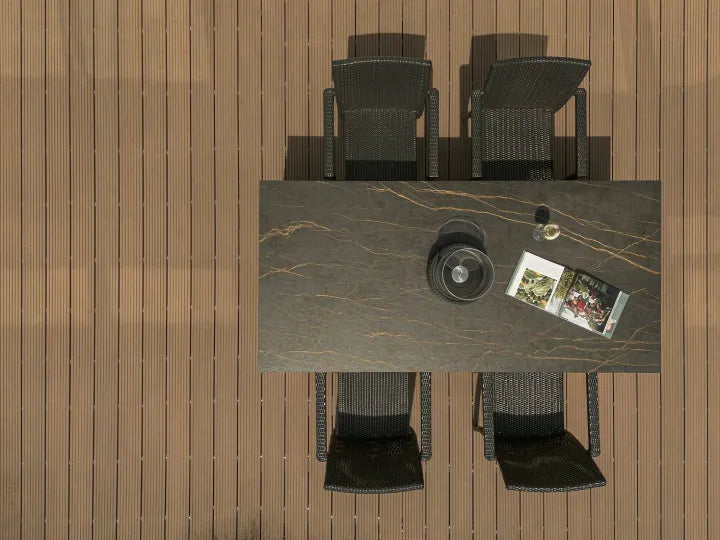
마이크로시멘트 vs 대형 포세린 슬래브

마이크로시멘트와 대형 포세린 슬래브를 시각적 연속성, 줄눈, 표면 변화, 바탕면, 가공, 보수 및 프로젝트 팀 책임으로 비교하세요.
LuCharlotte LuCharlotte 11 분 읽기 업데이트

Quick Answer

Choose microcement when true joint-free, hand-trowelled continuity across complex shapes is the design priority; choose large-format porcelain slabs when the project needs a repeatable factory-made surface, fewer but deliberately planned joints, and a panel-based fabrication and replacement route.

Neither system removes the need for a sound substrate or specialist execution. Before choosing, mark every joint, corner, penetration and movement location, then compare who accepts responsibility for preparation, finishing, fabrication, installation and future damage.

Microcement vs Porcelain Slabs at a Glance

The useful comparison is not “coating versus ordinary tile.” It is one complete surface system versus another: a finish built by hand on site and a large factory-made panel that must be selected, cut, transported and fixed.

Decision Microcement Large-format porcelain slab What to approve
How the surface is made Applied and finished on site in a named multi-coat system Factory-made face installed as panels System sample versus exact product, face and batch
Visual continuity Continuous field over the accepted build-up Broad faces with planned panel and movement joints Full elevations showing every visible joint
Surface character Hand-trowelled movement and applicator-dependent variation Repeatable manufactured colour and texture within product tolerances Representative mock-up in project lighting
Corners and details Finish can follow curves, returns and formed shapes Cuts, mitres, profiles, seams and edge finishing are designed and fabricated Large-scale corner, niche and penetration details
Primary specialists Microcement system applicator Slab supplier, fabricator/processor and large-panel installer One responsibility matrix with no unowned handoffs
Damage response Patch, blend or refinish a wider visual field Repair or replace a panel if matching material and safe access remain Written recovery method and spare-material plan

Which Surface Creates the Kind of Continuity You Want?

Microcement creates material continuity; porcelain slabs create visual continuity. A microcement applicator spreads the finish across the accepted substrate and can carry the same hand-made surface over walls, floors, steps, niches or formed furniture. Large slabs reduce the number of visual breaks, but they remain panels with joints at planned locations.

That distinction becomes obvious on drawings. A calm slab wall might need only a few vertical joints, yet corners, movement zones, changes of plane and panel limits still exist. Matching grout or sealant can make some joints quieter, but it should not be used to pretend they are absent.

Do not approve “seamless-looking” from a sample alone; approve a full elevation that shows the actual slab faces, cuts, joints, corners and changes of plane.

Illustrative bathroom with a continuous warm microcement-style surface across walls, floor and vanity
Illustrative visualization: a continuous microcement-style finish can carry one surface language across walls, floor and formed vanity details.
Illustrative bathroom wall with large factory-made panels and visible planned joints
Illustrative visualization: large panels reduce joint frequency, but the final elevation still depends on deliberate panel and movement-joint planning.

How Do Hand-Trowelled Variation and Factory Control Differ?

Microcement makes the applicator part of the visible design. Trowel pressure, layer sequence, sanding, pigmentation, sealing and site conditions can influence the final movement and sheen. That is attractive when the brief values a crafted surface, but a small sample cannot predict every square metre exactly.

A porcelain slab moves more appearance control upstream. The buyer can approve a named product, a full slab face, orientation and batch or shade information before fabrication. The installed result still depends on layout and workmanship, but the face itself is not created by the installer on site.

For one bespoke room, controlled hand variation may be the point. For repeated apartments, retail sites or several connected areas, a factory-made product code and face-approval process may make visual coordination easier. The relevant question is not which looks more “natural”; it is which type of variation the project team can approve and reproduce.

Illustrative close-up of hand-trowelled microcement-style texture and tonal movement
Illustrative texture study: hand application can create visible trowel movement and tonal variation that should be approved with a representative mock-up.

What Changes at Corners, Niches, Curves and Penetrations?

Microcement is usually more direct on complex continuous geometry because the coating follows the prepared form. Rounded corners, curved walls, integrated shelves and irregular returns can retain one surface language without dividing the shape into separate panels.

Porcelain slabs can create precise architectural details, but the geometry becomes a fabrication problem. External corners may use mitres or profiles; internal corners, niches, sockets, drains and fixtures need cut-outs, seams or separate pieces. Edge exposure and pattern direction must be resolved before cutting, not improvised after the slabs arrive.

Complex continuous geometry

Microcement starts with the formed substrate

Approve the substrate shape, reinforcement and named coating build-up, then use a representative site sample to lock colour, movement and sheen.

Crisp panel architecture

Porcelain starts with the fabrication drawing

Approve face orientation, joint locations, corner construction, cut-outs, tolerances and handling sequence before the first production piece is cut.

Illustrative microcement-style rounded corner and recessed bathroom niche
Illustrative visualization: coating systems can follow rounded returns and recessed niches when the substrate and full build-up are designed for the detail.
Illustrative large-format slab niche with metal trim, panel joints and an external corner
Illustrative visualization: slab niches and external corners become fabrication details involving cuts, seams, edge treatment and joint alignment.

How Do Substrate and Project Responsibilities Differ?

Both choices depend on what sits behind the visible finish. Microcement is thin, so movement, cracking, moisture or instability in the accepted background can telegraph into the finished system. The named microcement manufacturer and applicator must define preparation, primers, reinforcement, layer build-up, curing and sealer for the actual substrate and use.

Large-format porcelain also needs a stable, sufficiently flat background, but adds a logistics and fabrication package. The Tile Association notes that large panels need careful support, purpose-designed handling and cutting, adhesive coverage on the background and panel, and planned joints or movement accommodation. Access from delivery vehicle to final wall or floor can rule out a nominal slab size before aesthetics are considered.

The practical difference is the number of handoffs. A microcement proposal may concentrate the visible finish under one specialist applicator. A slab proposal may divide responsibility among supplier, fabricator, transport team and installer. That can be highly controlled when drawings and acceptance criteria are clear; it can also create gaps when one trade assumes another owns substrate flatness, edge quality or final joint alignment.

Which Route Is More Predictable Across Rooms or Repeated Projects?

Porcelain slabs are usually easier to repeat when the same product, finish and approved batch strategy can be procured for several areas or sites. Full-face images, physical samples, product codes and cutting layouts create a record that can be shared among buyer, fabricator and installer.

Microcement can repeat a colour direction and system, but its value often includes controlled hand variation. If several rooms or phases must read as one surface, the same system, applicator team, sample standard and site conditions become important. A later extension may not blend invisibly with an earlier finished field.

For international procurement, also separate material supply from local execution. Buying slabs does not automatically include local fabrication or installation, and specifying microcement does not guarantee that the chosen system has a trained applicator in the destination market. Confirm the complete delivery chain before the aesthetic choice is frozen.

How Do Maintenance, Damage and Repair Differ?

Microcement care follows its topcoat or sealer system. Abrasive dirt, incompatible cleaners and concentrated wear can affect the protective layer, while a local patch may show because colour and trowel movement have to be blended into the surrounding field. Some damage is best handled by refinishing a larger visual area rather than promising an invisible spot repair.

Porcelain slab care follows the exact product face and joint materials. A panel can sometimes be replaced, but only when a matching spare exists, the surrounding work allows removal and the replacement can be transported and installed safely. Replacement is a possibility, not an automatic low-cost repair.

Ask both bidders the same recovery question: “If this one visible area is damaged after handover, what is removed, what is retained, what matching material is needed and where will the repair boundary be visible?” The answer is more useful than a generic durability claim.

Illustrative close-up of a sealed microcement-style surface reflecting side light
Illustrative texture study: sheen and surface protection depend on the selected topcoat or sealer system and the approved sample.

Which System Fits Walls, Floors, Bathrooms and Furniture?

The preferred route changes by surface and geometry. Neither visible finish should be treated as the waterproofing, movement-control or structural design by itself.

Application Microcement advantage Porcelain slab advantage Decision gate
Feature wall Literal continuity and hand movement Large repeatable face with controlled tone or pattern Curves and transitions versus panel layout and access
Bathroom or wet-room wall Flows around niches and formed details Factory face with few joints and planned panel replacement Approved wet-area assembly, penetrations, corners and installer scope
Floor Continuous appearance across a suitable build-up Panelised route with defined joints and product surface options Substrate movement, slip requirement, access, joints and future damage
Vanity, desk or built form Can wrap sculptural forms on site Precise fabricated edges and coordinated slab faces Edge impact, cut-outs, support and acceptable seams
Illustrative living room with a continuous microcement-style wall, floor and built-in media unit
Illustrative visualization: the continuous route is especially relevant when walls, floors and formed furniture are intended to read as one field.
Illustrative bathroom with a large-format slab wall layout and planned vertical and horizontal joints
Illustrative visualization: the slab route is approved as a complete wall layout, not from a small surface sample alone.

For bathroom-specific slab planning, continue to Funtek's sintered stone bathroom wall system page. For broad coating-versus-tile cost, overlay and wet-area questions, use the existing Microcement vs Tiles comparison rather than repeating that wider task here.

When Should You Choose Microcement or Porcelain Slabs?

Choose microcement when

The continuous hand-made field is the product

  • Literal joint-free continuity matters more than factory repeatability.
  • Curves, niches, stairs or formed details would fragment into many panel pieces.
  • The named system accepts the substrate and use condition.
  • A proven applicator can own the complete visible finish and recovery method.
Choose porcelain slabs when

The planned panel system gives more control

  • Few deliberate joints are acceptable in place of literal continuity.
  • A repeatable factory surface and full-face approval are valuable.
  • Fabrication drawings can resolve corners, cut-outs, edges and orientation.
  • Access, handling, installation and matching spare material can be planned.

If the visual brief has already moved toward cement-look large panels, browse Funtek's cement-look sintered stone collection. Sintered stone is an adjacent factory-made slab route, not a synonym to apply automatically to every porcelain product; confirm the exact material declaration, format, finish and intended use for the selected product.

What Should the Project Team Send Before Samples or Quotes?

Send one package that lets both routes respond to the same design conditions:

  • room type, use zones and whether each surface is wet, dry, horizontal or vertical;
  • dimensioned plans and elevations with corners, niches, openings, drains and penetrations;
  • existing substrate or proposed backing build-up, including known movement or moisture concerns;
  • the desired colour, sheen, hand variation and maximum acceptable visible-joint pattern;
  • delivery route, lift and door limits, working space and site cutting restrictions;
  • who supplies samples, mock-ups, fabrication drawings, protection, spare material and post-handover repair.

A microcement bidder can then state the named system, preparation, sample method and applicator responsibility. A slab bidder can state the exact product, usable dimensions, layout, fabrication, edge details, handling plan and installer responsibility. Compare those complete work packages, not only a coating price per square metre with a slab price per piece.

Use the microcement-look tile and slab guide when format and joint frequency are the next decision, or the microcement alternatives guide when other material routes remain open.

The Bottom Line

Microcement is the stronger route when the project is defined by genuine hand-trowelled continuity over complex forms. Large-format porcelain slabs are the stronger route when the project can accept planned joints in exchange for a factory-made face, drawing-led fabrication and a panel replacement strategy. The decisive document is not the small sample—it is the combined elevation, build-up and responsibility plan.

Technical context for the system distinctions includes The Tile Association's large-format porcelain guidance, its panel fixing and movement-joint guidance, and Topciment's documented microcement application and sealing sequence. Use the current product, system and destination-market documents for final specification.

Continue Exploring Cement-Look Surfaces

Use the next guide that matches the decision your project still needs to make.

Compare a Cement-Look Slab Route for Your Project

Send Funtek your elevations, dimensions, application, preferred tone, joint intent, quantity, destination and programme. We can shortlist sintered stone slab options for sample and quotation review.

작성자 소개

LuCharlotte

신터드 스톤 스페셜리스트 & 기술 자문

LinkedIn에서 연결

LuCharlotte는 신터드 스톤 제조, 소재 테스트, 프로젝트 사양 검토에 대한 현장 경험을 바탕으로 글을 씁니다. 건축가, 디자이너, 가공업체, 프로젝트 구매자를 위해 표면 성능, 슬랩 규격, 가공 로직, 마감 선택, 적용 적합성에 관한 실무적인 가이드를 제공합니다. 기술적인 소재 결정을 더 명확하고 정확하며 검증하기 쉽게 만드는 것이 목표입니다.

마이크로시멘트 vs 포세린 슬래브 FAQ

01

포세린 슬래브는 마이크로시멘트처럼 이음매가 없나요?

아니요. 대형 포세린 슬래브는 일반 타일보다 훨씬 적은 줄눈으로 시각적으로 차분한 표면을 만들 수 있지만 패널 이음부, 면 전환 및 움직임 수용은 여전히 계획해야 합니다. 마이크로시멘트는 승인된 바탕 시스템 위에 수작업으로 연속 마감을 만듭니다.

02

곡면 벽, 니치 및 라운드 코너에는 어떤 소재가 더 적합한가요?

마이크로시멘트는 현장 도포이므로 복잡하고 곡선인 형상을 더 자연스럽게 따라갑니다. 포세린 슬래브는 선명한 건축 모서리와 니치를 만들 수 있지만 결과는 절단, 연귀, 엣지 마감, 줄눈 배치 및 가공업체 승인 상세에 따라 달라집니다.

03

대형 포세린 슬래브는 전문 시공자가 필요한가요?

네. 대형 패널에는 적절한 접근, 취급 프레임 또는 흡착 장비, 충분히 평탄하고 안정적인 바탕면, 적합한 절단 공구, 전면 접착 지지 및 계획된 줄눈이 필요합니다. 프로젝트에는 가공과 시공 책임이 모두 포함될 수 있습니다.

04

손상된 포세린 슬래브가 마이크로시멘트보다 보수하기 쉬운가요?

일치하는 예비 자재를 보관하고 인접 작업을 손상하지 않고 패널을 제거할 수 있으면 슬래브를 교체할 수 있습니다. 마이크로시멘트 손상은 패치하고 블렌딩할 수 있지만 색상과 흙손 편차로 국부 보수가 보일 수 있습니다. 승인 전 두 입찰자 모두에게 복구 방식을 정의하도록 하세요.

05

대형 세라믹과 포세린 슬래브는 같은가요?

반드시 그렇지는 않습니다. 시장 용어는 겹치지만 구성, 제조 선언, 표준, 규격 및 용도는 제품별로 다릅니다. Funtek은 대형 세라믹 슬래브를 공급하므로 모든 대형 공장 제조 슬래브가 같은 소재라고 가정하지 말고 정확한 제품 문서를 확인하세요.