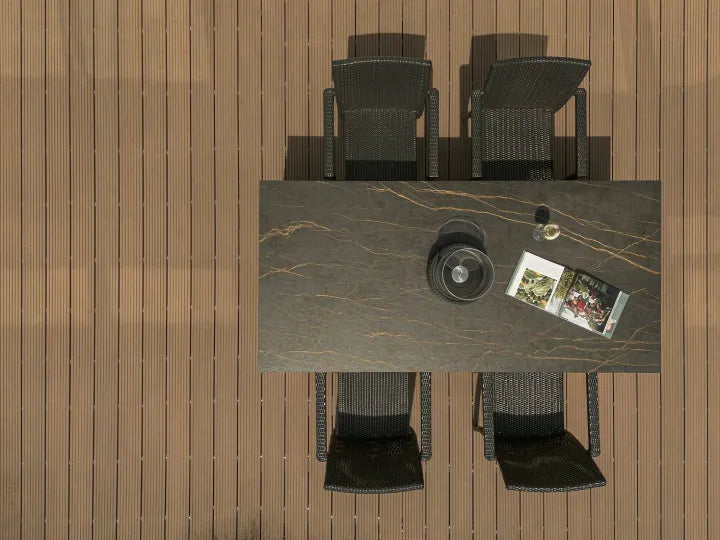
레스토랑·카페·호텔용 대형 세라믹 테이블 상판

레스토랑, 카페 및 호텔 테이블 상판을 위한 B2B 사양 가이드로 반복 규격, 두께와 지지, 엣지, 마감, 청소 주기, OEM 가공, 포장, 교체 수량 및 RFQ 입력 정보를 다룹니다.
LuCharlotte LuCharlotte 15 분 읽기 업데이트

Quick Answer

Choose sintered stone for a hospitality tabletop program when you can control the complete top assembly and the repeat-production record; do not buy it as an isolated slab thickness with an unspecified base.

If the furniture factory owns cutting, edging and drilling, buy full slabs and keep fabrication risk there. If the project needs repeatable finished parts, quote cut-to-size or processed components against frozen drawings. Funtek supplies slabs and processed stone components for furniture manufacturers; frames, bases, hardware and final assembly remain outside the standard scope unless the quotation includes them.

Release firstModule schedule + base interface
Lock togetherSurface + edge + first article
Keep traceableBatch + part code + packing mark

Why Sintered Stone for Commercial Table Tops?

Sintered stone fits projects that need stone, concrete or solid-colour faces repeated across many tables. It is a weaker choice when lowest first cost, local refinishing or the one-off variation of natural stone matters most; HPL, repairable timber or individually selected marble may suit those priorities better.

The slab face is rarely the first weak point. Chipped corners, holes for the wrong base, a twisting frame or an unsuitable adhesive/backing system turn a sound surface into a failed component. Leaving these interfaces out of the quote transfers breakage, assembly delay and after-sales cost to the furniture factory or site team.

Use the broader sintered stone pros and cons for material screening. Release hospitality tops only as a top-support-base assembly.

If the base drawing arrives after the tops are cut, the project can have visually correct stone parts that still require redrilling, replacement or an unplanned adaptor plate.

Restaurant vs Café vs Hotel Requirements

Do not use one “hospitality grade” brief for every venue. Group tables by movement, cleaning, combination and replacement; share a visual family only where those conditions match.

Restaurant

If hot serviceware, wine, oil and frequent sanitising are normal, test the chosen finish, exposed joints and backing with the venue's real cleaner. A surface-only sample can pass while a joint or backing fails in service.

Café

If staff move or combine tables daily, prefer fewer modules, restrained edges and base interfaces that cannot be confused during reassembly. A complex visual edge may look better in the sample but create more handling damage and slower replacement.

Hotel

If breakfast, lounge, banquet and guest areas have different cleaning and movement patterns, keep separate part codes even when the colour is shared. One universal specification either overpays for low-risk zones or leaves high-risk zones under-controlled.

If the surface family is still open, use the sintered stone versus quartz trade-offs and the sintered stone versus marble dining-table comparison before freezing the modules. A late material change can alter edges, support, weight, fabrication and replacements.

Table Sizes & Repeated Modules

Start with the furniture system, not with the largest rectangle that fits on a slab. A repeated module earns its value only when the top dimensions, finished height, edge, pattern direction and base interface are identical. Two tops with the same plan size but different drilling or support are different production parts.

Project condition Prefer Failure mode and commercial consequence
Tables are pushed together One finished-height datum, compatible edge geometry and a declared pattern direction on the joining sides A small height or edge mismatch creates a visible ridge, unstable serviceware and site adjustment across every paired table
One top shape uses several bases A separate part code for each hole or support interface, even if the stone outline is identical Warehouse staff cannot distinguish the parts; correct tops are drilled or installed on the wrong base
Many custom sizes appear on the plan Reduce them to the smallest workable module family before nesting and quotation Every extra module adds drawings, cutting programs, inspection criteria, labels and spare-parts exposure
Large communal or banquet tops are requested Decide panelisation, seam location, support lines, access route and site assembly before selecting the slab layout A part may be fabricable but impossible to move through the building or support without unplanned joints

Worked project example — illustrative assumptions: a hotel refurbishment needs 60 tables for its café and breakfast room. The drawing shows two top shapes, but the furniture list uses two base plates and splits delivery by room. Calling this “60 tops” hides four possible drilling codes. The safer decision is a matrix listing shape, base plate, room, quantity and package mark, followed by one assembled top on each real base. If the matrix cannot be frozen, supply the tops without holes and keep drilling with the furniture factory. This prevents correctly cut stone from reaching site with holes for the wrong base—and avoids crate searches, redrilling and opening-day replacement work.

Illustrative hotel tabletop module and metal base fit check before bulk installation

Thickness, Backing & Frame Support

Select the construction route before slab thickness. A thinner slab on a known backing or perimeter frame can outperform a thicker slab on an uneven or twisting base. If the substrate, bond or frame remains unknown, do not release a bonded thin-panel top.

6 mm direction
Use for supported cladding or bonded panel construction only after naming the substrate, bond/fixing method, exposed-edge treatment, moisture condition and party responsible for the composite panel.
9 mm direction
Use for furniture components after fixing the finished size, frame or backing, base plate, openings, edge construction, handling and transport route.
12 mm direction
Use as a tabletop starting point after checking base position, unsupported areas, holes, edge build-up and total assembly weight. It is not evidence that a frame is unnecessary.
Illustrative sintered stone tabletop dry fit on a backing panel and metal support frame

Common project mistake 1 — using thickness to correct a bad frame. An out-of-plane frame or concentrated base plate still loads a thicker top incorrectly, while the extra weight makes handling harder. The preventing decision is to reject the frame/top pairing until the bearing surfaces, support lines and lifting method are settled. Use the 9 mm, 12 mm and 20 mm thickness comparison for material background, not as movable-furniture overhang rules.

Edges and Corner Safety

For high-volume hospitality furniture, an eased edge with a fixed corner detail is usually the lowest-risk choice. Use a chamfer when the thin line matters, a larger external radius in tight circulation, and a built-up edge only when the thicker look justifies extra joints, adhesive work and packing protection.

  • Eased or pencil edge: best for repeatability and simpler inspection; it does not create the visual weight of a thick stone top.
  • Chamfered edge: makes a thin top deliberate, but exposes the relationship between surface print, edge colour and machining consistency.
  • Radiused external corner: reduces the sharp contact point in circulation routes, but changes nesting, pattern placement and the usable distance between the corner and any base hardware.
  • Built-up or framed edge: can conceal backing and create a thicker appearance, but every visible joint becomes an alignment, adhesive and future-repair risk.

“Eased edge” is not a production drawing: two factories can interpret it differently. Add a cross-section, exposed-edge schedule, visible-face direction and corner detail; use a fabricated sample where touch or joint visibility matters. The edge-profile reference helps choose geometry but cannot replace the component drawing.

Hot Plates / Coffee / Wine / Cleaning Cycles

Test the service routine on the complete top, not an “easy-clean” claim. Surface, edge joints, adhesive, backing and cleaner can have different limits; the weakest one sets the rule.

Condition Decision rule What commonly goes wrong Business consequence
Hot plates or serving vessels If the exact finished assembly has no documented exposure basis, use a trivet or service policy rather than assuming the slab claim covers the backing and bond Heat is evaluated at the face while the concealed adhesive or substrate is ignored Joint movement, local release or a dispute that the slab supplier and furniture maker assign to each other
Coffee, wine, oil and sauces Test the chosen finish, exposed edges and joints with the venue's removal method; a smooth coupon does not represent a textured face or built-up edge Residue remains in texture or at the joint even when the slab face wipes clean Longer table-turn cleaning, visible films and avoidable guest complaints
Repeated wiping Record cleaner, dilution, cloth or pad and rinse step. If the venue cannot name its chemical, hand over product care instructions without promising compatibility with an unknown routine Over-concentrated cleaner or abrasive pads leave streaks, residue or changed sheen Inconsistent appearance across the room and an after-sales claim that cannot be traced
Sanitising cycle Follow the labelled contact time for the venue-authorised product, then test it on the exact finish and assembly The maintenance team changes chemical or dwell time after the sample check The tested sample no longer represents actual operation

For cleaner selection, residue diagnosis and escalation, use the detailed sintered stone cleaning guide. The commercial handover should state who owns the cleaning method; otherwise each party can follow a different assumption and none can diagnose a later mark.

Matte vs Polished for Hospitality

Matte is usually the safer visual default where directional lighting, frequent wiping and a calm architectural finish matter. Polished is preferable when reflection and colour depth are deliberate design features and the operator accepts that fingerprints, streaks and reflected cleaning marks can be more visible. This is a visual and maintenance trade-off, not a durability ranking.

Illustrative matte and polished hospitality tabletop cleaning check under restaurant lighting
Condition Prefer matte / low reflection when... Prefer polished / high reflection when...
Spotlights or window glare The tables should stay visually quiet from several guest sightlines Highlights are part of the interior concept and glare has been checked at table height
Dark or strongly veined surface The pattern should read softly across many repeated tops The buyer wants stronger colour depth and accepts more visible reflections
Cleaning routine The tested texture releases the venue's actual residues without holding a film Staff can maintain a streak-free appearance under the real lighting
Sample check Place the physical sample flat, apply the actual cleaner, let it dry and view it from guest and staff angles. An upright showroom sample hides table-height reflections and residue.

For a quiet mineral direction, shortlist concrete-look tabletop surfaces, then test the finish on the intended support and service routine.

Indoor vs Outdoor Café Tables

Move a café table outdoors only when evidence covers the exact slab/finish and the full frame-base-hardware system. If product evidence or assembly responsibility is missing, keep the module indoors or change the system; “dense slab” is not an outdoor specification.

Product evidence

Match UV, moisture, freeze-thaw or other climate evidence to the selected product, finish and thickness. One sample report does not cover an entire visual collection.

Assembly evidence

Check corrosion protection, drainage, fixing method, dissimilar materials, base flatness and thermal movement. The stone face cannot correct a frame that racks or traps water.

Operating evidence

Record uneven paving, wind, umbrellas or heaters, relocation, overnight storage and fastener checks. A heavy top can still tip on the wrong base footprint.

Outdoor tables are often moved more and receive more edge contact than indoor tables. If staff use trolleys or stack modules, design that handling route before approving the edge and packing. Otherwise transport protection ends at delivery while the same damage mechanism repeats during daily operation.

Repeatability Across 20 / 50 / 100 Tables

Quantity does not change the material; it multiplies the cost of an ambiguous drawing, finish range, hole datum or packing mark. A simple 100-table run can be easier to control than 20 tables split across many shapes, finishes and bases. Production complexity rises with the number of modules, finishes, base interfaces and delivery phases—not with quantity alone.

20 tables

Freeze the module schedule, surface sample, edge/corner detail and first article before the remaining parts proceed. The main risk is treating a small run as too minor for change control.

50 tables

Add batch references, part IDs, orientation marks, packing groups and receiving sequence. The main risk is correct production followed by mixed parts at the warehouse or site.

100 tables

Control phases, retained references, replacement route and one drawing-revision owner across locations. The main risk is a successful first phase becoming impossible to reproduce after undocumented changes.

These are coordination examples, not universal inspection plans. Set sampling, spare and inspection rules from visual variation, fabrication complexity, number of phases and the commercial cost of replacement. If a defect would stop a hotel opening or leave one restaurant location unmatched, the acceptance plan needs to detect it before packing, not after installation.

OEM / Cut-to-Size / Drilling / Packing

Choose the supply format according to where the equipment, drawings and liability sit. More processing by the slab supplier reduces furniture-factory work only when the component definition is complete; otherwise it locks an uncertain design into expensive stone parts.

Supply format Choose it when Risk retained by the buyer or furniture factory
Full slabs The factory has proven cutting, edging, drilling, lifting and dust-control capability for the exact slab Nesting yield, machining breakage, finished tolerances, part identification and component packing
Cut-to-size panels The buyer wants controlled dimensions and pattern direction but will complete edges, holes or assembly locally Later operations can still damage a correctly cut panel; responsibility changes at the supplied edge of scope
Processed components Drawings, visible face, datum, base interface, holes, edges, first-article checks and packing groups are frozen Late furniture changes create replacement parts rather than an easy workshop adjustment

Common project mistake 2 — sending hole coordinates without a viewing face. A visible-face drawing read as an underside drawing mirrors the hole pattern; the finished top may need replacement because enlarging holes can weaken the hardware interface or expose them beyond the base plate. Prevent this by naming the face and datum on the drawing, attaching the base reference and fitting the first component to the real base before repeated drilling.

Pack processed tops by receiving and assembly sequence, not merely by slab batch. An undamaged top with no readable part mark can still stop installation while crews open crates to find one module. Use Funtek's component-supply process to allocate responsibility, then match it to the packing and shipping route.

Illustrative processed hospitality table tops protected in crates with table bases packed separately

Replacement Units & Batch Planning

Common project mistake 3 — recording only the product name for replacements. A later lot can carry that name yet differ in appearance, pattern position, edge tooling or hole layout, leaving one replacement visibly wrong or impossible to mount. Prevent this before production by choosing a finished spare, reserved slab material or a full reorder record.

Finished spare top
Choose this when rapid site recovery and close visual matching outweigh storage space and handling risk. Store it with the correct module, edge, holes, base reference and package mark; an unlabelled spare can be unusable.
Reserved slab material
Choose this when batch continuity matters but the site cannot safely store finished parts. Replacement still depends on the controlled drawing, fabricator, tooling and edge sample.
Reorder record only
Choose this when upfront storage is more costly than a possible rematching delay. Retain the SKU, finish, batch or lot, full-face reference, pattern direction, drawing revision and fabrication record, and accept the highest visual-rematch risk.

For multi-location brands, tie every spare or reorder record to the site, module and package mark. Do not reuse a furniture record across different applications merely because the surface is the same: office-desk components have different cable openings, hardware interfaces and handling risks from hospitality tables.

Commercial RFQ Checklist: Top Dimensions, Quantity, Edge, Base, Holes & Destination

Separate a budget indication from a production-release quotation. A supplier can estimate slab or component cost with open items, but no one should interpret that price as approval of the support, drilling, outdoor use, packing or final assembly.

  • 1. ApplicationName the restaurant, café, hotel restaurant, lounge, banquet or outdoor condition; do not use “hospitality” as the only service description.
  • 2. Top dimensionsGive length, width or diameter, shape, finished construction and a unique module code.
  • 3. QuantitySeparate units by module, site and delivery phase; state whether spares or reserved material are required.
  • 4. SurfaceGive product/SKU or visual direction, finish, sample status and pattern orientation.
  • 5. Edge and cornerAttach the profile cross-section, exposed-edge schedule, corner detail and any visible build-up.
  • 6. Base and supportAttach the base model, top plate, frame/substrate layout, fixing method and support drawing.
  • 7. Holes and openingsGive diameter, coordinates, datum, tolerance, hardware reference and whether the drawing is viewed from the face or underside.
  • 8. Fabrication scopeState full slabs, cut panels or processed parts and name who owns each remaining operation and final assembly.
  • 9. Service conditionsName hot serviceware, common spills, actual cleaner, indoor/outdoor exposure and movement/storage routine.
  • 10. Quality recordList the sample, first article, batch/lot record, appearance range, inspection point and part identification.
  • 11. PackingList face/edge protection, package groups, marks, loading/receiving order and unloading constraints.
  • 12. DestinationGive country, city or port, shipment basis, access limits and required delivery sequence.

Apply three stop rules: no base/support drawing means no drilling or assembly-suitability approval; no exact finish/sample means appearance remains open; no destination and receiving plan means packing and logistics remain provisional. Mark those exclusions on the quotation so a budget number cannot become an accidental production instruction.

Build a Quote-Ready Hospitality Tabletop Program

Send the module schedule, controlled drawings, surface and finish, base/support interface, quantities, processing scope, packing groups and destination. Funtek will identify what can be quoted as slabs, cut panels or processed components—and which open items must be resolved before production release.

작성자 소개

LuCharlotte

신터드 스톤 스페셜리스트 & 기술 자문

LinkedIn에서 연결

LuCharlotte는 신터드 스톤 제조, 소재 테스트, 프로젝트 사양 검토에 대한 현장 경험을 바탕으로 글을 씁니다. 건축가, 디자이너, 가공업체, 프로젝트 구매자를 위해 표면 성능, 슬랩 규격, 가공 로직, 마감 선택, 적용 적합성에 관한 실무적인 가이드를 제공합니다. 기술적인 소재 결정을 더 명확하고 정확하며 검증하기 쉽게 만드는 것이 목표입니다.

상업용 대형 세라믹 테이블 상판 FAQ

01

Funtek은 베이스가 포함된 완제품 레스토랑 테이블을 공급하나요?

Funtek의 표준 범위는 대형 세라믹 슬래브, 치수 절단 상판 및 견적된 가공입니다. 프레임, 베이스 및 최종 가구 조립은 서면 견적에 명시적으로 포함되지 않는 한 표준 범위 밖입니다.

02

대형 슬래브 한 장에 여러 레스토랑 테이블 상판을 네스팅할 수 있나요?

실제 슬래브 규격, 모듈 치수, 절단 여유, 패턴 방향, 엣지와 타공 요건 및 검사 기준에 따라 달라집니다. Funtek이 현실적인 네스팅과 수율 계획을 확인할 수 있도록 전체 상판 일람표를 제출하세요.

03

Funtek에서 상업용 테이블 상판의 장착 홀을 미리 가공할 수 있나요?

승인 도면에 홀 직경, 중심 좌표, 공차, 노출 면 및 예정 베이스나 하드웨어를 표시하면 프로젝트별 천공을 견적할 수 있습니다. 반복 생산 전에 초도품을 승인하세요.

04

레스토랑 체인이 나중에 같은 테이블 상판 색상을 재주문할 수 있나요?

활성 제품 코드, 승인 샘플, 마감, 로트 기록, 슬래브 참조, 패턴 방향 및 가공 도면을 유지하면 재현성이 높아지지만 이후 생산 로트는 달라질 수 있습니다. 교체 시 근접 매칭이 중요하면 예비 유닛 또는 예약 자재를 계획하세요.

05

야외 카페 테이블 상판은 무엇이 달라지나요?

정확한 슬래브와 마감의 외부용 근거를 확인한 뒤 프레임, 하드웨어, 배수, 열 움직임, 베이스 안정성, 바람 노출 및 현장 운영을 조율하세요. 실내 적합성만으로 전체 실외 테이블 조립체가 승인되지는 않습니다.