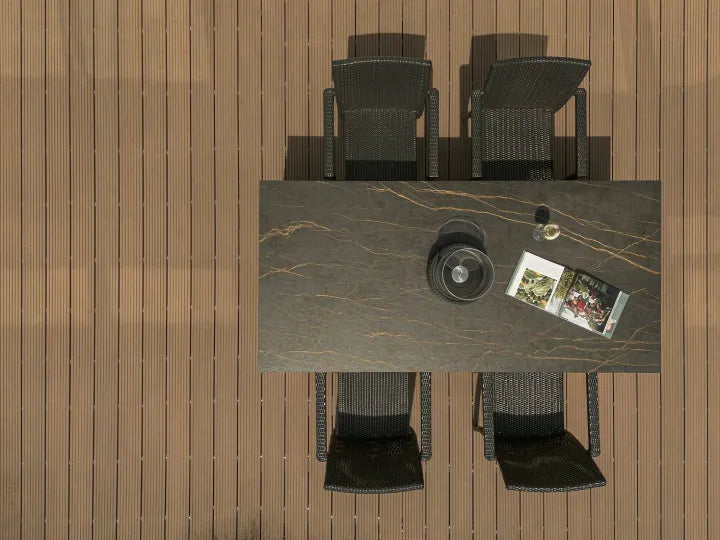
트래버틴 vs 대형 세라믹: 천연 트래버틴인가, 트래버틴 디자인 슬래브인가?

천연 트래버틴은 고유한 편차와 보이는 기공이 있고, 트래버틴 룩 대형 세라믹은 더 치밀하고 관리가 쉬운 선택입니다. 더 나은 선택을 바꾸는 조건을 비교하세요.
LuCharlotte LuCharlotte 11 분 읽기 업데이트

Quick Decision

Choose natural travertine when the project depends on genuine geological variation, open or filled pores, and a surface that can age visibly. Choose travertine-look sintered stone when lower absorption, simpler routine care, repeatable slab selection, and verified resistance to stains, acids, UV exposure or heat matter more than owning the natural stone itself.

Neither route wins everywhere. Natural travertine can be excellent for floors, walls, bathrooms, furniture and outdoor work when the stone, finish and installation are selected for that use. Sintered stone is often the more practical route for busy counters, repeated furniture modules and low-maintenance wall or exterior programs—but only after the exact slab’s technical data and fabrication requirements are confirmed.

Choose natural travertine forAuthenticity and one-off variation
Choose sintered stone forControlled performance and repeatability
Verify before eitherFinish, application and installation system

What Are Natural Travertine and Travertine-Look Sintered Stone?

Natural travertine is a calcareous dimension stone formed by calcium-carbonate deposition, commonly around mineral springs. Its banding, pores and voids belong to the stone itself. A supplier may offer it unfilled, or fill larger voids with cementitious or resin-based material before honing or polishing it. The finished surface is still natural travertine; filling changes the surface treatment, not the geology.

Travertine-look sintered stone is a manufactured mineral slab whose colour and pattern are designed to evoke travertine. It is not quarried travertine. Its dense fired body, surface decoration, thicknesses and performance vary by manufacturer and product. The useful comparison is therefore not “real stone versus fake stone,” but authentic natural variation versus a controlled slab system with a different care and fabrication profile.

If this pair is only one part of a wider shortlist, use Funtek’s sintered stone material comparison to compare additional natural and manufactured surface families.

Visual Variation: Authentic Irregularity or Controlled Repeatability?

Natural travertine can change visibly from block to block and even across one slab. Bands may tighten or spread, pores may cluster, mineral tones may shift, and filled areas may read differently from the surrounding stone. Vein cutting emphasizes linear layers; cross cutting creates a cloudier, more dispersed movement. That variability is the reason to choose it—not a defect to be edited out after purchase.

Sintered stone offers a designed interpretation. It can reproduce linear bands, quiet beige fields, silver-grey movement or stronger rust-red directions with greater control across a project. The trade-off is repetition: printed faces and pattern placement can recur, and a cut edge may not carry the same visual composition as the top face. Review every available face, the planned layout and the actual edge detail before approval.

For a broader explanation of linear, stone, marble, concrete and other design families, see the sintered stone patterns guide. For colour-specific routes, use the separate gray travertine-look slab shortlist or the red travertine guide; this page does not replace either colour owner.

Pores, Sealing, Stains and Acid: The Biggest Practical Difference

Travertine’s pores affect appearance, cleaning and specification. Filling can close the larger visible voids, while an impregnating sealer may reduce the rate at which liquids enter the stone. It does not make the surface stain-proof. The Natural Stone Institute describes impregnators as repellents and recommends deciding whether and how often to seal with the stone and sealer supplier rather than applying one fixed calendar to every travertine.

Acid is a separate issue. Travertine is calcium-carbonate based, so lemon, vinegar, acidic cleaners and similar substances can chemically etch or dull the surface. A penetrating sealer may help with liquid absorption and staining, but it does not change that mineral reaction. The operating rule is simple: use a stone-compatible neutral cleaner, blot spills promptly and accept that a natural honed surface may develop patina in active areas.

A dense sintered slab generally does not need a penetrating sealer, but stain and chemical resistance must still be read from the exact product data sheet. Surface texture, fabrication residue, adhesives and joints can change how the finished installation cleans. “Non-porous slab” does not mean “maintenance-free assembly.”

Close-up comparison of porous natural travertine and a dense travertine-look sintered stone edge
Editorial material study: natural travertine shows irregular open voids and a varied edge, while the travertine-look sintered sample is shown as a dense manufactured slab. Verify the actual project materials before specification.

Sealing may reduce liquid absorption in travertine, but it cannot turn a calcium-carbonate stone into an acid-resistant surface.

Decision factor Natural travertine Travertine-look sintered stone
Material identity Quarried calcareous stone with natural pores and mineral variation Manufactured mineral slab with a designed travertine appearance
Variation Unique and less predictable; approve actual slabs or pieces More controlled, but faces and repeats must be mapped
Pores Visible voids may be left open or filled Dense slab surface; no natural travertine void structure
Sealing May benefit from an impregnator depending on stone, finish and use Slab normally does not require a penetrating stone sealer; verify product instructions
Staining Absorption risk varies; filling and sealer are not stain-proofing Typically lower absorption; verify the exact stain test and finish
Acid Calcareous surface can etch Many products document chemical resistance; verify the named slab and test scope
Scratches and impact Can scratch, pit or chip; refinishing and repair options depend on finish and damage Hard and scratch-resistant, yet brittle edges and cut-outs can chip
Outdoor route Proven outdoor use is possible with suitable stone, finish, climate and installation Possible only when the exact product and installation system are approved for UV, weather and freeze-thaw exposure
Repeatability Batch matching and future replacement are inherently variable Usually easier to schedule across repeated modules, subject to face and batch availability
Primary reason to choose Authentic depth, tactile pores and natural ageing Lower-care performance with a controlled travertine visual

Heat, UV, Scratches and Edges: Hardness Does Not Eliminate Damage

Heat: Both material families can tolerate heat better than many resin-rich surfaces, but that does not make every installation heat-proof. The Natural Stone Institute still recommends trivets on natural stone. For sintered stone, use the named manufacturer’s limit and care instructions, and consider thermal shock, bonded components and nearby sealants—not only the slab body.

UV and weather: Natural travertine has a long history outdoors, where weathering and colour development can be part of the intended character. Suitability still depends on the specific stone, soundness, fill, finish, drainage, climate and installation. Sintered stone brands such as Lapitec publish UV, frost and weather resistance for specified products, but one brand’s document is not proof for every slab sold as “sintered stone.”

Scratches and edges: Travertine is comparatively easy to scratch and can expose or lose fill around pores, yet a stone restoration professional may be able to hone, refill or blend some damage. Sintered stone is harder against abrasion, but a hard slab can still be brittle at sharp corners, sink cut-outs and exposed edges. Edge radius, support, cut-out geometry, handling and fabricator experience matter. Do not use “scratch-resistant” as a substitute for an edge and support plan.

Which Material Works Better by Application?

Application Natural travertine route Sintered stone route Decision that changes the winner
Countertops Choose for an authentic, patina-friendly statement surface with disciplined care Often the practical default for food, cosmetics and frequent cleaning Acid exposure, acceptable patina, edge/cut-out design and care tolerance; continue with the dedicated travertine countertop guide
Bathrooms Strong design route when pores, fill, sealer, waterproofing and stone-safe cleaning are deliberately resolved Lower-absorption route for vanity tops and large wall panels; joints and substrate waterproofing still matter Wet-zone detail, slip rating for floors, cleaner regime and maintenance responsibility
Floors Authentic tactile floor with natural module variation; finish and abrasion suitability must match traffic Controlled large-format look with low absorption; verify slip class, thickness and installation method Traffic, slip requirement, module rhythm, substrate and repair strategy
Outdoor areas Valid for many patios, walls and landscape settings when the selected travertine and system suit local exposure Compelling where a verified product documents UV, frost and weather performance Climate, drainage, freeze-thaw, finish, anchoring or bedding system and local codes
Furniture and tables Best for one-off sculptural pieces where unique variation justifies weight and care Best for repeated tables, active hospitality use or easier cleaning, provided edges and support are engineered Number of units, stain exposure, edge contact, base support and replacement plan
Walls and features Depth, pores and natural irregularity create the strongest material expression Large, controlled faces can simplify visual alignment and maintenance Desired authenticity, panel size, anchoring, weight, access and future replacement
Editorial comparison of natural travertine feature surfaces and repeated travertine-look sintered stone furniture
Editorial application illustration, not a documented Funtek project: natural travertine is presented as a one-off feature material, while travertine-look sintered stone is shown across repeated furniture surfaces.

For a sintered-stone countertop project that has already passed the material decision, continue to Funtek’s countertop slab and project-supply page. That page owns product supply and project planning; this comparison stops at choosing the material route.

Slab Size, Joints and Edge Design

Factory-made sintered slabs are commonly offered in large standard formats, which can help a designer plan tall wall panels, long worktops or repeated table modules. Large format does not automatically mean a joint-free result. Transport access, lift size, cut-outs, pattern placement, support, installation sequence and maximum workable piece size can still create seams.

Natural travertine slab dimensions depend on the quarry block, selection and soundness. A smaller module or deliberate joint rhythm can be a design advantage on floors and walls, while a one-piece counter or furniture top may require more selective slab sourcing. Compare usable pieces after defect removal and layout—not headline slab dimensions alone.

Edges reveal another difference. Natural travertine edges expose real stone and may show pores or fill. Many travertine-look sintered products carry their main design on the face, so a thick visual edge may require a mitred build-up or another approved detail. Ask to see a fabricated edge sample, not only a flat surface sample.

Price: Compare the Installed Scope, Not the Material Label

There is no reliable universal rule that natural travertine is always cheaper or always more expensive than sintered stone. Natural-stone cost changes with quarry, colour, block yield, selection, cut, fill, finish, piece size and local availability. Sintered-stone cost changes with brand, design, face count, format, thickness, finish, fabrication, crating and freight.

Compare equal installed scopes: approved pieces or faces, usable yield, edge work, cut-outs, backing or support, sealing where applicable, delivery access, installation, spare pieces and maintenance responsibility. A low material-only number can lose its advantage after specialist fabrication or selective slab matching; a higher initial surface cost can be rational when repeatability or care burden matters across many units.

When to Choose Natural Travertine—and When to Choose Sintered Stone

Choose natural travertine when:

  • the brief specifically requires authentic quarried stone rather than a travertine appearance;
  • variation, pores, fill and gradual patina are accepted design characteristics;
  • the client will use stone-safe cleaners and accept the selected sealing or restoration plan;
  • actual slabs, tiles or pieces can be approved for colour, cut, soundness and fill;
  • the exterior, wet-area, floor or furniture detail has been designed around that exact stone.

Choose travertine-look sintered stone when:

  • the project wants travertine movement without natural pores or acid-sensitive calcium carbonate;
  • low absorption and simpler routine cleaning are important operating requirements;
  • multiple rooms or repeated furniture modules need controlled faces and replacement planning;
  • large panels or long worktop pieces suit the access, support and fabrication plan;
  • the exact product documentation confirms the required indoor, outdoor, heat, UV, stain or chemical scope.

The Bottom Line

Natural travertine is the stronger choice when material authenticity and one-off variation are the design value. Travertine-look sintered stone is the stronger choice when the project needs a denser, lower-care surface and more controlled repetition. The most important distinction is not appearance; it is whether the client wants to live with a natural calcareous stone or specify a manufactured slab system.

Before approval, compare an actual natural travertine piece with a full-size sintered face and a fabricated edge sample. Then verify the maintenance plan, technical data, installation system and quote scope for the chosen route. To shortlist the manufactured route, browse the travertine-look sintered stone collection.

Evidence note: Natural-stone care and sealing guidance was checked against the Natural Stone Institute care guidance and its Dimension Stone Design Manual resource library. Sintered-stone performance varies by product; manufacturer documents such as the Lapitec processing manual are examples to verify against the exact slab being specified, not universal proof for every brand.

Compare the Travertine Look at Full-Slab Scale

Send the application, approximate dimensions, colour direction and indoor or outdoor location. Funtek can prepare a relevant travertine-look sintered stone sample route for your project review.

작성자 소개

LuCharlotte

신터드 스톤 스페셜리스트 & 기술 자문

LinkedIn에서 연결

LuCharlotte는 신터드 스톤 제조, 소재 테스트, 프로젝트 사양 검토에 대한 현장 경험을 바탕으로 글을 씁니다. 건축가, 디자이너, 가공업체, 프로젝트 구매자를 위해 표면 성능, 슬랩 규격, 가공 로직, 마감 선택, 적용 적합성에 관한 실무적인 가이드를 제공합니다. 기술적인 소재 결정을 더 명확하고 정확하며 검증하기 쉽게 만드는 것이 목표입니다.