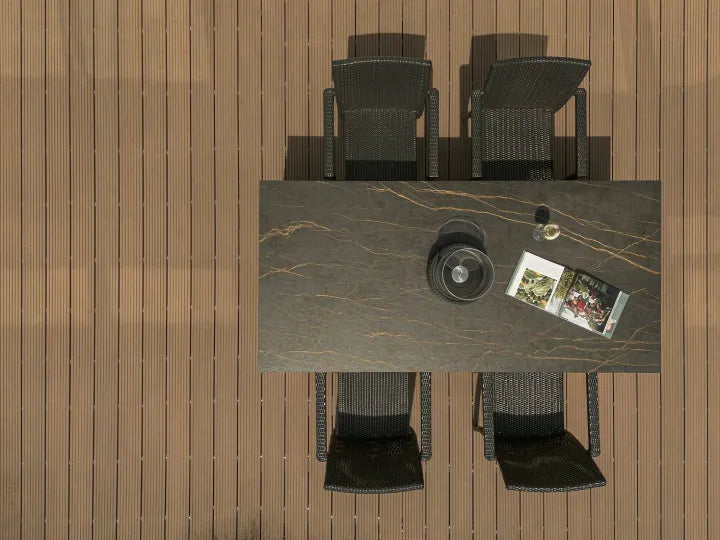
Anti-slip tiles should be selected for the conditions in which people will actually walk, not by colour, appearance or a single product label. Funtek supplies large-format sintered stone floor surfaces in matte, low-glare and textured directions; the right project choice depends on the use area, expected water or contaminants, cleaning method and the slip-resistance standard required in the destination market.
For an initial recommendation, send Funtek the application, country, preferred surface, slab size, thickness and quantity. We can then help you compare current floor products, arrange samples and discuss the technical information required for project approval.
Funtek Anti-Slip Tile Options
Funtek's current floor range includes cement, natural-stone and travertine looks that give architects, distributors and project buyers several visual starting points. The products below are active in the Funtek catalogue and are available in multiple large-format slab sizes and 6, 9, 12 and 15 mm thicknesses.
Alps Grey Sintered Stone Slabs
Alps Grey combines a soft grey field with off-white, taupe and warm-beige movement. It gives neutral commercial interiors and entrance floors more depth than a flat cement colour while remaining restrained across a large layout.
View productCaesar Silver Travertine Sintered Stone Slabs
Caesar Silver Travertine uses layered silver-grey bands and a low-glare travertine character. It suits buyers who want a linear stone direction without the stronger contrast of a marble pattern.
View productNordic Rock – Light Grey Sintered Stone Slabs
Nordic Rock – Light Grey has a pale beige-grey field and subtle mineral clouding. Its quiet pattern stays visually stable across broad interior floors and coordinated wall-and-floor schemes.
View productDior Beige Cement Look Sintered Stone Slab
Dior Beige combines a warm cream-beige base with a fine cement-inspired texture. It offers a softer alternative to cool grey concrete looks for retail, hospitality and front-of-house areas.
View productVerified performance of the Textured / Anti-Slip surface
All four products above can be specified with Funtek's Textured / Anti-Slip surface. Funtek's August 2026 technical data sheet reports the following results for that surface:
| Use condition | Test method | Reported result |
|---|---|---|
| Shod use | DIN 51130 | R11 |
| Wet-barefoot use | DIN 51097 | Class C |
| Wet dynamic coefficient of friction | ANSI A326.3 / DCOF | ≥ 0.69 |
The same sheet lists water absorption at ≤ 0.1%, resistance to deep abrasion at ≤ 175 mm3, frost resistance as resistant with no damage, and stain resistance at Class 4–5. These values apply to the named Textured / Anti-Slip surface. Confirm the selected product, surface, size and destination-market documentation together in the project quotation.
Where Can Anti-Slip Tiles Be Used?
Anti-slip tiles can be used in bathrooms, entrances, commercial floors, food-service areas, outdoor walkways and pool surrounds, but those spaces do not create the same slip conditions. The useful first question is not simply “Is this tile anti-slip?” It is “What will be on the floor, who will walk on it, and how will the area be cleaned and drained?”
| Application | Conditions to define | What the specification should address |
|---|---|---|
| Bathroom and shower floors | Water, soap, bare feet, drainage and cleaning residue | Wet or wet-barefoot test method, exact surface, drainage and cleanability |
| Commercial entrances | Rainwater carried indoors, grit, heavy traffic and frequent cleaning | Wet classification, wear, entrance matting and maintenance plan |
| Restaurants and commercial kitchens | Water, oil, grease, food residue and wheeled equipment | Contaminant-specific classification, drainage and cleaning process |
| Patios and outdoor walkways | Rain, slope, standing water, weather exposure and outdoor dirt | Exterior-wet use, local code, drainage and climate requirements |
| Pool surrounds and spas | Continuous water, bare feet, pool chemicals and drainage | Wet-barefoot testing, surface comfort, drainage and maintenance |
Bathrooms and shower floors
A bathroom floor outside the shower and a continuously wet shower floor may require different evidence. For a stone-led bathroom palette, Caesar Silver Travertine offers a low-glare visual direction, but the project team still needs to identify whether the selected floor will be walked on with footwear, bare feet or both, and whether soap residue is expected.
Drainage belongs in the same decision as the surface. A tile cannot compensate for water that is allowed to pond, and a heavily structured finish may create a different cleaning requirement from a restrained matte surface.
Commercial entrances and high-traffic floors
Commercial entrances need a finish that is evaluated for water carried in from outside, abrasive dirt, cleaning cycles and long-term traffic. Alps Grey and Nordic Rock provide low-glare, neutral directions for this kind of interior design, while the final surface still has to match the entrance conditions and the project's selected standard.
For larger transport, retail or hospitality schemes, the related high-traffic sintered stone flooring specification explains how substrate, movement joints, finish evidence, maintenance and installed-floor verification affect the wider floor system.
Restaurants and commercial kitchens
Water-wet data alone does not answer a commercial kitchen question. Oil and grease are more viscous contaminants, and they can require a different product-use classification, more pronounced surface structure and a cleaning procedure designed to remove residue instead of spreading it.
Front-of-house dining floors and back-of-house food-preparation floors should therefore be treated as separate use zones. Dior Beige may suit the warm visual direction of a restaurant dining area; the working kitchen must be selected from the actual oil, grease, drainage, footwear and cleaning conditions.
Patios, walkways and outdoor areas
An outdoor floor needs more than an indoor wet rating. The specification should identify rain exposure, slope, drainage, climate, expected dirt and whether the area includes stairs or ramps. In the United States, ANSI A326.3 uses a separate Exterior Wet category; in other markets, local building provisions or project standards may prescribe a different test and classification.
Ask Funtek to match the outdoor requirement before selecting a visual product. This prevents an interior surface from being approved only because its colour and texture look suitable in a catalogue image.
Pool surrounds and barefoot wet areas
Pool surrounds and spas need wet-barefoot evidence because ordinary shod-footwear ratings do not reproduce the same use condition. Surface comfort, drainage, pool-water exposure and cleaning also affect the choice. A useful pool specification therefore identifies each zone—surround, entry step, changing area or permanently immersed surface—rather than assigning one rating to the entire project.
For the full testing and project-approval process, read how to choose anti-slip tiles around a swimming pool. That guide covers wet-barefoot methods, PTV interpretation, drainage, cleaning and installed verification in greater depth.
How Are Anti-Slip Tiles Rated?
Anti-slip ratings describe results from defined test methods; they are not interchangeable labels for a universally “safe” tile. The project location and use condition determine which system belongs in the specification.
Funtek's Textured / Anti-Slip data sheet reports R11, Class C and wet DCOF ≥ 0.69 separately because each value comes from a different test method and use condition. They are three pieces of project evidence, not three ways of expressing the same result.
| System | Common market or use | What it tells the buyer |
|---|---|---|
| ANSI A326.3 | United States, hard-surface flooring | Product-use classes for Interior Dry, Interior Wet, Interior Wet Plus, Exterior Wet and Oils/Greases |
| Wet DCOF | US interior wet classification and comparative testing | Dynamic coefficient of friction under the stated device and test condition; it is one input, not a prediction that nobody will slip |
| R9–R13 | Shod commercial and work areas | Acceptance-angle class from an oil-wet ramp test using safety footwear |
| A, B or C | Wet-barefoot areas | Acceptance-angle class from a barefoot ramp test with a soap solution |
| Pendulum Test Value | United Kingdom and other project specifications | Slip-potential assessment using a stated slider, dry or contaminated condition and test direction |
| AS 4586 | Australian pedestrian surfaces | Classification methods used with application-specific National Construction Code requirements |
ANSI A326.3 and DCOF for US projects
ANSI A326.3:2021 classifies hard-surface flooring as Interior Dry (ID), Interior Wet (IW), Interior Wet Plus (IW+), Exterior Wet (EW) or Oils/Greases (O/G). The Tile Council of North America lists a dry DCOF of at least 0.42 for ID and a wet DCOF of at least 0.42—or a manufacturer declaration—for IW. IW+, EW and O/G are manufacturer-declared classifications under the standard.
The same standard makes the limitation clear: DCOF and slip resistance are not synonymous. Traffic, contaminants, footwear, drainage, maintenance, wear and whether the floor is flat or inclined all change the project decision. ANSI A326.3's product-use categories also do not cover ramps or inclined surfaces.
R ratings and wet-barefoot classifications
The R scale comes from a shod ramp method using safety footwear and oil. The acceptance-angle bands are R9 at 6–10 degrees, R10 above 10–19 degrees, R11 above 19–27 degrees, R12 above 27–35 degrees and R13 above 35 degrees. A higher R class indicates a higher acceptance angle in that specific test; it should not be translated directly into a DCOF or PTV number.
Wet-barefoot ramp testing uses a different setup and reports A, B or C classes. The bands commonly reported are A at 12–17 degrees, B at 18–23 degrees and C above 24 degrees. Because the contaminant, footwear condition and method differ from the R test, an R11 product is not automatically a Class B or Class C barefoot product. European projects may reference the methods consolidated in EN 16165:2021.
PTV and Australian classifications
The UK Health and Safety Executive uses the pendulum as its preferred method for assessing floor slipperiness in dry and contaminated conditions. Its guidance classifies a PTV of 0–24 as high slip potential, 25–35 as moderate and 36 or more as low slip potential. It also identifies Slider 96 for shod pedestrians and Slider 55 for barefoot areas. These values are useful only when the slider, condition, direction and operator procedure are stated. See the HSE technical sheet on assessing the slip resistance of flooring.
Australian projects commonly use AS 4586 classifications together with the National Construction Code. The NCC sets application-specific requirements for stair treads, nosings and ramps, including different dry and wet conditions; those requirements should not be turned into a single universal grade for every floor.
DCOF, R classes, A–C barefoot classes and PTV results come from different methods, so do not convert one into another or approve a project from the rating name alone.
Which Surface Finish Should You Choose?
Choose the surface finish that satisfies both the required slip-resistance method and the real maintenance conditions. Matte and textured finishes can be useful starting points, but appearance alone cannot show how the floor will behave with water, soap, oil, wear or cleaning residue.
Matte surfaces for low-glare interiors
Matte finishes reduce visual glare and can support calm, continuous floor schemes. Alps Grey and Nordic Rock – Light Grey are current Funtek examples of this direction. They can be shortlisted by appearance and floor application first, then matched to the finish and project evidence needed for the intended use zone.
Textured and low-glare stone looks
Texture can help a surface interact with footwear and contaminants, but deeper or sharper structure may retain dirt and require different cleaning equipment. Caesar Silver Travertine provides a low-glare linear texture, while Dior Beige uses a finer cement-inspired texture. Comparing these two samples under the project's lighting and cleaning process is more useful than selecting from the word “textured” alone.
Polished surfaces in wet areas
A polished surface should not be the default choice for a floor that is expected to remain wet. If a polished visual is important, separate the wall and dry-area design from the wet walking surface, or request a different surface finish that preserves the colour direction while addressing the floor condition.
Cleaning, drainage and wear
Cleaning is part of slip performance, not a later housekeeping detail. A detergent film, grease residue or unsuitable polishing process can reduce traction, while an overly aggressive texture can slow cleaning and trap contaminants. Define the contaminant and cleaning method before approving the sample.
Installation can also change the finished floor. Grouting, final cleaning, on-site polishing, drainage, joint layout and later wear may alter the conditions represented by an ex-factory sample. The sintered stone installation guide provides the wider installation sequence; the flooring specification should still state the acceptance test and responsibility for the completed walking surface.
How to Order Anti-Slip Tiles for a Project
Send enough project information for the supplier to identify the correct use condition before preparing a quotation. A product name and square-meter quantity are not enough when the floor may be wet, greasy, outdoors or used barefoot.
- Application area and room or zone
- Destination country and applicable standard or project specification
- Indoor, outdoor, level, stair or ramp condition
- Dry, water-wet, barefoot, oil or grease exposure
- Expected traffic, footwear and wheeled loads
- Drainage and cleaning method
- Preferred Funtek product or visual direction
- Required slab or module size and thickness
- Estimated quantity and cutting or fabrication requirements
- Destination port, project timeline and sample requirement
The August 2026 anti-slip technical sheet lists 6, 9, 12, 15 and 20 mm product-line thicknesses, with approximate weights of 14.4, 21.6, 28.8, 36.0 and 48.0 kg/m2 respectively. The four products featured above are currently presented in 6, 9, 12 and 15 mm options; confirm 20 mm availability and every size, thickness and anti-slip-surface combination in the quotation.
If the quantity is still being developed, use the sintered stone area calculator to organize the first estimate. For broader floor planning, product supply and sample approval, review the Funtek sintered stone flooring page.
With the use zone, target standard, preferred surface and quantity defined, Funtek can help shortlist current floor products, arrange physical samples and prepare a project quotation. Final approval should be based on the selected finish and the evidence required by the project's designer, specifier or local authority.
Specify Anti-Slip Tiles for Your Project
Send the use area, destination country, preferred product and surface, size, thickness and estimated quantity. Funtek can then match samples, technical information and the project quotation.