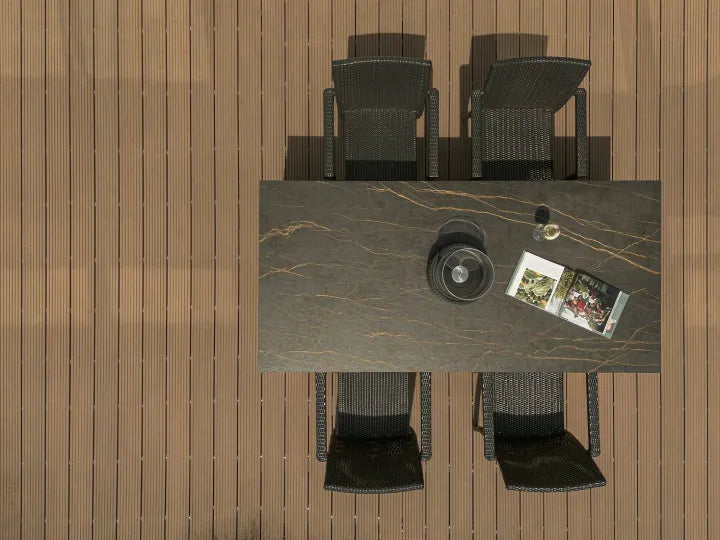
A Silestone alternative can mean two different things: another branded mineral or quartz surface with a similar indoor-countertop experience, or a different material chosen to improve heat, exterior suitability, repairability, natural variation or budget. Separate those two routes before comparing colors. Otherwise, a lookalike sample can hide a completely different fabrication and use profile.
What Is the Best Alternative to Silestone?
For the closest familiar indoor-countertop experience, compare another established mineral or engineered-quartz brand. For greater heat and UV flexibility, shortlist an exterior-approved sintered stone or large-format porcelain. Choose granite or quartzite for natural slab character, solid surface for repairable seamless details, and laminate when initial budget and low weight matter most.
There is no universal winner. The correct replacement is the option that meets the exact application, visual reference, local fabrication capability, written technical documentation and equal-scope installed quote.
First Confirm What You Are Replacing
Silestone is a brand, not a generic name for every manufactured stone. Its current manufacturer describes the portfolio as a low-silica mineral surface made with premium minerals and recycled materials. Current colors carry labels indicating a maximum crystalline-silica content of 10% or 40%, so a buyer should not assume that every present-day Silestone color has the same composition as an older quartz worktop.
Record the exact color, finish, thickness, slab format, application, market and date of the specification you are replacing. Then identify the reason for changing. Is the project trying to reduce cost, find a similar pattern, obtain an exterior-approved surface, improve heat tolerance, simplify repair, lower weight, shorten lead time or work with a trusted local fabricator? Each answer produces a different shortlist.
Do not compare a Silestone color name with a generic material label; compare two current product documents, two physical samples and two quotations built from the same drawing and inclusions.
Choose Between a Same-Category Substitute and a Material Switch
A same-category substitute preserves the familiar qualities that led the buyer to Silestone: a controlled pattern, a low-porosity finished surface, indoor countertop use and an established fabricator network. Cambria, Caesarstone, MSI Q, Viatera and other documented regional brands may belong on that route, but the best option depends on the exact local collection, warranty, stock and installer—not a global brand ranking.
A material switch changes the engineering brief. Sintered stone and porcelain can strengthen the heat and exterior conversation; natural stone introduces unique slab variation; solid surface makes seams and repairs a different design problem; laminate reduces weight and often initial cost. Use Funtek's broader surface material comparison when you need to step back from the brand name and compare material families.
Seven Silestone Alternatives Compared
| Alternative route | What it preserves or improves | Main trade-off to approve | Best starting use |
|---|---|---|---|
| 1. Another mineral or quartz brand | Controlled colors, familiar indoor use and conventional quartz-fabrication route | Exact composition, warranty, design tier, stock and installer vary by product and market | Indoor kitchens needing the closest category match |
| 2. Sintered stone | Low porosity, strong heat and UV direction, large-format design range | Edges, corners, cutouts, support and specialist fabrication need early approval | High-use interiors, exposed applications and B2B slab projects |
| 3. Large-format porcelain | Heat, stain and UV direction with thin slab options and printed stone looks | Thin-body handling, edge appearance, chipping risk and fabricator availability | Countertops, walls and designs needing material continuity |
| 4. Granite | Natural variation, exterior potential and strong heat direction | Each stone and slab varies; porosity, sealing and fissures require product-specific review | Buyers who want genuine natural-stone character |
| 5. Quartzite | Natural movement and heat direction with a premium slab identity | Trade names can be unreliable; verify geology, porosity, finish and care on the actual slab | Design-led kitchens where natural veining is the priority |
| 6. Solid surface | Visually quiet seams, integrated shapes and repairable scratches in many systems | Lower scratch and direct-heat tolerance than hard mineral slabs; finish can show wear | Curved, seamless or hygiene-led interior details |
| 7. Laminate or compact laminate | Lower weight, broad décor range and often lower initial project cost | Different edge, heat, scratch, moisture and premium-feel expectations | Budget-led interiors, rentals and lightweight cabinetry |
1. Another Mineral or Engineered-Quartz Brand
This is the first route when the client likes the general Silestone experience and mainly wants a different pattern, price tier, warranty, country of manufacture or local stock position. Compare physical samples from established brands under the real project lighting, then check the current safety data, technical sheet, care guide and warranty for the exact design.
Do not assume that all brand differences are performance differences. Fabricator skill, slab yield, seam position and quote scope may matter more than the logo for a normal indoor kitchen. The same-category route is also the least disruptive when cabinetry, edge profiles and installation planning were developed around a conventional 20 or 30 mm mineral/quartz worktop.
2. Sintered Stone
Sintered stone is the strongest Funtek route when the project wants a mineral slab without a polymer-resin binder, stronger heat and UV direction, and large-format stone, marble, concrete or solid-color visuals. It is not automatically better in every detail: the hard working face does not eliminate edge impact, cutout, handling, support or fabrication risk.
For the full material decision, use the dedicated sintered stone vs quartz countertop comparison. Once the route is selected, require the fabricator to approve the actual thickness, edge build-up, sink and cooktop radii, seam plan, support and site access.
3. Large-Format Porcelain
Large-format porcelain is a close technical neighbor to sintered stone in many countertop conversations, but product terminology and manufacturing standards are not interchangeable. It can offer thin profiles, low porosity, printed stone looks and exterior potential when the exact product is approved for that use.
The body and edge may not reproduce the face pattern. Ask to see a finished edge and a completed sink or cooktop cutout, not just the polished face. A strong product installed by a team without large-format slab experience is not a low-risk substitute.
4. Granite
Granite is the natural-stone route for buyers who prefer geological variation over controlled repetition. Many granites can be suitable for demanding indoor and exterior applications, but “granite” in the showroom is a commercial label that can cover stones with different absorption, mineral structure and performance.
Approve the actual slab, not a small sample. Record any resin treatment, mesh backing, fissures, finish, sealing recommendation and exterior limitation. Natural variation is the value proposition, so it should be planned rather than treated as a defect after fabrication.
5. Quartzite
Quartzite is a natural metamorphic stone, not manufactured quartz. It can provide the depth, translucence and movement that printed or molded patterns only approximate. It can also carry a premium price and a more demanding slab-by-slab approval process.
Ask the supplier to identify the stone accurately and provide current care guidance. Some slabs sold under quartzite trade names behave more like marble or dolomitic stone when exposed to acid. A sample test, written supplier information and an experienced natural-stone fabricator are more useful than the trade name alone.
6. Solid Surface
Solid surface changes the decision from “hardest slab” to “most controllable shape and repair.” Acrylic-rich systems can form integrated sinks, curved details and visually quiet joints. Many scratches can be renewed within the material's approved repair process, which is valuable in hospitality, healthcare and high-service interiors.
The trade-off is a softer working surface with different heat and scratch limits. Approve the finish, joint locations, sink detail and repair responsibility. If the design depends on a convincing deep-vein natural-stone look, review large samples carefully because solid surface often excels more in quiet colors, terrazzo directions and seamless geometry.
7. Laminate or Compact Laminate
Laminate is a valid alternative when the real brief is affordable, lightweight and quick to install—not when the buyer expects a mineral slab at a lower price. Modern décors can photograph convincingly, while compact laminate can create a thinner visual profile than a conventional built-up worktop.
Compare the core, edge, sink detail, heat guidance, moisture exposure and replacement plan. A lower material quote does not automatically mean a lower completed-project cost if the design still requires complex templating, premium edging or changes to cabinetry.
Match a Specific Silestone Look Without Chasing an Exact Copy
Start with the visual attributes, not the brand name. Record the background undertone, vein color, vein width, direction, repeat scale, contrast, finish and how the pattern crosses a full slab. “White Calacatta” is not a sufficient brief: one design may be cool white with blue-grey branching, while another is warm ivory with fine brown and gold movement.
Use this approval sequence:
- Place physical samples beside the actual cabinet, floor, paint and hardware. Check daylight and evening light.
- Review the full-slab image or actual slab. A hand sample cannot show vein frequency, large blank areas or repeats.
- Compare the finish at the intended angle. A horizontal countertop and vertical backsplash reflect light differently.
- Map every major piece. Mark seams, cutouts, waterfall ends and the main viewing direction.
- Approve a finished edge. The face, body and miter joint may have different visual behavior.
An alternative should reproduce the design intent, not impersonate a named color. If a contract, brand standard or client approval specifies Silestone, obtain written approval before substituting another product.
Compare Performance at the System Level
A countertop is the slab plus edges, cutouts, seams, adhesive, support, cabinetry and installation. Surface hardness does not prove edge-impact resistance. Low water absorption does not prove that an undermount-sink detail is correctly reinforced. A heat-resistant face does not remove the temperature limits of adhesives or adjacent appliances.
For Silestone itself, Cosentino's current use and care guidance advises against placing hot cookware directly on the surface and identifies pointed corners and fine edges as areas to protect from impact. Apply the same discipline to every alternative: read the current manufacturer document for the exact product and design the complete system around it.
When the selected route is sintered stone, use the sintered stone installation workflow to structure the handoff, then require the product manufacturer and fabricator to approve the project-specific details.
Build an Equal-Scope Quote Before Comparing Cost
Material-only rates, slab prices and installed countertop quotes are different numbers. A cheaper-looking alternative can become more expensive after an extra slab, specialist freight, mitered edges, complex cutouts, access equipment or a distant fabricator is added. Use the Funtek sintered stone price guide for the cost framework, then give every bidder the same drawing and responsibility list.
Require each quote to state:
- manufacturer, product name or code, batch, finish, thickness and slab format;
- quantity, slab yield, offcut ownership and allowance for visual matching;
- templating, cutouts, drainage grooves, edge profiles, miters, seams and support;
- delivery, access, installation, protection, breakage and remake responsibility;
- technical data, safety data, care instructions, warranty and registration steps;
- lead time, validity period, exclusions and the currency and tax basis of the quote.
For a factory-direct sintered-stone project, Funtek's sintered stone sourcing process adds sample, batch, inspection, packing and logistics controls that do not appear in a local installed-worktop quote.
Australia Requires a Separate Product-Legality Check
Do not carry a US or UK material shortlist into Australia unchanged. Safe Work Australia states that manufacture, supply, processing and installation of engineered-stone benchtops, panels and slabs have been prohibited since July 1, 2024. The definition and exclusions are product-specific: the official guidance excludes sintered stone and porcelain when they do not contain resin, and products below the stated crystalline-silica threshold are outside the engineered-stone definition.
That exclusion is not a declaration that fabrication dust is harmless. The same Safe Work Australia guidance says processing crystalline-silica substances must still be controlled. Before specifying an Australian benchtop, obtain the current product composition, legal status and fabricator control plan for the exact jurisdiction and date.
The Bottom Line
The best Silestone alternative is not the longest list of surface names. It is a two- or three-product shortlist built from the reason for changing. Stay with another documented mineral or quartz brand when the goal is the closest indoor-countertop experience. Move to sintered stone or porcelain when heat and exterior direction lead; natural stone when unique slab character leads; solid surface when seamless repairable geometry leads; or laminate when budget and weight lead.
Finish the decision with physical samples, full-slab review, a finished edge, current technical documents, an experienced fabricator and equal-scope quotes. Buyers ready to evaluate the material-switch route can review Funtek's sintered stone countertop options before preparing a project brief.
Need a Project-Ready Sintered Stone Alternative?
Send the application, destination, drawings, quantity, preferred visual direction and required documentation. Funtek can review current factory-direct slab options, samples, fabrication coordination, packing and supply responsibilities.