


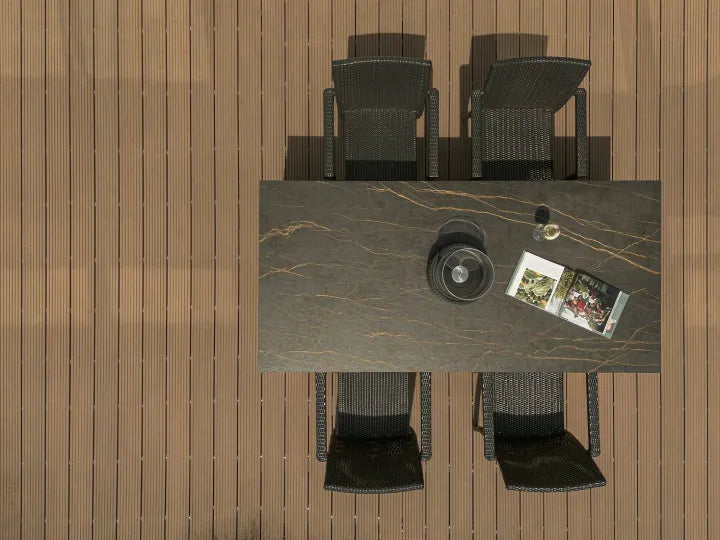


La pierre frittée est le meilleur matériau global pour les paillasses de laboratoire pour la plupart des laboratoires modernes d’enseignement, de recherche, de préparation d’échantillons et à usage général. Il combine une surface pratiquement non absorbante, une grande résistance aux produits chimiques de laboratoire courants, une excellente performance thermique et de rayure, un nettoyage simple, de grands formats de dalles et bien plus de liberté de conception que les paillasses en résine noire. C’est la réponse la plus claire.
La raison n’est pas la mode. Les données publiées sur les surfaces frittées utilisent couramment la série d’essais ISO 10545 et rapportent une absorption d’eau autour de 0–0.1 %, aucun dommage visible lors de multiples essais acides et alcalins, une résistance à la flexion autour de 59–67 N/mm² et aucun dommage après les essais par choc thermique. Ce sont précisément les propriétés dont une surface de laboratoire travailleur a besoin.
Quel est le meilleur matériau pour le paillasse dans un laboratoire?
Spécifiez la pierre frittée comme paillasse par défaut pour la majorité des établis de laboratoire. Il offre le meilleur équilibre entre résistance chimique, résistance à la chaleur, résistance aux rayures, hygiène, résistance aux taches, qualité visuelle et entretien au cycle de vie. La résine époxy reste un choix spécialisé pour les établis dominés par une exposition agressive et prolongée à des produits chimiques humides ou des éviers moulés intégrés. L’acier inoxydable reste le choix spécial pour les zones soudées stériles et les zones de lavage.
Pourquoi la pierre frittée remporte la comparaison globale
Un paillasse de laboratoire doit résister à plusieurs contraintes simultanées. La seule résistance chimique ne suffit pas. La surface doit aussi résister à l’eau, à la chaleur, aux rayures, aux taches et au nettoyage quotidien; équipements de soutien; rester présentable; et éviter un entretien coûteux. La pierre frittée est la seule option grand public qui fonctionne bien dans toutes ces catégories sans dépendre d’une surface riche en polymères, d’un corps naturel poreux ou d’une finition métallique qui raye et se forme visiblement des bosses.
| Matériel | Position générale | Eau et taches | Chaleur et rayures | Produits chimiques | Principale faiblesse |
|---|---|---|---|---|---|
| Pierre frittée | Meilleur choix global | Absorption quasi nulle; Pas de scellement | Excellent | Excellent contre des groupes très expérimentés | Les bords et les découpes nécessitent une fabrication correcte |
| Résine époxy | Meilleur choix spécialiste en chimie humide | Non poreux | Forte performance thermique; Les rayures peuvent s’accumuler | Excellent avec un rapport SEFA 3 spécifique au produit | Esthétique lourde et limitée, coût plus élevé pour les systèmes spécialisés |
| Résine phénolique | Choix de mobilier économique/flexible | Bonne résistance à l’humidité | Modéré; Dépendant du produit | Bien, mais généralement en dessous de l’époxy de laboratoire | La chaleur et la durabilité des tranchants varient selon la qualité |
| Acier inoxydable | Meilleur choix stérile/lavage | Non poreux; soudable | Excellente chaleur; rayures et bosses visibles | Bien, mais les chlorures et certains acides peuvent l’attaquer | Bruit, usure visible et limites spécifiques à la corrosion |
| Stratifié | Choix économique léger | Le face est nettoyable; Les joints et le substrat sont vulnérables | Limité | Limité à modéré | Pas adapté à une exposition intense à la chaleur ou aux produits chimiques |
Pour un projet de laboratoire entier — pas une seule hotte extrême — la pierre frittée offre la performance globale la plus solide avec le moins de compromis quotidien.
Les chiffres derrière la décision
Le benchmark suivant est basé sur des données techniques publiées pour les surfaces commerciales ultra-compactes frittées. Il s’agit d’une preuve de catégorie, et non d’un substitut à la devis de la Funtek exacte de la dalle sélectionnée pour un projet.
| Propriété | Résultat publié | Méthode d’essai | Pourquoi c’est important en laboratoire |
|---|---|---|---|
| Absorption de l’eau | 0–0.1% | EN ISO 10545-3 | Les éclaboussures restent à la surface au lieu de s’imprégner du corps. |
| Porosité ouverte | Environ 0.2 % | EN ISO 10545-3 | Soutient la résistance aux taches et une décontamination simple. |
| Résistance à la flexion | 59–67 N/mm² | EN ISO 10545-4 | Supporte de longues longues plages d’établi lorsque l’épaisseur et le support de l’armoire sont correctement conçus. |
| Produits chimiques/nettoyants ménagers | UA — aucun dommage visible | EN ISO 10545-13 | Forte résistance aux produits de nettoyage de routine. |
| Acides/alcalis à faible concentration | ULA — aucun dommage visible | EN ISO 10545-13 | Excellentes performances pour de nombreux flux de travail d’enseignement, de tests et de préparation d’échantillons. |
| Acides/alcalis à haute concentration testés | UHA — aucun dommage visible | EN ISO 10545-13 | Démontre que la catégorie peut résister à des groupes chimiques exigeants lorsque le produit exact est vérifié. |
| Choc thermique | Aucun dommage | EN ISO 10545-9 | Utile autour d’équipements chauds et de variations rapides de température. |
| Résistance aux taches | Classe 5 | EN ISO 10545-14 | La classe la plus élevée rapportée dans ce système, incluant le test d’iode dans le jeu de données cité. |
Ces chiffres proviennent de la Manuel technique Dekton publié, qui rapporte quatre familles de produits sous le même cadre ISO. Les normes pertinentes définissent des méthodes répétables: ISO 10545-3 mesure l’absorption et la porosité de l’eau, tandis que ISO 10545-13 mesure la résistance chimique. Pour l’approvisionnement en laboratoire, l’habitude gagnante est simple: exiger des preuves équivalentes pour la plaque exacte fournie.
1. Une absorption d’eau quasi nulle facilite le contrôle de la surface
L’absorption de l’eau autour de 0–0.1 % signifie que le corps du paillasse ne se comporte pas comme une pierre poreuse non traitée. Le café, les colorants, les taches biologiques, l’eau de lavage et les réactifs de routine restent à la surface, où ils peuvent être nettoyés selon le protocole du laboratoire. Aucun mastic périodique n’est nécessaire.
Cela est important sur le plan opérationnel. Les mastics introduisent une autre date d’entretien, une autre question de compatibilité chimique et une autre variable dans l’apparence de surface. La pierre frittée supprime cette variable. Dans les passages d’évier et les zones humides, le fabricant doit encore détailler correctement les joints, les étanchés, les supports et les interfaces d’évier — la dalle peut être non absorbante alors qu’un joint mal exécuté ne l’est pas.
2. La résistance chimique est large, testable et facile à spécifier
La pierre frittée est fabriquée à partir de matières premières minérales sous une pression et une température extrêmes, créant un corps inorganique dense. Les résultats publiés ISO 10545-13 ne montrent aucun dommage visible dû au chlorure d’ammonium/produits de nettoyage, aux sels de piscine de type Javel, à 3 % d’acide chlorhydrique, d’acide citrique, d’hydroxyde de potassium, d’acide chlorhydrique à 18 % et d’acide lactique dans les conditions de test indiquées.
C’est une preuve solide et précise — pas l’expression vague « résistant aux produits chimiques ». La bonne spécification du projet doit indiquer chaque réactif, concentration, temps de contact et méthode de nettoyage, puis exiger que la dalle exacte réponde au critère d’acceptation. Pour un flux de travail d’approbation détaillé, utilisez notre Guide des paillasses de laboratoire résistants aux produits chimiques.
3. La chaleur, les rayures et l’usure quotidienne favorisent une surface inorganique
Contrairement au quartz riche en résine ou au stratifié, la pierre frittée ne dépend pas d’un liant polymère exposé pour sa face de travail. La surface tolère bien mieux les équipements de laboratoire chauds et résiste bien mieux aux rayures causées par la verrerie, les racks et les outils de routine que les feuilles souples. Les ensembles de données publiés ne rapportent également aucun dommage après ISO 10545-9 tests de choc thermique.
Le résultat pratique est un établi qui conserve sa finition au quotidien. Les objets chauds doivent toujours être gérés par des procédures de laboratoire, et des équipements chauffés en continu doivent être installés selon les exigences de dégagement du fabricant. L’essentiel n’est pas qu’un paillasse fait disparaître le risque de chaleur; c’est que la pierre frittée commence par une marge de chaleur et d’usure beaucoup plus forte.
4. L’hygiène vient d’une surface dense et d’un nombre réduit d’joints
Les dalles grand format réduisent le nombre de joints sur les longues séries de plateaux. Combiné à une absorption quasi nulle et à une surface résistante aux taches, cela rend le nettoyage de routine prévisible et empêche la saleté de s’enfermer dans le corps du matériau. Les couleurs claires révèlent également des résidus qui peuvent disparaître visuellement sur les plateaux noirs conventionnels.
Pour les espaces auxiliaires pharmaceutiques, les laboratoires d’enseignement, les salles de soutien clinique, la préparation d’échantillons et les établis de R&D, cette combinaison est convaincante: une surface dur, nettoyable, avec moins d’interruptions et sans mastic. Lorsqu’un procédé stérile validé nécessite spécifiquement un métal soudé en continu, l’acier inoxydable reste le choix local approprié.

5. La pierre frittée donne à un laboratoire l’apparence d’un conçu, pas simplement équipé
L’époxy noir traditionnel fonctionne techniquement, mais cela crée une réponse visuelle unique. La pierre frittée peut produire des motifs blancs, gris clair, en béton, en pierre et en marbre retenu sans renoncer à la performance d’une surface technique conçue. De grandes dalles peuvent coordonner les paillasses, les supports de montage, les panneaux d’extrémité et la protection des murs en un seul langage matériel.
Ce n’est pas du fluff cosmétique. Des surfaces claires et uniformes améliorent l’inspection visuelle de nombreux résidus, aident la lumière du jour à pénétrer dans la pièce et permettent aux laboratoires d’enseignement, aux centres de R&D destinés aux clients et aux espaces d’innovation de communiquer propreté et qualité technique. La performance passe avant tout; La pierre frittée est un matériau rare qui ne force pas le concepteur à s’arrêter là.
Là où l’époxy ou l’acier inoxydable appartiennent encore
Une recommandation ferme est plus utile lorsque ses exceptions sont précises. Utilisez de l’époxy de qualité laboratoire sur un établi qui reçoit une exposition répétée et prolongée à des combinaisons de réactifs agressives non couvertes par le rapport chimique de la plaque sélectionnée, notamment lorsque les éviers intégrés moulés et les criques sans joint sont obligatoires. Utilisez de l’acier inoxydable soudé dans les traitements stériles, les installations animales, les stations de lavage et d’autres zones où le protocole de nettoyage est conçu autour d’un ensemble métallique continu.
Ce sont des stations spécialisées, pas des raisons de couvrir un bâtiment entier avec un seul matériau spécialisé. Un laboratoire moderne peut utiliser la pierre frittée comme norme de projet et n’attribuer de l’époxy ou de l’inox que lorsque le calendrier des risques les prouve nécessaires.
Comment spécifier un paillasse en pierre frittée
- Définissez le calendrier chimique. Listez le réactif, la concentration, la température, la durée de la fuite et la méthode de nettoyage.
- Exigez des documents d’examen exacts. Demandez les résultats ISO 10545-3, ISO 10545-13, chocs thermiques et résistance aux taches pour le produit ou la famille de produits sélectionnés.
- Choisissez l’épaisseur du système de soutien. Ne spécifiez pas l’épaisseur de la dalle sans les portées des meubles, les charges d’équipement et les détails des bords.
- Ingénie chaque ouverture. Utilisez des rayons intérieurs adéquats, un espace entre les découpes, un support continu et les outillages approuvés par le fabricant.
- Coordonnez les éviers et les joints. États du type de dissipation, position verticale, position des joints, mastic et qui justifie l’interface complète.
- Approuvez une maquette grandeur nature. Incluez le bord avant, une joint, une découpe, un support et le protocole de nettoyage proposé.
La sentence d’approvisionnement à utiliser
« Fournir des paillasses en pierre frittée grand format avec des données de tests physiques et chimiques approuvées par le projet ISO 10545 des tests, fabriquées et soutenues en continu conformément au manuel technique actuel du fabricant de la dalle; soumettez la matrice chimique, les plans d’atelier, les détails de l’évier et la maquette grandeur nature avant la production. »
Pour les détails de fabrication et les zones de laboratoire appropriées, continuez à notre guide dédié aux spécifications des paillasses en pierre frittée. Pour une comparaison directe avec l’option traditionnelle spécialisée, voir paillasses en céramique versus époxy.
Le résultat final
La pierre frittée est le meilleur matériau pour les paillasses de laboratoire pour la plupart des projets modernes. Il offre aux spécificateurs une surface de travail à proche de zéro absorption, chimiquement, résistante à la chaleur, aux rayures et aux taches, dans des formats volumineux et des couleurs utiles. Il est plus facile de garder un aspect propre que la résine, plus flexible en conception que l’acier inoxydable et plus durable que le stratifié.
Spécifiez l’époxy uniquement pour les stations de chimie humide agressives qui ont réellement besoin de son système chimique spécialisé, et l’acier inoxydable uniquement pour les zones soudées stériles ou de lavage. Pour le reste du laboratoire, commencez par la pierre frittée et vérifiez la dalle exacte par rapport au calendrier chimique du projet.
Spécifiez la pierre interfritée appropriée pour votre laboratoire
Envoyez à Funtek vos plans d’établi, le planning chimique, le plan de découpe et de l’évier, l’épaisseur de la cible et la destination. Nous associerons le projet aux options actuelles de dalles et aux documents techniques nécessaires à l’approbation.