


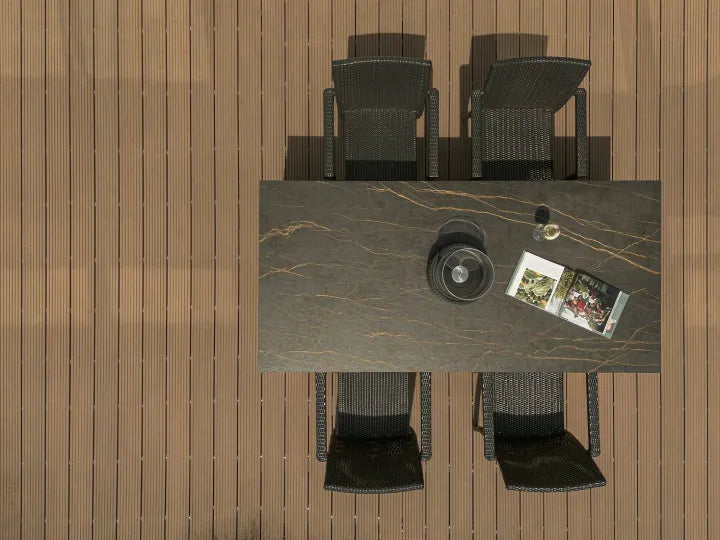


le grès cérame et le travertin peuvent tous deux créer une terrasse de piscine réussie, mais ils répondent à des priorités de projet différentes. Le travertin offre une variation naturelle et est souvent présélectionné pour le confort des pieds nus de couleur claire. le grès cérame extérieure offre un calibrage contrôlé, une faible absorption de surface et un entretien relativement simple. Aucun des noms du matériau ne prouve l’adhérence sur sol mouillé, le confort thermique ou la margelle à l’installation.
le grès cérame ou le travertin sont-ils meilleurs autour d’une piscine?
Choisissez le grès cérame extérieure lorsque le briefing est faible à entretenir, avec une apparence constante, une résistance aux taches et un taillement répétable. Choisissez le travertin lorsque le caractère naturel authentique, une voie établie pour la pierre et le confort pieds nus de couleur claire comptent davantage — et le projet accepte la sélection des pierres, les choix de scellement et la variation naturelle.
Pour les deux voies, approuvez la finition exacte par temps humide, testez un échantillon en plein soleil et comparez l’ensemble du système de terrasse et de parement. Le plus large Guide des matériaux de la piscine reste le point de départ lorsque la liste restreinte inclut plus que ces deux documents.
Décision rapide: choisissez le grès cérame ou le travertin
| Choisissez du grès cérame extérieure si... | Choisis le travertin si... |
|---|---|
| Vous voulez un entretien facial de routine minimal, des tailles répétables, une couleur contrôlée et une correspondance plus facile à l’avenir. | Vous voulez des pores authentiques, un mouvement tonal et un caractère traditionnel de piscine en pierre naturelle. |
| La propriété est un hôtel, une maison de location ou une maison familiale animée où le nettoyage prévisible et la planification des remplacements sont essentiels. | Le projet accepte la sélection en lots, une décision de scellement spécifique à la pierre et un certain vieillissement naturel. |
| Une grille moderne, un bord au niveau de la terrasse ou un aspect en pierre coordonné intérieur-extérieur est à l’origine du design. | La pierre naturelle légère et la maçonnerie établie sont au cœur du cahier des charges. |
Pour la plupart des propriétaires qui privilégient la maintenance minimale, commencez par le grès cérame extérieure. Pour les propriétaires qui privilégient le caractère naturel et acceptent l’entretien des pierres, commencez par le travertin. Ensuite, éliminez tout candidat qui échoue à la finition humide, à l’examen de soleil ou à l’examen de margelle.
Un chiffre utile: selon la définition nord-américaine du carreau, le grès cérame a une absorption d’eau de 0.5 % ou moins lorsqu’il a été testé selon la norme ASTM C373. Cela permet une liste restreinte à faible absorption; Cela ne prouve pas l’adhérence sur sol mouillé ni l’adéquation de la piscine. Voir le Explication du Conseil des tuiles d’Amérique du Nord.
Comparez les produits exacts, pas les catégories idéalisées
« grès cérame » peut désigner un carrelage intérieur fin, un pavé extérieur ou une plage de découpage coordonnée. Le « travertin » peut varier selon la carrière, le grade, le remblai, la finition, l’épaisseur et le traitement. Une comparaison équitable indique le code produit, les dimensions, la finition, la méthode d’installation, la pièce de margelle et le plan d’entretien des deux côtés.
Un carreau de grès cérame poli et un pavé extérieur structuré ne sont pas interchangeables; aucun n’est en travertin affûté et rempli ni en pierre extérieure roulée.
Ce que les résultats de recherche simplifient souvent à l’excès
De nombreuses pages comparatives réduisent le choix à « le grès cérame est durable » et « le travertin reste frais ». Ces affirmations sont trop larges pour une spécification. Les dalles extérieures en grès cérame diffèrent par leur corps, épaisseur, finition structurée, rectification et méthode de support approuvée. Le travertin varie selon la carrière, le lit, la porosité, les trous ouverts, le remplissage d’usine, la direction des veines, la réparation, la finition et le tri. Deux devis portant la même étiquette de matériau peuvent donc décrire des systèmes de piscines substantiellement différents.
La décision ne devient utile qu’après que les deux fournisseurs répondent aux mêmes questions: Est-ce exactement le produit extérieur? Quel rapport d’utilisation humide appartient à cette finition? La pierre est-elle remplie ou non remplie, et avec quoi? Est-ce que la margelle vient du même lot ou du même range? L’installation est-elle collée, posée à sec ou supportée par un piédestal? Que requiert la garantie pour le drainage, le gel et l’entretien?

Comparaison de terrasses de piscine en grès cérame vs travertin
| Décision | grès cérame extérieure | Travertin | Étape d’approbation |
|---|---|---|---|
| adhérence sur sol mouillé | Finition et rapport d’essai spécifiques | Pierres et finition spécifiques | Examinez les preuves exactes sur les cheveux mouillés ou pieds nus |
| confort thermique pieds nus | Fortement influencé par la couleur et le soleil | Les pierres lumineuses sont souvent présélectionnées | Tester ensemble des échantillons grandeur nature au sommet du soleil |
| Apparence | Motif, tonalité et taille contrôlés | Pores naturels, mouvement et variations en lots | Approuvez les pièces de production ou le véritable lot de pierres |
| Entretien | En général, pas de produit de scellement facial; Les joints ont encore besoin de soins | Le nettoyage et le scellement dépendent de la pierre et de l’exposition | Obtenez des instructions écrites pour la maintenance |
| Eau et gel | Une faible absorption est courante dans les pavés extérieurs | Cela varie selon la pierre, le remblai et le traitement | Exiger des preuves de congélation pertinentes pour le projet |
| margelle | Des pièces standard ou fabriquées peuvent être disponibles | Voie établie dans la fabrication de la maçonnerie | Approuvez le bord, la courbe, le support et les joints |

Lequel est le plus frais pieds nus?
Ne transformez pas une comparaison de matériaux en une affirmation universelle de température. La couleur de la surface, l’exposition solaire, l’ombre, le vent, l’humidité, la densité et l’installation influencent le résultat. Le travertin clair est fréquemment choisi dans les régions chaudes, mais un travertin foncé peut être inconfortable; Un pavé en grès cérame clair peut surpasser un produit en grès cérame foncée.
Placez des échantillons de taille égale dans le soleil du site en même temps. Mouillez-les et séchez-les au fur et à mesure que la piscine sera utilisée, puis comparez à la période la plus chaude du projet. Si le confort est crucial, planifiez les itinéraires d’ombre et de circulation au lieu de vous fier uniquement à une déclaration de brochure.
Lequel est le plus sûr quand il est mouillé?
Aucun des deux ne gagne par catégorie. Les finitions roulées, brossées, affûtées et structurées interagissent différemment avec les pieds nus, l’eau, la crème solaire, la pente et l’usure. Demandez le rapport pour le produit exact et confirmez la méthode locale et la zone d’utilisation applicables. Les dévoués Guide des spécifications des carreaux antidérapants pour piscine explique comment lire les classifications R, les classifications pieds nus, les PTV et d’autres preuves sans traiter un seul chiffre comme un certificat de sécurité.
Entretien, sel et congélation
La face à faible absorption du grès cérame peut simplifier le nettoyage et réduire les taches, mais le joint, les mastics, les bords et l’ensemble d’installation nécessitent toujours un entretien. Le travertin peut bien fonctionner lorsque la pierre, la finition, le remplissage et le traitement correspondent à la chimie de l’eau et au climat. Demandez si un scellement est nécessaire, comment cela modifie l’apparence ou le comportement de la surface, et quels nettoyants sont compatibles.
L’eau salée n’affecte pas seulement la face de pavage. Les dépôts, efflorescent, joints, adhésifs, garnitures métalliques et éléments de drainage doivent être inclus dans la revue. Dans les climats gelés, comparez les performances documentées de gel-dégel et le système de drainage/support plutôt que d’utiliser la seule porosité comme verdict.
Le travertin doit-il être scellé?
Il n’existe pas de oui ou non universel responsable. L’Institut de la Pierre Naturelle Bibliothèque de ressources techniques Notez que l’étanchéité peut avoir du sens pour certaines pierres et expositions, tandis que laisser la pierre non traitée peut être préférable pour d’autres; Les produits topiques peuvent modifier la texture et créer une couche de surface moins durable. Pour une terrasse de piscine, cela signifie que la décision du produit de scellement doit inclure l’apparence, le comportement de la vapeur, la compatibilité chimique, la performance du glissement, les conditions d’application et le renouvellement — et non seulement la résistance aux taches.
Demandez le nom proposé du produit, s’il est pénétrant ou formant un film, le nombre de couches, le temps de durcissement avant le service humide, les nettoyants compatibles et la méthode de test de l’adhérence sur sol mouillé après traitement. Exigez une maquette traitée à côté d’une maquette non traitée. Si le fournisseur estime que le scellement n’est pas nécessaire, notez le choix de la pierre, le comportement attendu de tache et la méthode de nettoyage afin que l’équipe de maintenance comprenne le compromis.
La voie d’installation peut changer le gagnant
Un pavé extérieur épais en grès cérame peut être installé sur un lit collé correctement conçu, un piédestal ou une autre voie de support approuvée; La disponibilité dépend du produit et du projet. Le travertin peut être installé sous forme de dalles ou dans un assemblage en pierre collée. Ce ne sont pas des lignes de coûts interchangeables. Ils modifient la tolérance du substrat, le drainage, la retenue des bords, l’accès de remplacement, le contrôle du rebord et la manière dont le mouvement est pris en place.
Comparez au moins ces questions du système:
- Qu’est-ce qui soutient les pièces de terrain et la margelle, et où le soutien complet est-il obligatoire?
- Comment se forment les chutes, et l’eau peut-elle s’écouler en dessous comme au-dessus de la finition lorsque cela est pertinent?
- Quels joints de mouvement continuent jusqu’à la fin, et où se rencontrent les systèmes différents?
- Quelles tolérances s’appliquent aux lèvres, aux joints, aux unités de basculement et aux niveaux finis aux drains?
- Peut-on retirer une pièce endommagée sans démonter la protection ou l’étanchéité adjacente?
LATICRETE’s Manuel technique de la piscine, fontaine et spa montre pourquoi l’humidité, le mouvement thermique et différentiel doivent être conçus sur l’ensemble de l’ensemble. Une devis uniquement matérielle ne peut pas répondre à cela.

Apparence et continuité intérieur-extérieur
Le travertin apporte une variation authentique: les pores, les variations tonales et le mouvement minéral font partie du matériau. le grès cérame offre une répétabilité et peut coordonner un design à l’apparence de pierre entre les zones intérieures et extérieures. Décidez si la variation est une caractéristique de conception ou un risque d’approvisionnement, puis approuvez suffisamment de pièces pour comprendre la véritable répétition du motif ou le lot de pierres.
Comparez les stratégies de margelle avant de choisir le plage de piscine
Un matériau de terrasse peut sembler convaincant sur le terrain et échouer au niveau des courbes, des marches ou au bord de l’eau. Vérifiez les pièces standards, les retours fabriqués, les profils à nez ou à l’écart, la stratégie des coins et la carrosserie visible avant de commander. Le Comparaison des matériaux de garde-piscine sépare les systèmes de bordure en grès cérame, pierre naturelle et béton.
Normaliser les deux devis
Comparez à l’échelle commerciale égale: surface de terrasse, périmètre de revêtement, épaisseur, finition, disposition du modèle, déchets, base ou substrat, drains, joints, fabrication, étanchéité, livraison, installation, protection et refaits. Un numéro moins cher et uniquement en matériau peut produire le pack de piscine fini plus coûteux.
Utilisez une approbation d’échantillon en deux étapes
La première étape est l’exemple de design: comparer la couleur, la texture, le mouvement visuel et l’aspect sec/humide. La deuxième étape est la maquette de construction: utiliser l’épaisseur souhaitée, le joint, le coulis ou le joint, le profil de garde, le produit de scellement s’il y en a, et une transition de drain ou de bord réaliste. Exposez-le au soleil et à l’eau de la piscine, nettoyez-le selon la méthode proposée et inspectez-le à nouveau.
Pour le grès cérame, vérifiez la répétition des motifs sur plusieurs pièces, la calibration et la relation bord/corps visible. Pour le travertin, examinez la plage réelle des lots, les trous, les remblais, les réparations, la variation des ombres et toutes les pièces que l’installateur rejetterait. Le dossier d’approbation doit définir quelle variation est acceptable, et non simplement indiquer « échantillon approuvé ».
Les projets résidentiels et hôteliers peuvent choisir différemment
Une villa privée peut accepter plus de variations naturelles et un entretien spécialisé occasionnel en échange d’un caractère particulier en travertin. Un hôtel ou un complexe privilégie souvent des remplacements répétables, un nettoyage documenté, la planification par lots et une apparence cohérente pour les clients, ce qui peut favoriser une voie extérieure en grès cérame. Ce n’est pas une règle universelle: un hôtel de luxe peut délibérément choisir la pierre, tandis qu’un propriétaire peut souhaiter l’entretien le plus simple possible.
Traduire le type de projet en besoins mesurables — trafic humide quotidien, personnel de nettoyage, tolérance d’arrêt, stock de rechange, accès de remplacement, variation souhaitée et budget de maintenance. Ensuite, évaluez exactement les propositions en grès cérame et travertin selon ces exigences au lieu de choisir parmi des images de style de vie.
Le résultat final
le grès cérame est le point de départ plus fort pour la constance et un faible entretien de surface. Le travertin est le point de départ plus solide pour un caractère authentique de la pierre et une esthétique naturelle légère de piscine. Le gagnant est le produit exact qui passe les contrôles de finition humide, de confort thermique pieds nus, de climat, de margelle, d’entretien et d’installation sur le site.
Comparez les échantillons de piscines avant de spécifier
Envoyez la zone de la piscine, le périmètre d’étalage, l’emplacement, le type de traitement de l’eau et la direction de finition. Nous pouvons aider à organiser des questions d’exemple et de documents techniques appropriées pour une comparaison à égalité.